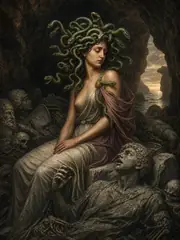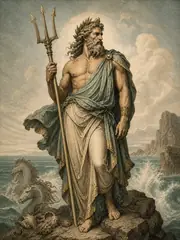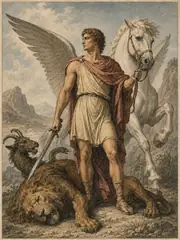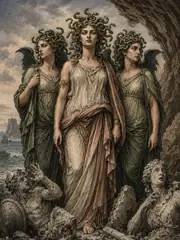
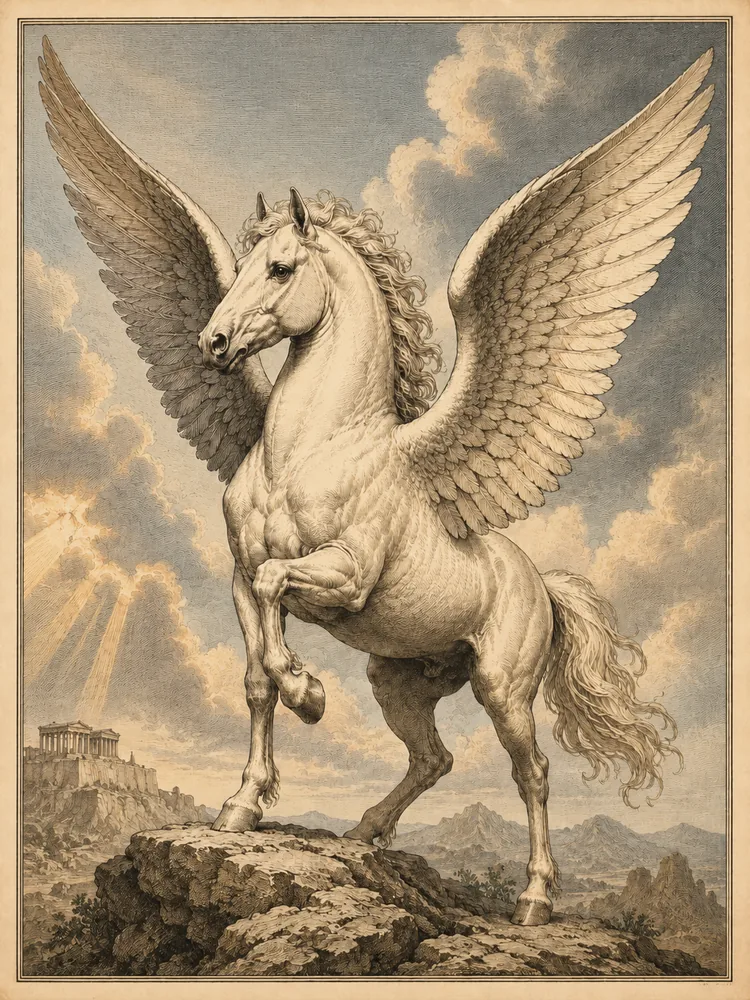
When Perseus severed the head of Medusa, from her wound there sprang up two strange children — for Medusa had lain with Poseidon and was pregnant when she died. The first was the warrior Chrysaor, the man with the golden sword, who afterward became the father of the three-bodied Geryon. The second was Pegasus, the winged horse, white as snow and swift as the wind, who flew up at his birth to dwell upon Mount Helicon among the Muses, and afterward upon Olympus.
Pegasus had no rider in the early days; he was a creature of the gods, and would not consent to be ridden. But the hero Bellerophon, who had been set the task of slaying the Chimera and could not approach the monster from the ground, was advised by the seer Polyeidus to sleep in the temple of Athena at Corinth. There the goddess appeared to him in a dream and gave him a golden bridle; and when Bellerophon awoke he found the bridle truly in his hands. With it he went to the spring of Pirene, where Pegasus came to drink, and bridled the horse, and Pegasus accepted him.
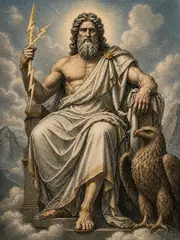
On Pegasus, Bellerophon flew up against the Chimera and slew her with arrows from above; afterward they performed many other feats together, and were everywhere victorious. But Bellerophon grew proud, and at last attempted to fly Pegasus to Olympus itself, that he might dwell among the gods. Zeus, displeased, sent a gadfly to sting the horse; Pegasus reared, and Bellerophon was thrown — to fall to earth, lamed and blinded, and to wander the rest of his days as a beggar. But Pegasus flew on alone to Olympus, and Zeus took him into his own stable; and there he served the king of the gods, bringing his thunder and lightning to him as needed.
Pegasus was sacred to the Muses, for it was at a stamp of his hoof upon the slope of Mount Helicon that the spring Hippocrene burst forth — the Horse-Spring, whose waters gave inspiration to all who drank of them. The Greeks therefore associated him not only with heroism and the wars of monsters, but with poetry and the divine afflatus.