A Compendium of the Ancient Gods
The Gorgons, plate

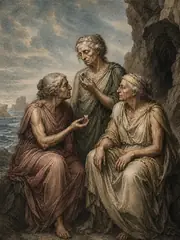
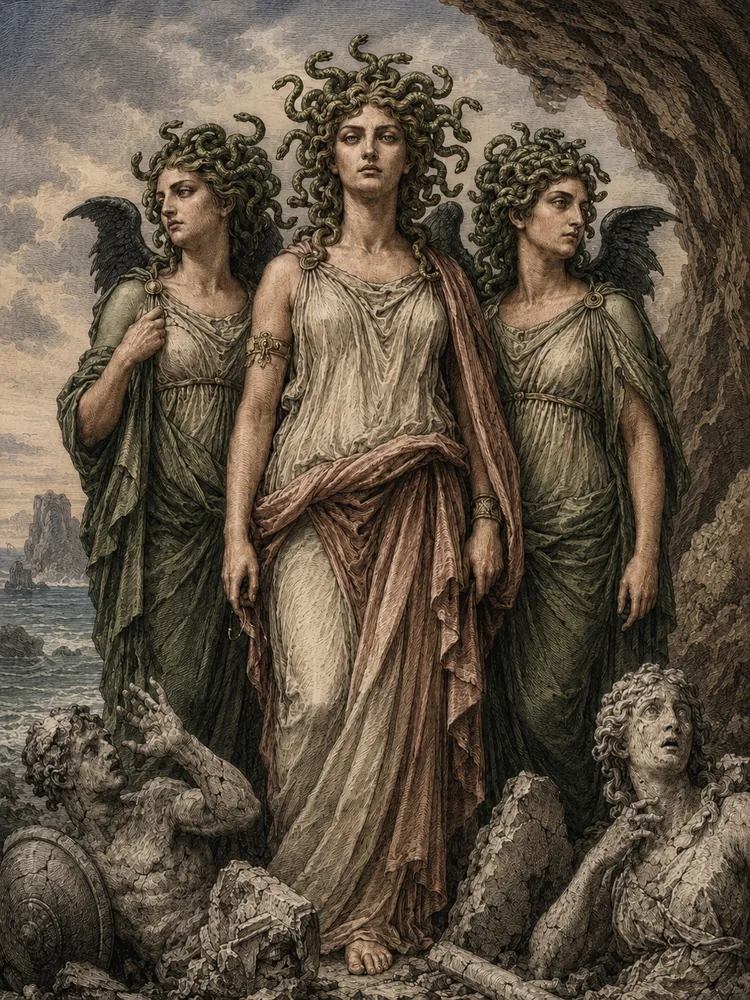
The Gorgons were three sisters: Stheno the Strong, Euryale the Far-Springing, and Medusa the Queen. They were daughters of Phorcys and Ceto, sisters to the Graeae and to the Hesperides, and they dwelt in the far west beyond the Ocean stream, on the island called Sarpedon, where the day and night meet. Two of them — Stheno and Euryale — were immortal; only Medusa was mortal, and her death is part of the heroic legend.

All three were horrors to look upon. Their hair was a tangle of living serpents; their teeth were the tusks of boars; their hands were of brass; and their wings were of gold. Most terrible of all was their gaze: any creature, mortal or immortal, who met the eye of a Gorgon was instantly turned to stone, and the rocky places about their dwelling were filled with the petrified shapes of men and animals who had stumbled there. Even the gods avoided their company.

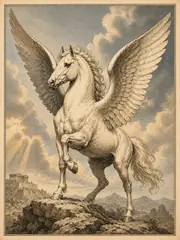
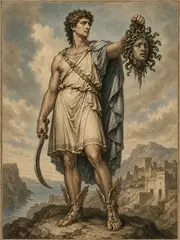
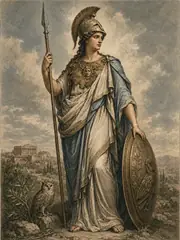
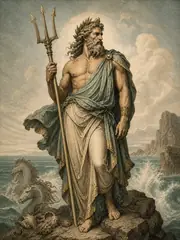
Of Medusa, who alone among them could die, it was told that she had once been beautiful — a priestess of Athena, the older mythographers said, with hair so lovely that it had been her chief glory. But Poseidon had loved her and lain with her in Athena's own temple; and Athena, outraged at the desecration, had transformed her hair into serpents and made her face a horror. So Medusa was punished for what had been done to her — a hard moral, but the Greeks did not always make their gods just. When Perseus afterward severed her head, from the wound there sprang up the winged horse Pegasus and the warrior Chrysaor; for Medusa had been pregnant by Poseidon, and these were her children, born of her death.

Stheno and Euryale, finding their sister slain, pursued Perseus with terrible cries; but the helmet of Hades made him invisible, and he escaped them. They could not die, and so they remained in the western place, weeping for Medusa with a wail that was the origin of the mournful aulos-music — for Athena, hearing them, invented the double pipe in imitation of their grief. So says Pindar.
Curator’s note

What the sources say, and what later tradition added. The sources for this bay

The Gorgons are first named in Hesiod (Theogony 274-283), where their parentage and the immortality of two of them are fixed. The transformation of Medusa from beauty to horror, with Athena's role as the punisher, comes from Ovid (Metamorphoses 4.794-803) and is not in the older Greek sources, where Medusa is simply monstrous from birth. The Pindaric origin of aulos-music in the Gorgon-lament is given in Pindar's Twelfth Pythian Ode (line 6 ff., the great encomium for the flute-player Midas of Acragas). The Perseus narrative is told in Pseudo-Apollodorus (Bibliotheca 2.4.2-3), Hesiod (Shield of Heracles 216-237), and Ovid (Metamorphoses 4.604-803). The petrifying gaze is the iconic feature: archaic vase-painting depicts the Gorgon-face as an apotropaic mask, used to ward off evil from city gates and shields. Medusa's head, after Perseus took it, was set in the aegis of Athena, where it remained as a sign of the goddess's power.

Kin in the sources

Each tie is quoted from the entry that states it.

When the sources speak

Dated witnesses for The Margins and the Monsters. A date marks when the evidence was written down, not when the belief began. The whole timeline

c. 1600–1100 BCE
Mycenaean palace tablets in Linear B record offerings and divine names, but little continuous myth.
c. 1100–800 BCE
Post-palatial oral traditions and changing cult landscapes precede the surviving alphabetic epics.
late 8th–7th centuries BCE
The Iliad, Odyssey, Hesiodic Theogony and Works and Days give influential but non-exclusive divine orders.
7th–6th centuries BCE
Homeric Hymns, lyric poetry, colonization, and local sanctuary traditions multiply regional narratives.
6th–5th centuries BCE
Orphic, Pythagorean, and mystery materials develop alternative cosmogonies and afterlife doctrines.
5th century BCE
Athenian tragedy and comedy recast heroic houses and divine justice for civic audiences.
4th century BCE
Philosophers, antiquarians, and local historians interpret or criticize inherited myth.
323–31 BCE
Hellenistic poets and scholars systematize variants across an enlarged Greek world.

Floor plan

The rooms follow one another in the order their peoples first appear in the written record.

  1. The Cradle of Citiesc. 3400 BCE to 395 CE. 115 works
  2. The Gift of the Nilec. 4000 BCE to 395 CE. 73 works
  3. The Olympian Orderc. 1600 BCE to 750 CE. 152 works
  4. The Persian Worldc. 2000 BCE to 1010 CE. 30 works
  5. The Levantine Borderlandsc. 1200 BCE to 500 CE. 20 works
  6. The Edges of Empirec. 2000 BCE to 1500 CE. 33 works
  7. The Etruscan Worldc. 900 BCE to 750 CE. 22 works
  8. The Roman Inheritancec. 1200 BCE to 500 CE. 58 works
  9. The Northern Inheritancec. 2000 BCE to 1600 CE. 131 works