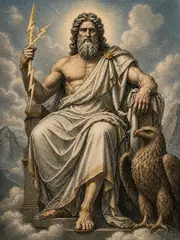
Perseus was the son of Zeus by Danaë, daughter of Acrisius king of Argos. The conception was as strange as those of most Greek heroes. An oracle had told Acrisius that his daughter's son would kill him; Acrisius therefore shut Danaë in a bronze chamber underground (or, in some versions, in a tower), to keep her from any contact with men. But Zeus visited her in the form of a golden shower, falling through the chamber's roof; she conceived; she bore Perseus. Acrisius, on discovering the boy, refused to believe in Zeus's paternity; unwilling to murder his daughter directly, he set Danaë and her infant in a wooden chest and cast them into the sea. The chest washed up on the island of Seriphos; Danaë and Perseus were taken in by the fisherman Dictys, brother of King Polydectes of the island.
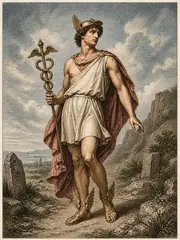
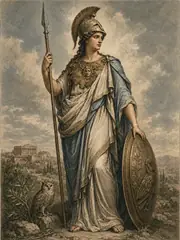
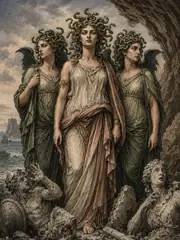
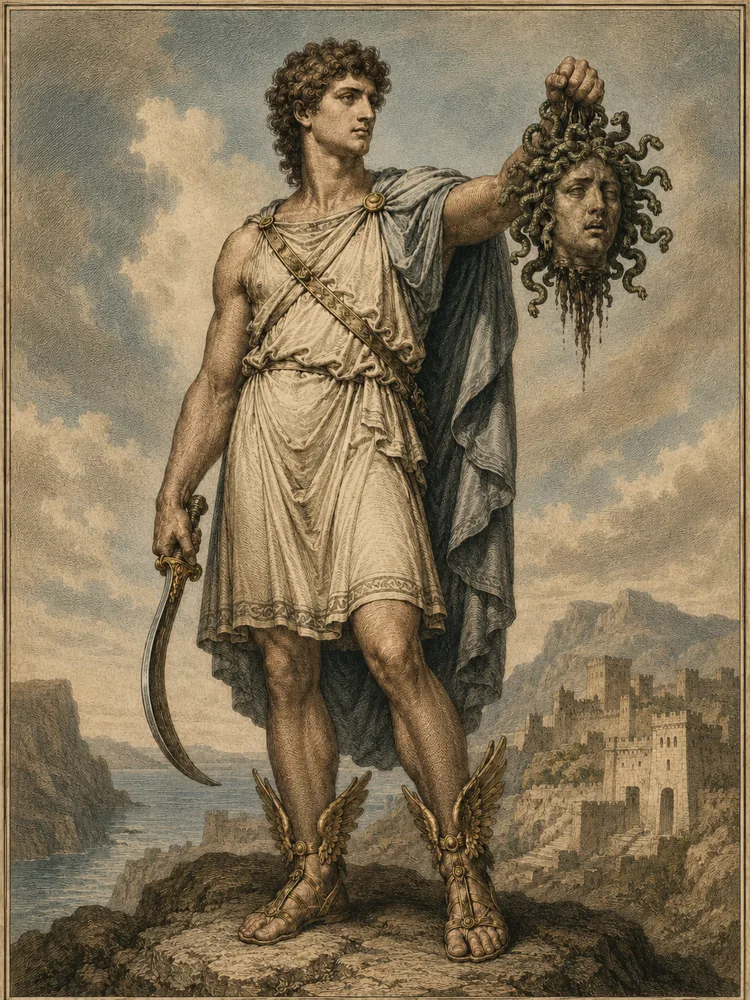
When Perseus had grown to manhood, Polydectes (who desired Danaë and was hindered by her son's protection) contrived to send Perseus on what was meant to be a fatal errand: to bring back the head of Medusa. Perseus, advised by Hermes and Athena, made his way first to the Graeae (the three old gray sisters of the Gorgons, who shared a single eye and a single tooth among them), seized their eye while they were passing it, and refused to return it until they directed him to the nymphs of the north, who provided him with the cap of Hades (which made the wearer invisible), winged sandals, and a satchel for the head. He flew to the Gorgons' lair, found Medusa asleep among her two immortal sisters, watched her reflection in his polished shield to avoid her gaze, severed her head with the sickle of adamant given him by Hermes, put the head in the satchel, and fled (pursued ineffectually by the immortal Gorgons, whom his invisibility-cap protected him from).
On his return journey he passed Ethiopia and saw the princess Andromeda chained to a rock as sacrifice to a sea-monster (her mother Cassiopeia having boasted that she was more beautiful than the Nereids); Perseus killed the monster, freed Andromeda, married her, and brought her back to Seriphos. There he found his mother Danaë taking refuge in a temple from Polydectes's renewed advances; he went to Polydectes's hall, displayed Medusa's head, and turned the king and his retainers to stone. He installed Dictys as king of Seriphos, gave Medusa's head to Athena (who set it in her aegis), gave the other implements back to Hermes, and traveled with his mother and Andromeda back to Argos. There the original oracle was fulfilled: at funeral games in Larissa where Perseus competed in the discus, his throw struck and killed an old man in the crowd, who proved to be his grandfather Acrisius. Perseus, unwilling to inherit the kingdom of one he had killed, exchanged it for nearby Tiryns and there founded a new dynasty; he and Andromeda became the ancestors of the Perseid line, which included Heracles.