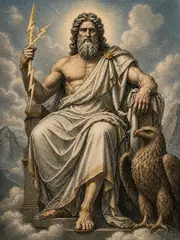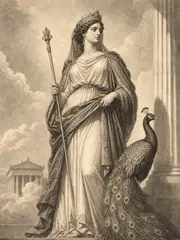
Heracles (whose name the Romans gave as Hercules, and under which he is most commonly known in modern Western tradition) was the greatest of all Greek heroes, the son of Zeus by the mortal Alcmene wife of Amphitryon king of Tiryns. The night Heracles was conceived, Zeus came to Alcmene in the form of her absent husband and lay with her; Amphitryon returned the following night and lay with her also; and so the twins Heracles (the son of Zeus) and Iphicles (the son of Amphitryon) were begotten on consecutive nights and born together. Zeus had announced before the birth that the descendant of Perseus born that day should rule over Mycenae; Hera, jealous, hastened the birth of Eurystheus (also a Perseid) and delayed the birth of Heracles, so that Eurystheus was born first and accordingly received the kingdom that Zeus had intended for his own son. Heracles thereafter served Eurystheus, and it was Eurystheus who imposed upon him the famous Twelve Labors.
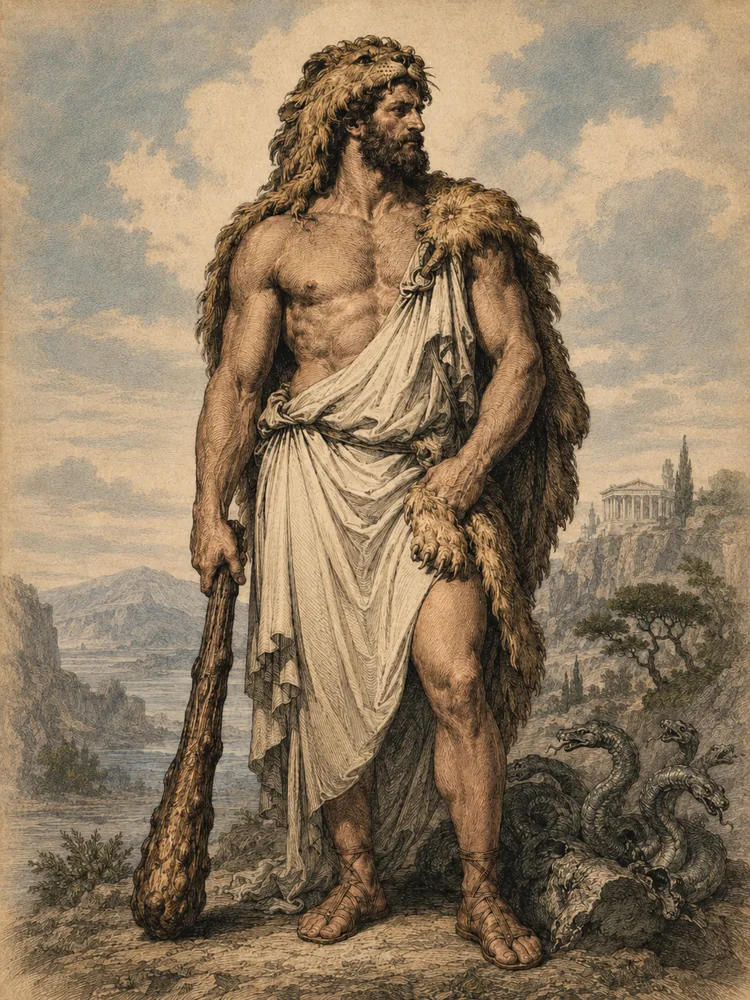
Hera's hatred pursued Heracles from infancy. She sent two great serpents to his cradle to kill him, but the infant strangled them with his bare hands. As a young man, struck by Hera-induced madness, he killed his own wife Megara and their children; the Twelve Labors were imposed (by the Pythia at Delphi) as the expiation of this defilement, on the condition that he serve Eurystheus for the duration. The labors, in their canonical Apollodoran ordering, were these. First, to kill the Nemean Lion, an immense lion whose hide was impervious to weapons; Heracles strangled it with his hands and skinned it with its own claw, wearing the hide thereafter as his cloak. Second, to kill the Lernaean Hydra, the nine-headed (or, in some accounts, fifty- or hundred-headed) water-serpent in the marshes of Lerna, whose heads grew back two-for-one when severed; Heracles, with his nephew Iolaus's help, cauterized each stump as a head was cut, and at length killed the immortal central head and buried it under a great rock.
Third, to bring back alive the Ceryneian Hind, a swift deer with golden horns sacred to Artemis; he chased it for a year before catching it. Fourth, to bring back alive the Erymanthian Boar; he caught it in deep snow and carried it slung over his shoulders to Eurystheus, who hid in a great storage-jar at the sight of it. Fifth, to clean in a single day the Augean stables, where King Augeas's cattle had been kept for thirty years without cleansing; Heracles diverted the rivers Alpheus and Peneus through the stables and washed them out. Sixth, to drive away the Stymphalian Birds, man-eating birds with bronze beaks that infested a Stymphalian lake; Heracles startled them with bronze rattles given by Athena and shot them as they flew. Seventh, to bring back the Cretan Bull, the magnificent white animal that Poseidon had sent to Minos and that had begotten the Minotaur on Pasiphae; Heracles wrestled it into submission and brought it to Eurystheus, who released it (and it became the Marathonian Bull, eventually killed by Theseus). Eighth, to bring back the man-eating Mares of Diomedes, king of the Bistones in Thrace; Heracles fed Diomedes to his own horses, which then became docile.
Ninth, to bring back the girdle of Hippolyta, queen of the Amazons; the queen offered the girdle peacefully, but Hera, in disguise, stirred the Amazons against him, and Heracles, mistakenly believing himself betrayed, killed Hippolyta and seized the girdle. Tenth, to bring back the cattle of Geryon, the three-bodied giant of the western island Erytheia; Heracles traveled to the western edge of the world, killed Geryon's herdsman Eurytion and his two-headed dog Orthrus (a sibling of Cerberus), shot Geryon himself with a single arrow, and drove the cattle home, setting the Pillars of Heracles (the Strait of Gibraltar) at the western limit of his journey. Eleventh, to bring back the golden apples of the Hesperides; Heracles got the apples (in some versions himself, in others by tricking Atlas, as told in Atlas's entry) and returned them to Eurystheus, who had no use for them and gave them back, and Athena returned them to the Hesperides. Twelfth and last, to bring up Cerberus from the underworld; Heracles wrestled the great hound into submission, brought him before Eurystheus (who again hid in his jar), and returned him to his post.
After the Labors, Heracles's life continued in a great train of further exploits, more than can be summarized here. He sacked Troy in an early war (years before the great Trojan War), in vengeance against King Laomedon. He fought beside the gods in the Gigantomachy. He wrestled Death itself for the soul of Alcestis. He killed the Centaur Nessus, who was attempting upon his second wife Deianira; the dying centaur, in vengeance, told Deianira that his blood would be a love-charm to keep Heracles faithful — a lie that she believed, and that brought about the hero's death. When Heracles, years later, fell in love with the captive Iole, Deianira sent him a tunic smeared with Nessus's blood, expecting it to renew his love; but the blood was poison, and when Heracles put on the tunic it burned his flesh inextricably; he tore at it, ripping his own flesh away with the cloth; he could not be rescued; he had himself laid upon a great pyre on Mount Oeta and asked his companion Philoctetes to light it. As the flames consumed his mortal part, the immortal part — the divine inheritance from Zeus — was raised by chariot to Olympus, where Heracles was reconciled with Hera and married to Hebe, the goddess of youth, with whom he lived thereafter in apotheosis.