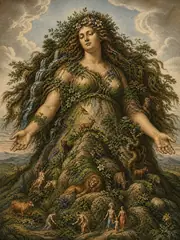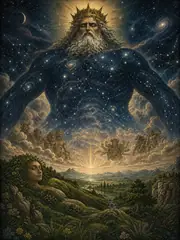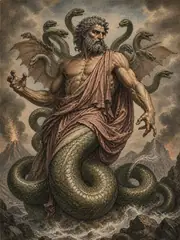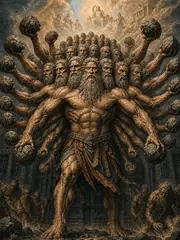
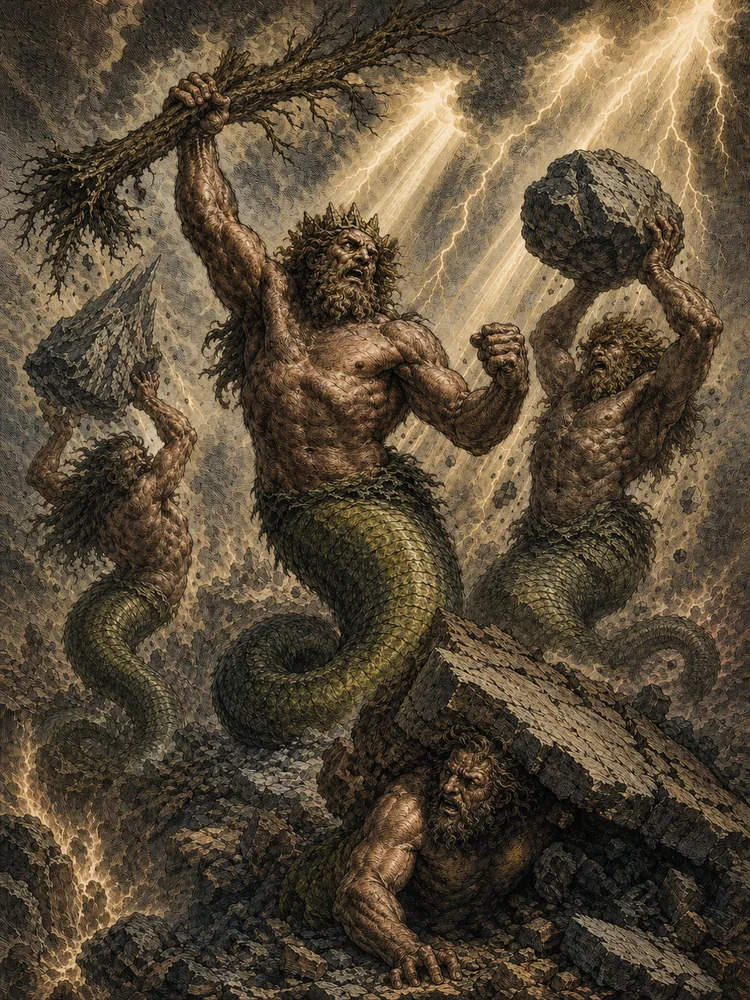
When Cronus had cut Uranus with the sickle and the blood of the wounded sky-god had fallen upon the earth, Gaia received it; and from those drops there sprang up a race of monstrous beings called the Gigantes — the Giants, the Earthborn — vast of stature, with the legs of serpents and hair and beards that fell to their belts. They were not gods, though they were of divine blood, and they were not mortal in the manner of men; they were a third kind, and they took for themselves the wild high places of the earth.
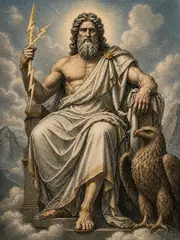
In the time after the Titans had been overthrown and Zeus reigned in heaven, Gaia, grieving for her old children imprisoned in Tartarus, stirred up the Giants to make war upon the Olympians. The battle was joined in the great plain of Phlegra in Macedonia (or, others say, on the peninsula of Pallene), and it was fought with terrible weapons — the Giants hurled mountains, and Zeus answered with thunderbolts. Yet the Giants could not be slain by the gods alone, for an oracle had declared that no god could kill them; only by the hand of a mortal champion could the Earthborn be brought down.
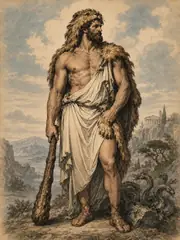
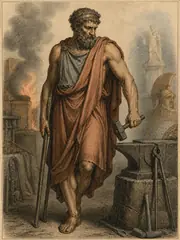
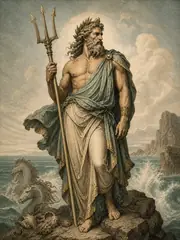
So Heracles was summoned to the war, and at his side fought all the Olympians. Porphyrion the king of the Giants was slain by Zeus and Heracles together, his thunderbolt and the hero's arrow striking simultaneously. Alcyoneus, who could not die so long as he stood upon his native ground, was lifted by Heracles into the air and there strangled. Enceladus was crushed beneath the island of Sicily, and his struggling beneath the earth is still the cause of the eruptions of Mount Etna; Mimas was overcome by Hephaestus with bolts of molten metal; Polybotes was buried beneath the island of Nisyros, which Poseidon broke from Cos and hurled upon him. So one by one the Giants fell, until none remained.
The Greeks regarded the Gigantomachy as the second great cosmic war, after the Titanomachy — the war by which the order of the Olympians was sealed and after which no further challenge to their reign would come, save only the brief and terrible appearance of Typhon. The bones of the slain Giants, the ancients said, were the great bones that travellers found buried in the earth in their own time, in Phlegra and elsewhere; and the volcanic activity of Sicily and the Aegean was the unquiet sleep of the Earthborn.