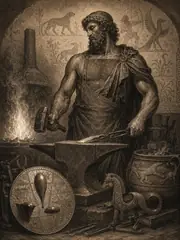
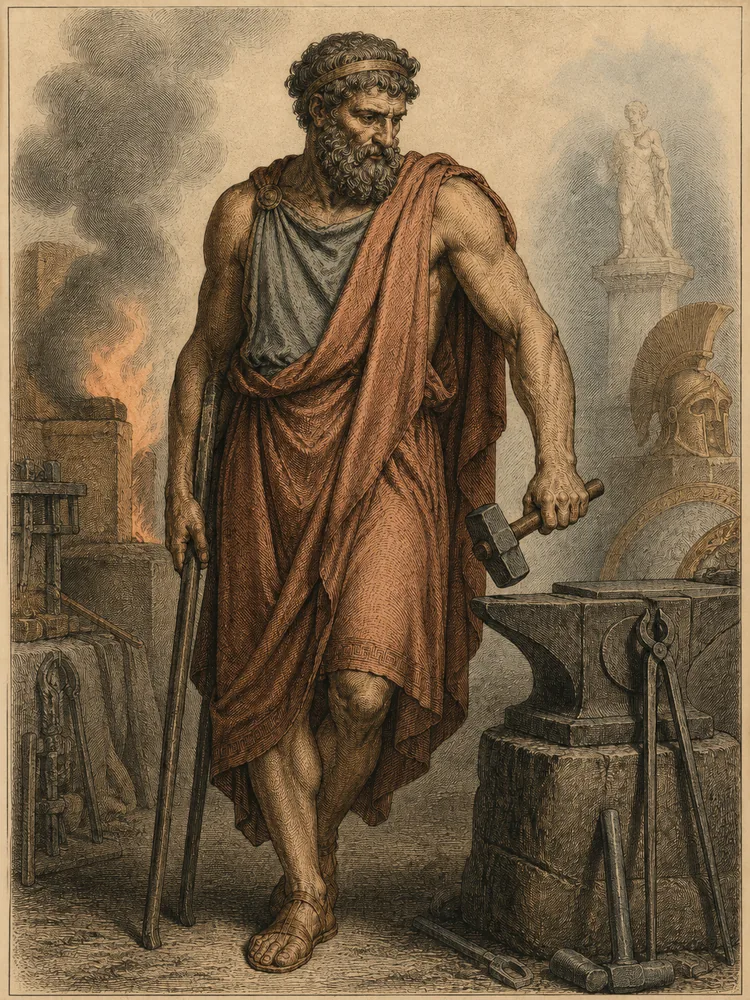
Hephaestus was the god of fire, of metalwork, of craftsmanship — the divine smith, whose forge produced the armor of Achilles, the shield with its cosmic decorations, the great weapons of the gods, and the marvels of automation that delighted the Olympian household (golden tripods that wheeled themselves, golden serving-maidens that walked and spoke). He was a son of Hera; the question of whether Zeus was his father, or whether Hera bore him in parthenogenesis (in pique at Zeus's having brought forth Athena from his head), was variously answered. He was lame from birth, the lameness being attributed in different versions to a fall from Olympus (Zeus having thrown him out for taking Hera's part in a quarrel; or Hera having thrown him out herself, in disgust at his ugliness), or to a congenital weakness compounded by these falls. His lameness is one of the few clearly remembered physical features of any Olympian, and it set him apart in the assembly of physically perfect immortals.
He was married to Aphrodite, by Zeus's decree, and the marriage was the subject of the famous catching-in-the-net story told in Ares's entry above. He had no children by her, but he sired several offspring elsewhere, and it was through one of these stories — his attempt upon Athena, the seed falling upon the earth, the autochthonous Erichthonius being born — that the founding line of Athenian kings was established. His forge was variously located: on Olympus, beneath the volcano Etna in Sicily, on Lemnos. The latter was his principal cult-site in Greece; the people of Lemnos honored him as their patron, and the great Hephaesteia festival there was attended by participants from across the Aegean. At Athens his cult was substantial; the splendidly preserved temple on the Agora called the Theseion is in fact the Hephaesteion (Temple of Hephaestus), built about 460–415 BCE, the best-preserved Greek temple of its size. His Roman counterpart was Vulcan, with whom his identification was complete.