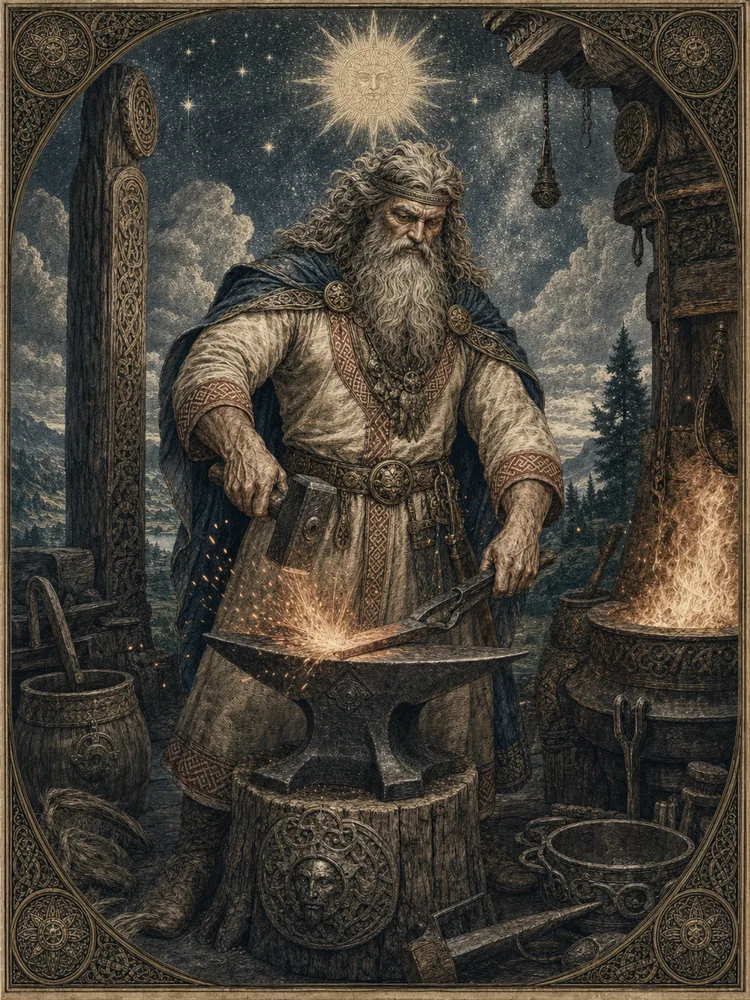
Svarog (or Svarozhich in some sources, the latter being technically "son of Svarog") was a Slavic god of the sky, of fire, of smithcraft — a kind of Slavic Hephaestus, in whose forge the sun was made each day, and who was the father of Dazhbog the sun. His name is etymologically connected to the Sanskrit svarga ("heaven"), suggesting Indo-European antiquity. He is mentioned in the 12th-century Hypatian Chronicle's gloss on the Greek Hephaestus (in a translation of the Byzantine chronicle of John Malalas), where Svarog is given as the Slavic equivalent. The figure is otherwise sparsely attested; the reconstruction of Svarog as the celestial-fire-god has been done principally on linguistic grounds and on the basis of folk-survivals.
 Before thisVeles
 Next on the wallDazhbog
Curator’s note
What the sources say, and what later tradition added. The sources for this bay
The principal source is the Hypatian Chronicle's gloss (12th c.). The Sanskrit svarga connection is securely established. Some modern scholars have questioned how much of the developed "Svarog" theology is genuine and how much is reconstructed from suggestive but limited data; see Mathieu-Colas, Le Dictionnaire des dieux et déesses (2017).
Kin in the sources
Each tie is quoted from the entry that states it.
- Parent ofDazhbog
who was the father of Dazhbog the sun
 Parent ofSvarozhich
the latter being technically "son of Svarog"
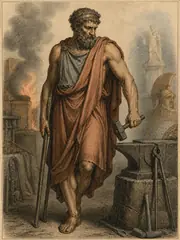 Named as the same god asHephaestus
gloss on the Greek Hephaestus (in a translation of the Byzantine chronicle of John Malalas), where Svarog is given as the Slavic equivalent
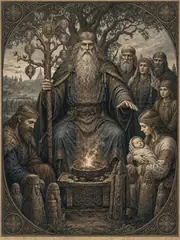 Named as the same god asRod
Some scholars have tried to identify him with various other Slavic gods (Stribog, Svarog)
The same god in other rooms
The ancient sources themselves name these as one god under different names. See Hephaestus, Sethlans and Svarog hung together
When the sources speak
Dated witnesses for The Slavic Gods and Spirits. A date marks when the evidence was written down, not when the belief began. The whole timeline
- 2nd–1st millennia BCE
- Indo-European language dispersals and regional Bronze Age cultures provide a remote comparative background, not a recoverable common canon.
- c. 500 BCE–1 CE
- Iron Age material culture, names, sanctuaries, and classical ethnography offer early but external evidence for Celtic and Germanic religions.
- 1st–4th centuries CE
- Roman inscriptions and provincial cults preserve many Celtic, Germanic, and local divine names.
- 4th–8th centuries CE
- Migration-period and early medieval conversion transform ritual institutions while heroic traditions continue.
- 8th–11th centuries CE
- Viking Age poetry, runic evidence, archaeology, and Scandinavian conversion form the core context of Norse myth.
- 9th–12th centuries CE
- Slavic, Baltic, and Finnic traditions enter chronicles and missionary accounts, often through hostile observers.
- 11th–14th centuries CE
- Irish, Welsh, and Icelandic manuscripts preserve major narrative corpora in Christian literary environments.
- 12th–16th centuries CE
- Saxo, saga compilers, Baltic chroniclers, and later antiquarians systematize or reinterpret older material.