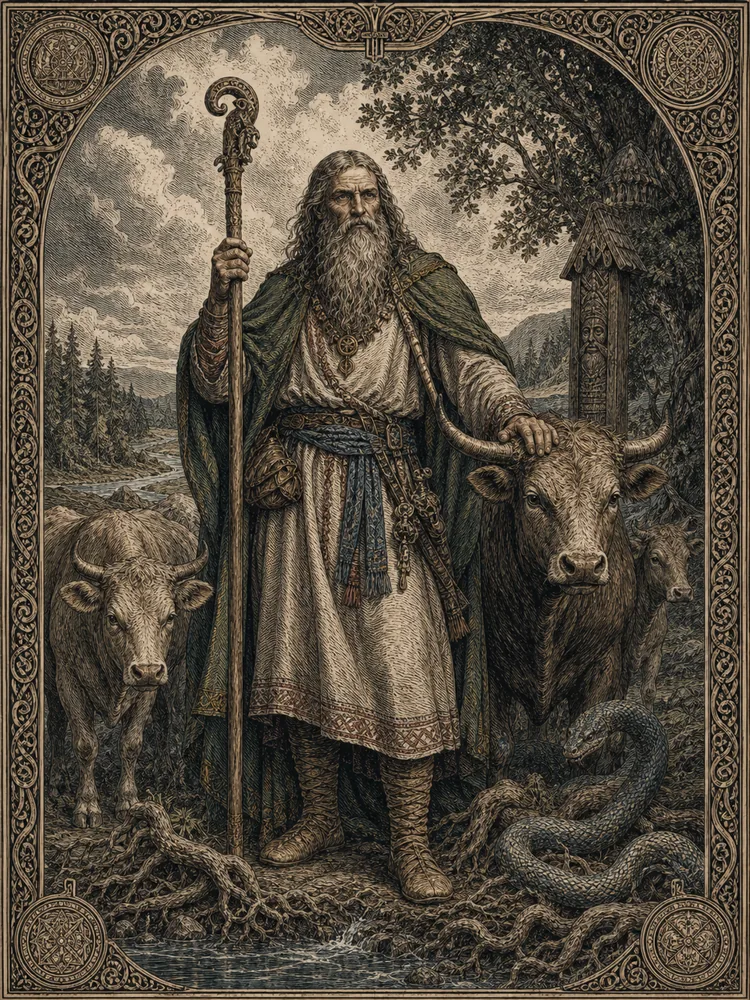
Veles (also Volos, the variant being a regional rather than a separate name) was the Slavic god of the underworld, of cattle, of wealth, of poetry, of magic — a complex god whose various offices the modern reconstructions have variously interpreted. He was opposed to Perun in the modern Ivanov-Toporov reconstruction of a foundational Slavic cosmic conflict (Perun the upper sky-god, Veles the lower chthonic god, with Perun pursuing Veles for his theft of cattle and rain — an Indo-European storm-god-vs.-serpent pattern, with Slavic specifics). The reconstruction is plausible and based on indirect evidence (the names' alternation in oath-formulas, the iconographic associations, the folkloric residue) but is not directly attested. What is certainly attested is that Veles was honored alongside Perun in the Kievan pantheon, that oaths were sworn by both gods (the Russian-Byzantine treaty of 907 binds Russian signatories to swear by Perun and Volos, with breach to result in being "cursed by God and Perun" or "by Volos the cattle-god"); that he had a substantial pre-Christian cult; and that his cult was suppressed at the conversion alongside the rest of the pantheon. He survived in folk-memory partly under the Christian name of Saint Blaise (Vlasiy in Russian, the saint's day February 11), patron of cattle, whose name's similarity to Volos's facilitated the substitution.
 Before thisPerun
 Next on the wallSvarog
Curator’s note
What the sources say, and what later tradition added. The sources for this bay
The principal sources are the Russian-Byzantine treaty of 907 (preserved in the Primary Chronicle); the same chronicle's account of Vladimir's conversion (Veles is mentioned as one of the gods); the Tale of Igor's Campaign (12th c., where the bard Boyan is called "Veles's grandson"). The modern reconstruction (Ivanov-Toporov 1974 and later) has been accepted by some scholars and questioned by others (notably Leszek Moszyński, Die vorchristliche Religion der Slawen, 1992).
Kin in the sources
Each tie is quoted from the entry that states it.
- Rival ofPerun
with Perun pursuing Veles for his theft of cattle and rain
- Companion ofPerun
Veles was honored alongside Perun in the Kievan pantheon, that oaths were sworn by both gods
When the sources speak
Dated witnesses for The Slavic Gods and Spirits. A date marks when the evidence was written down, not when the belief began. The whole timeline
- 2nd–1st millennia BCE
- Indo-European language dispersals and regional Bronze Age cultures provide a remote comparative background, not a recoverable common canon.
- c. 500 BCE–1 CE
- Iron Age material culture, names, sanctuaries, and classical ethnography offer early but external evidence for Celtic and Germanic religions.
- 1st–4th centuries CE
- Roman inscriptions and provincial cults preserve many Celtic, Germanic, and local divine names.
- 4th–8th centuries CE
- Migration-period and early medieval conversion transform ritual institutions while heroic traditions continue.
- 8th–11th centuries CE
- Viking Age poetry, runic evidence, archaeology, and Scandinavian conversion form the core context of Norse myth.
- 9th–12th centuries CE
- Slavic, Baltic, and Finnic traditions enter chronicles and missionary accounts, often through hostile observers.
- 11th–14th centuries CE
- Irish, Welsh, and Icelandic manuscripts preserve major narrative corpora in Christian literary environments.
- 12th–16th centuries CE
- Saxo, saga compilers, Baltic chroniclers, and later antiquarians systematize or reinterpret older material.