A Compendium of the Ancient Gods
Perun, plate

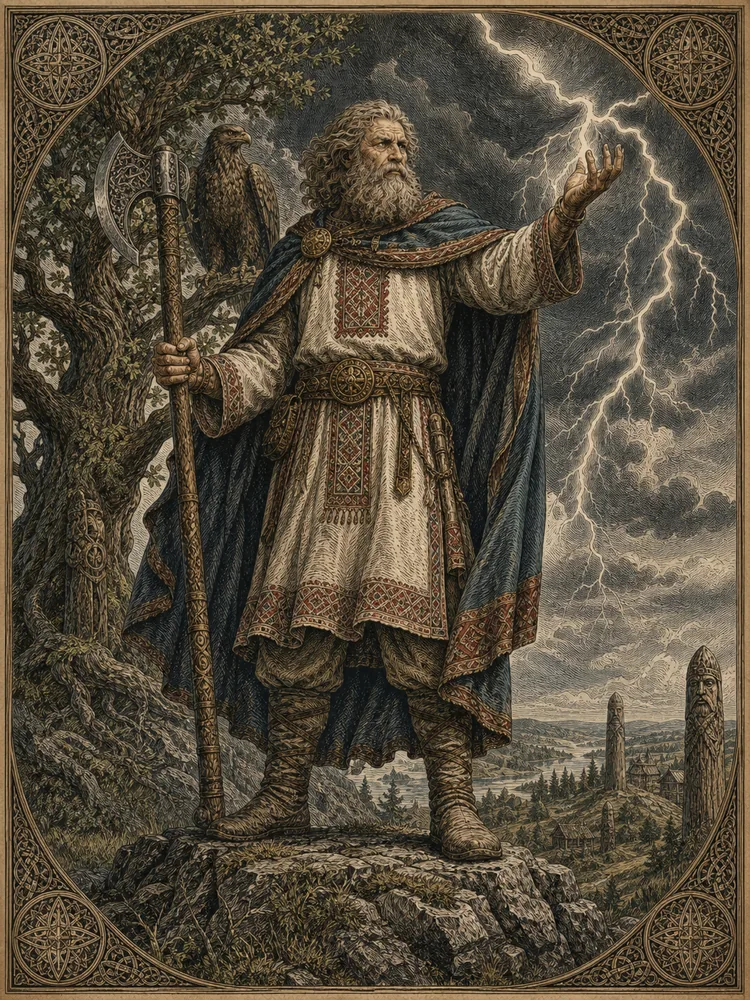
Perun was the Slavic god of thunder, of storms, of war, of oath-binding — the supreme god of the pre-Christian Kievan pantheon and (by the analogy of his name and function) the principal sky-god of the Slavic peoples generally. His name is etymologically secure: from the Indo-European root *per-/*perkw-, "to strike," the same root that gave the Vedic Parjanya, the Lithuanian Perkūnas (treated in the next book), and (with prefix-loss) Greek keraunos ("thunderbolt"). His weapon was a great axe or hammer that returned to his hand when thrown — a striking parallel to Thor's Mjölnir, suggesting either deep Indo-European inheritance or borrowing from the Germanic neighbors. His sacred tree was the oak (whose tall stature and frequent lightning-strikes connected it with thunder-gods across Indo-European traditions); his cult-images stood in oak-groves; his priests wore beards.

The Russian Primary Chronicle records that Vladimir the Great, before his Christianization in 988, set up a great cult-image of Perun at Kiev with a head of silver and a moustache of gold; at his conversion, the same Vladimir had the image torn down and dragged through the city by oxen, beaten by twelve men, and thrown into the Dnieper river — a vivid attested moment of pagan-Slavic destruction at the conversion. The Chronicle's narrative has been confirmed in its essentials by archaeological finds at Kiev. The cult of Perun thereafter survived in folk-memory, with the prophet Elijah of the Old Testament being identified with him in popular Russian piety (Elijah, like Perun, was a sky-and-fire-bringing figure, and the substitution allowed continued reverence for the storm-god under a Christianizing name).
Curator’s note

What the sources say, and what later tradition added. The sources for this bay

The principal source is the Russian Primary Chronicle (entry for the year 980 in the conventional dating). Procopius (Wars 7.14) mentions the supreme god of the Slavs but does not name him; the identification with Perun is reasonable but not certain. The Indo-European *per- etymology is in Watkins, Calvert, How to Kill a Dragon (1995). The Ivanov-Toporov reconstruction of the Perun-Veles myth (V. V. Ivanov and V. N. Toporov, Issledovaniya v oblasti slavyanskikh drevnostei, 1974) is an influential structural reconstruction; it remains an interpretive hypothesis, not directly attested in any primary source.

Kin in the sources

Each tie is quoted from the entry that states it.

When the sources speak

Dated witnesses for The Slavic Gods and Spirits. A date marks when the evidence was written down, not when the belief began. The whole timeline

2nd–1st millennia BCE
Indo-European language dispersals and regional Bronze Age cultures provide a remote comparative background, not a recoverable common canon.
c. 500 BCE–1 CE
Iron Age material culture, names, sanctuaries, and classical ethnography offer early but external evidence for Celtic and Germanic religions.
1st–4th centuries CE
Roman inscriptions and provincial cults preserve many Celtic, Germanic, and local divine names.
4th–8th centuries CE
Migration-period and early medieval conversion transform ritual institutions while heroic traditions continue.
8th–11th centuries CE
Viking Age poetry, runic evidence, archaeology, and Scandinavian conversion form the core context of Norse myth.
9th–12th centuries CE
Slavic, Baltic, and Finnic traditions enter chronicles and missionary accounts, often through hostile observers.
11th–14th centuries CE
Irish, Welsh, and Icelandic manuscripts preserve major narrative corpora in Christian literary environments.
12th–16th centuries CE
Saxo, saga compilers, Baltic chroniclers, and later antiquarians systematize or reinterpret older material.

Floor plan

The rooms follow one another in the order their peoples first appear in the written record.

  1. The Cradle of Citiesc. 3400 BCE to 395 CE. 115 works
  2. The Gift of the Nilec. 4000 BCE to 395 CE. 73 works
  3. The Olympian Orderc. 1600 BCE to 750 CE. 152 works
  4. The Persian Worldc. 2000 BCE to 1010 CE. 30 works
  5. The Levantine Borderlandsc. 1200 BCE to 500 CE. 20 works
  6. The Edges of Empirec. 2000 BCE to 1500 CE. 33 works
  7. The Etruscan Worldc. 900 BCE to 750 CE. 22 works
  8. The Roman Inheritancec. 1200 BCE to 500 CE. 58 works
  9. The Northern Inheritancec. 2000 BCE to 1600 CE. 131 works