A Compendium of the Ancient Gods
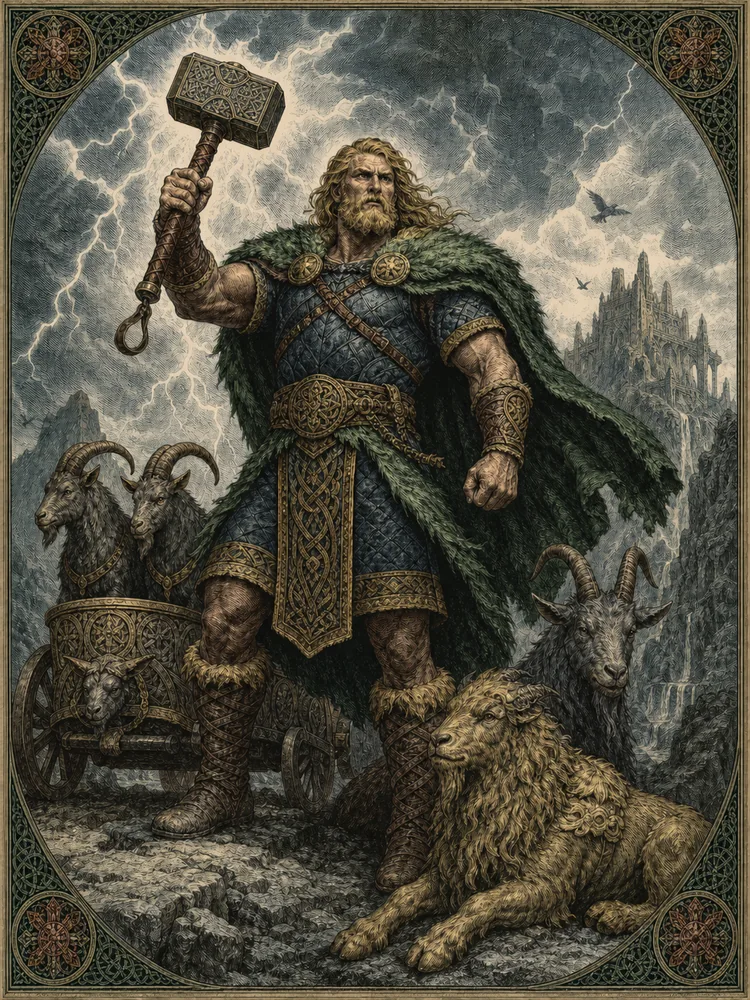
Thor, plate

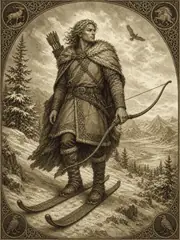
Thor (Old Norse Þórr, Anglo-Saxon Þunor, whence Thursday) was the god of thunder, of storms, of the strength of arm that stood between the gods and their giant enemies. He was the son of Odin and the earth-goddess Jörð (or, in some versions, Fjörgynn), red-bearded and immensely strong, the most popular of the Norse gods to judge by the great number of personal names compounded with his (Thorvald, Thorgrim, Thorkel, Thorbjörn, and so on, by the thousands in Icelandic and Scandinavian tradition). His weapon was the great hammer Mjölnir, forged for him by the dwarves; thrown, it never missed its target and always returned to his hand; small enough to be hidden in his clothing when he traveled. He wore the iron gauntlets Járngreipr to grip the hammer, and the belt Megingjörð that doubled his already prodigious strength. He drove a chariot drawn by two goats, Tanngrisnir and Tanngnjóstr, which he could slaughter and eat at need, then wrap their bones in their hides and resurrect them by raising the hammer over them.

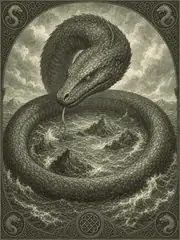
Thor's principal enemies were the giants (jötnar), against whom he undertook countless expeditions; the Eddas record more of his individual narratives than of any other Norse god. He fished for the World-Serpent Jörmungandr from a boat with the giant Hymir, hauling the monster up by a hook baited with an ox's head; he would have killed the serpent then, but Hymir in terror cut the line. He was outwitted (the only such case) by the giant-king Útgarða-Loki on a journey into Jötunheim, where he discovered that an old woman who had defeated him at wrestling was Old Age, that a great drinking-horn he could not empty was the ocean, that a cat he could not lift was the World-Serpent in disguise — that the giants had used illusion against him, but that the apparent failure had been, by other measures, a series of cosmic-scale victories. He killed the giant Geirrod, the giantess Hrungnir, the giant Thrym (who had stolen the hammer Mjölnir, and forced Thor to retrieve it disguised as a bride at the wedding-feast — a comic narrative of considerable charm in the Þrymskviða). At Ragnarök, Thor would kill Jörmungandr with the hammer but would die nine paces later from the serpent's venom; the prophecy was old and was understood as fixed.
Curator’s note

What the sources say, and what later tradition added. The sources for this bay

The principal sources are throughout the Poetic Edda (especially Þrymskviða, Hymiskviða, Hárbarðsljóð, Alvíssmál) and Snorri's Prose Edda. The Útgarða-Loki episode is in Snorri (Gylfaginning 45–47). Thor's continental Germanic counterpart was Donar (whence German Donner, "thunder"); the Anglo-Saxon Þunor; the modern German Donnerstag ("Thunder's day") and English Thursday preserve the cult-name. The hammer Mjölnir was the principal Norse cult-symbol; small hammer-pendants are extremely common in Viking-age archaeological contexts and were worn as amulets, in some cases possibly in deliberate parallel to the Christian cross. The iconography of Thor as a red-bearded warrior with hammer is attested in stone-carvings and in the Eddic tradition consistently.

Kin in the sources

Each tie is quoted from the entry that states it.

When the sources speak

Dated witnesses for The Norse and Germanic Gods. A date marks when the evidence was written down, not when the belief began. The whole timeline

2nd–1st millennia BCE
Indo-European language dispersals and regional Bronze Age cultures provide a remote comparative background, not a recoverable common canon.
c. 500 BCE–1 CE
Iron Age material culture, names, sanctuaries, and classical ethnography offer early but external evidence for Celtic and Germanic religions.
1st–4th centuries CE
Roman inscriptions and provincial cults preserve many Celtic, Germanic, and local divine names.
4th–8th centuries CE
Migration-period and early medieval conversion transform ritual institutions while heroic traditions continue.
8th–11th centuries CE
Viking Age poetry, runic evidence, archaeology, and Scandinavian conversion form the core context of Norse myth.
9th–12th centuries CE
Slavic, Baltic, and Finnic traditions enter chronicles and missionary accounts, often through hostile observers.
11th–14th centuries CE
Irish, Welsh, and Icelandic manuscripts preserve major narrative corpora in Christian literary environments.
12th–16th centuries CE
Saxo, saga compilers, Baltic chroniclers, and later antiquarians systematize or reinterpret older material.

Floor plan

The rooms follow one another in the order their peoples first appear in the written record.

  1. The Cradle of Citiesc. 3400 BCE to 395 CE. 115 works
  2. The Gift of the Nilec. 4000 BCE to 395 CE. 73 works
  3. The Olympian Orderc. 1600 BCE to 750 CE. 152 works
  4. The Persian Worldc. 2000 BCE to 1010 CE. 30 works
  5. The Levantine Borderlandsc. 1200 BCE to 500 CE. 20 works
  6. The Edges of Empirec. 2000 BCE to 1500 CE. 33 works
  7. The Etruscan Worldc. 900 BCE to 750 CE. 22 works
  8. The Roman Inheritancec. 1200 BCE to 500 CE. 58 works
  9. The Northern Inheritancec. 2000 BCE to 1600 CE. 131 works