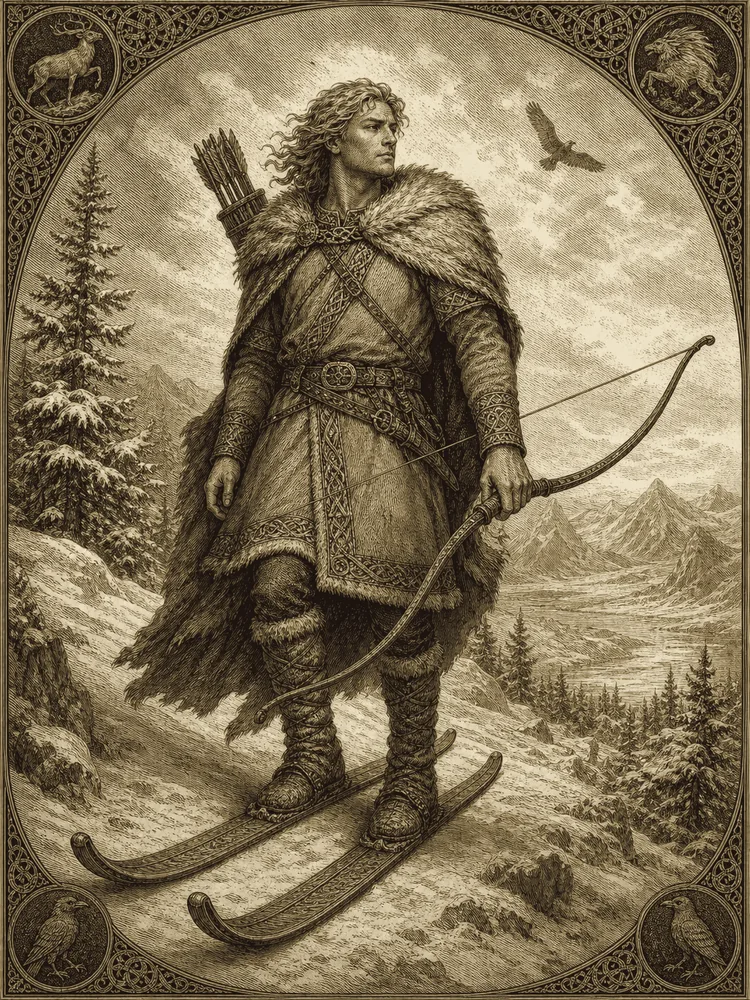
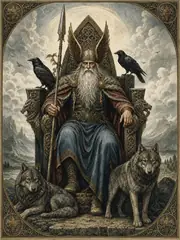
Ullr was a god of hunting, of archery, of skiing, of the cold mountain north — the ski-god of the Norse winter. The Eddic poems give him little narrative; but the great number of Norse and Swedish place-names compounded with his name (Ulleråker, Ulltuna, Ullern, and others) testifies to a substantial cult, particularly in central Sweden, that the Eddas have not fully preserved. He was a stepson of Thor (his mother Sif having had him before her marriage), and was reckoned a useful god to invoke before single combat. Saxo Grammaticus has a curious tale (under the Latinized name Ollerus) in which Ullr ruled Asgard for a time when Odin was driven out; the episode does not appear in the Eddic sources and may be Saxo's invention or a survival from a different Norse tradition.
 Before thisForseti
 Next on the wallSif
Curator’s note
What the sources say, and what later tradition added. The sources for this bay
Grímnismál 5, 42; Atlakviða 30; Gylfaginning 31; Saxo, Gesta Danorum 3. The place-name evidence (collected by Magnus Olsen and others in the early 20th century) is the strongest evidence for an originally substantial Ullr-cult in Sweden; the Eddic record's relative paucity may reflect the geographical bias of the Icelandic source-tradition.
Kin in the sources
Each tie is quoted from the entry that states it.
- Child ofSif
He was a stepson of Thor (his mother Sif having had him before her marriage)
 Child ofThor
He was a stepson of Thor (his mother Sif having had him before her marriage)
 Rival ofOdin
Ullr ruled Asgard for a time when Odin was driven out
When the sources speak
Dated witnesses for The Norse and Germanic Gods. A date marks when the evidence was written down, not when the belief began. The whole timeline
- 2nd–1st millennia BCE
- Indo-European language dispersals and regional Bronze Age cultures provide a remote comparative background, not a recoverable common canon.
- c. 500 BCE–1 CE
- Iron Age material culture, names, sanctuaries, and classical ethnography offer early but external evidence for Celtic and Germanic religions.
- 1st–4th centuries CE
- Roman inscriptions and provincial cults preserve many Celtic, Germanic, and local divine names.
- 4th–8th centuries CE
- Migration-period and early medieval conversion transform ritual institutions while heroic traditions continue.
- 8th–11th centuries CE
- Viking Age poetry, runic evidence, archaeology, and Scandinavian conversion form the core context of Norse myth.
- 9th–12th centuries CE
- Slavic, Baltic, and Finnic traditions enter chronicles and missionary accounts, often through hostile observers.
- 11th–14th centuries CE
- Irish, Welsh, and Icelandic manuscripts preserve major narrative corpora in Christian literary environments.
- 12th–16th centuries CE
- Saxo, saga compilers, Baltic chroniclers, and later antiquarians systematize or reinterpret older material.