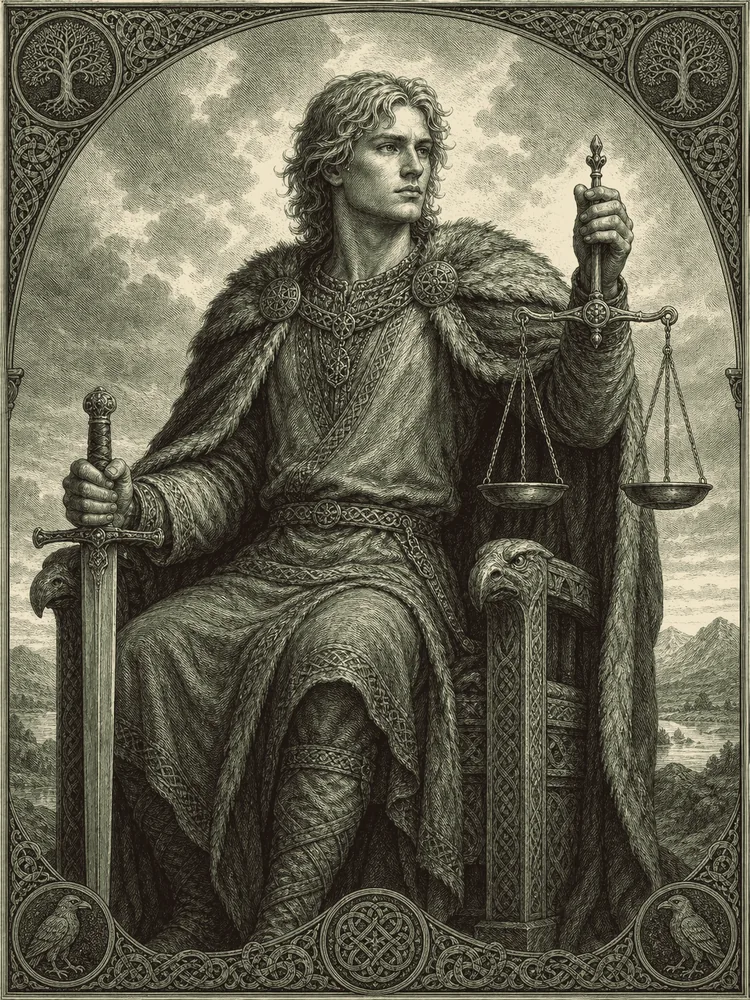
Forseti was the son of Baldr and Nanna, the god of justice, of legal proceedings, of the right resolution of disputes. He held court in his hall Glitnir ("Glittering," gold-pillared and silver-roofed) and there reconciled all who came before him; the Eddas say no quarrel was ever brought to him that he did not settle to the satisfaction of both parties. He had little mythology beyond this office; he was a god of court and council rather than of narrative.
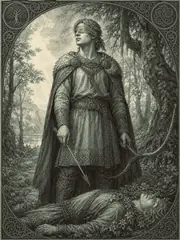 Before thisHodr
 Next on the wallUllr
Curator’s note
What the sources say, and what later tradition added. The sources for this bay
Gylfaginning 32; Grímnismál 15. Forseti's Frisian counterpart Fosite was the chief god of the holy island Fositesland (modern Heligoland), described by Alcuin in the Vita Willibrordi (8th c.); the Frisian cult was destroyed by St. Willibrord in the late 7th century.
Kin in the sources
Each tie is quoted from the entry that states it.
 Child ofBaldr
Forseti was the son of Baldr and Nanna, the god of justice
 Child ofNanna
Forseti was the son of Baldr and Nanna, the god of justice
When the sources speak
Dated witnesses for The Norse and Germanic Gods. A date marks when the evidence was written down, not when the belief began. The whole timeline
- 2nd–1st millennia BCE
- Indo-European language dispersals and regional Bronze Age cultures provide a remote comparative background, not a recoverable common canon.
- c. 500 BCE–1 CE
- Iron Age material culture, names, sanctuaries, and classical ethnography offer early but external evidence for Celtic and Germanic religions.
- 1st–4th centuries CE
- Roman inscriptions and provincial cults preserve many Celtic, Germanic, and local divine names.
- 4th–8th centuries CE
- Migration-period and early medieval conversion transform ritual institutions while heroic traditions continue.
- 8th–11th centuries CE
- Viking Age poetry, runic evidence, archaeology, and Scandinavian conversion form the core context of Norse myth.
- 9th–12th centuries CE
- Slavic, Baltic, and Finnic traditions enter chronicles and missionary accounts, often through hostile observers.
- 11th–14th centuries CE
- Irish, Welsh, and Icelandic manuscripts preserve major narrative corpora in Christian literary environments.
- 12th–16th centuries CE
- Saxo, saga compilers, Baltic chroniclers, and later antiquarians systematize or reinterpret older material.