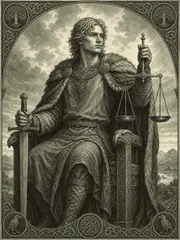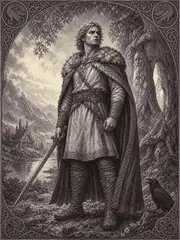
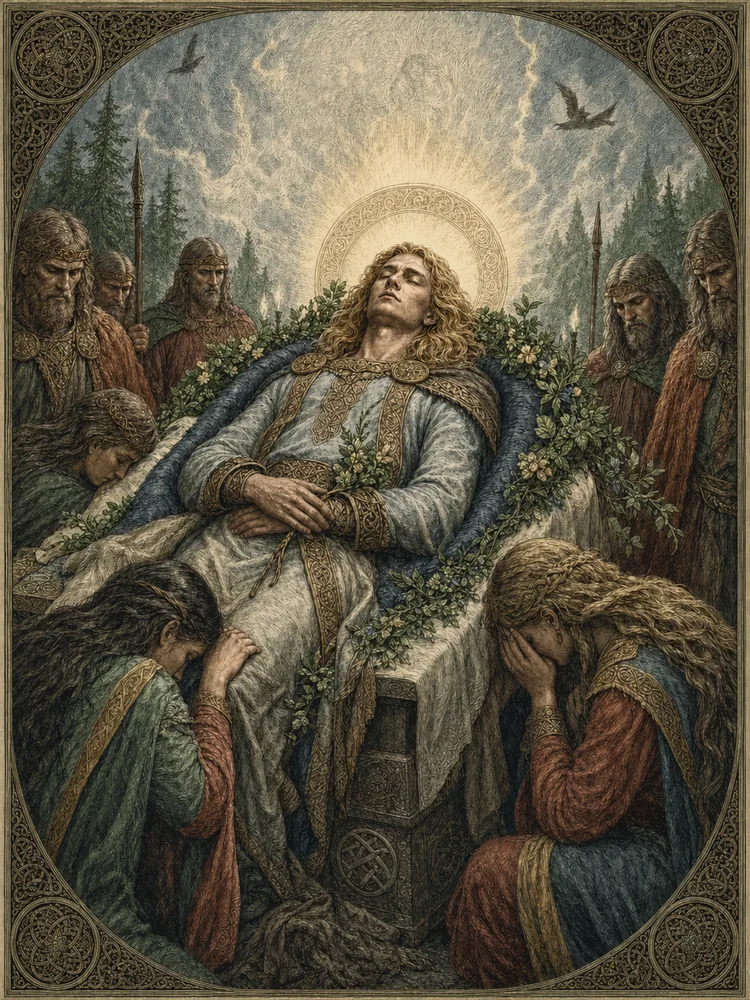
Baldr was the most beloved of the Aesir, son of Odin and Frigg, husband of Nanna, father of Forseti. He was the most beautiful of the gods, the most gentle, the wisest in counsel, dwelling in a hall called Breiðablik where no impurity was permitted. His narrative is the death-narrative — the most elaborately developed in Norse mythology and, by Snorri's organization, the central tragic episode of the Eddic cycle.
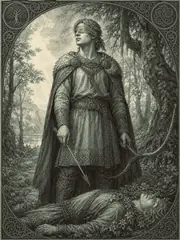
Baldr began to have ominous dreams. The gods, alarmed, sought protection for him; his mother Frigg went out and took oaths from every creature, every plant, every metal, every stone, every disease, that none would do him harm. So armored, Baldr became invulnerable; the gods made sport of throwing things at him, to see them bounce off harmlessly, and the gathering became a regular Asgardian entertainment. But Loki, in his dark and resentful character, asked the questioning Frigg whether absolutely everything had been sworn; and Frigg admitted that one small plant, the mistletoe growing west of Valhalla, had seemed too young and inconsequential to bother oath-binding. Loki went, found the mistletoe, made a dart of it, gave the dart to the blind god Hodr (Baldr's brother) who had been excluded from the throwing-game by his blindness, and guided his hand. Baldr fell dead with the mistletoe in him.
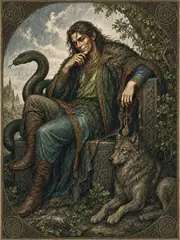
The grief of the Aesir was overwhelming. Baldr was given the great ship-funeral on Hringhorni, his own ship — but the ship would not move from the strand, and the giantess Hyrrokkin had to be brought to push it off; even she could not start it without setting it shuddering and Thor's hammer raised in anger. Baldr's wife Nanna died of grief and was placed on the pyre with him. The god Hermod was sent to ride down to the underworld realm of Hel (Loki's daughter, treated below) to plead for Baldr's return; Hel agreed, on condition that every thing in the world should weep for Baldr. Messengers went out across the worlds; everything wept — every man, every animal, every plant, even the stones — except for one giantess in a cave who refused, saying "Let Hel keep what she has." The giantess was Loki in disguise. Baldr remained in Hel; and the gods, learning of Loki's continuing role, bound him beneath the earth with the entrails of his own son, with a serpent dripping venom upon his face — and there he must remain until Ragnarök, when his struggles will at last break his bonds and he will join the giants against the gods.
Baldr's death is, by the Eddic understanding, the beginning of the end. The world's trust is broken; the gods know now that they will not always be victorious; Ragnarök comes nearer with the death of Baldr and the binding of Loki. After Ragnarök, in the new world, Baldr will return from Hel — the cycle will close and reopen — but the present age is irrecoverable.