A Compendium of the Ancient Gods
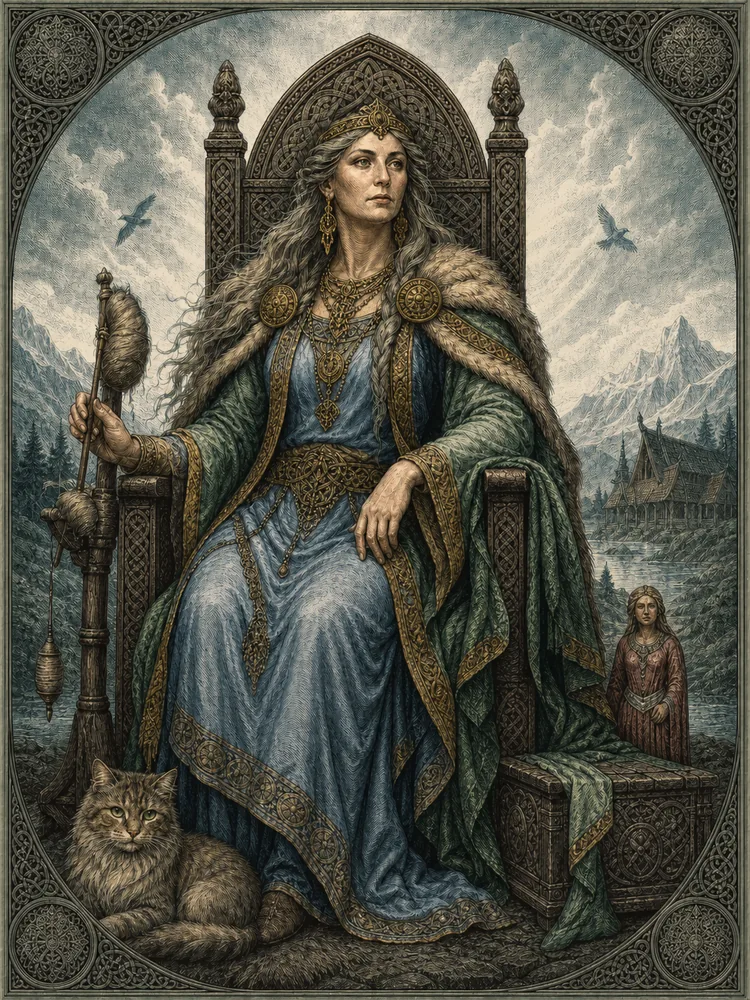
Frigg, plate

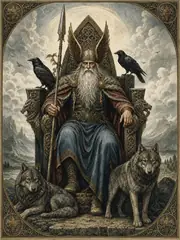
Frigg was the queen of the Aesir, wife of Odin, mother of Baldr. She was a goddess of marriage, of motherhood, of household, of foreknowledge — the only being besides Odin who knew the fates of all things, but who (unlike Odin) did not speak what she knew. She had her own hall, Fensalir; she was attended by handmaidens; she wove with golden threads, her spindle (some traditions said) being identified with the constellation that the modern Swedes still call Friggerock, "Frigg's distaff," which is otherwise Orion's belt.

Her great narrative is the death of her son Baldr, treated under his entry below: she had taken oaths from every thing in the world that none should harm him, and so he was invulnerable — except that she had overlooked the mistletoe, considered too young and small to swear; and Loki, learning of the oversight, made a dart of mistletoe and gave it to the blind god Hodr, who killed Baldr with it. The Eddic poem Lokasenna shows Frigg at the moment of mourning, refusing to be drawn into Loki's mockeries by reproach for her son's death. The English weekday Friday is named for her (or, by the alternative tradition, for Freyja — the question of which goddess gave the name to the day of the week is unresolved, the names being etymologically related and the cults overlapping).
Curator’s note

What the sources say, and what later tradition added. The sources for this bay

The principal sources are throughout the Eddas; Lokasenna 26 is the moment of Frigg's foreknowledge. The Frigg/Freyja-Friday question is in Simek and other handbooks of Germanic religion. The Mediterranean identification of Frigg with Venus (in the Latinized days-of-the-week) is a Roman-period identification; the actual goddess was differently characterized, with marriage and motherhood as her principal domains rather than love and beauty.

Kin in the sources

Each tie is quoted from the entry that states it.

When the sources speak

Dated witnesses for The Norse and Germanic Gods. A date marks when the evidence was written down, not when the belief began. The whole timeline

2nd–1st millennia BCE
Indo-European language dispersals and regional Bronze Age cultures provide a remote comparative background, not a recoverable common canon.
c. 500 BCE–1 CE
Iron Age material culture, names, sanctuaries, and classical ethnography offer early but external evidence for Celtic and Germanic religions.
1st–4th centuries CE
Roman inscriptions and provincial cults preserve many Celtic, Germanic, and local divine names.
4th–8th centuries CE
Migration-period and early medieval conversion transform ritual institutions while heroic traditions continue.
8th–11th centuries CE
Viking Age poetry, runic evidence, archaeology, and Scandinavian conversion form the core context of Norse myth.
9th–12th centuries CE
Slavic, Baltic, and Finnic traditions enter chronicles and missionary accounts, often through hostile observers.
11th–14th centuries CE
Irish, Welsh, and Icelandic manuscripts preserve major narrative corpora in Christian literary environments.
12th–16th centuries CE
Saxo, saga compilers, Baltic chroniclers, and later antiquarians systematize or reinterpret older material.

Floor plan

The rooms follow one another in the order their peoples first appear in the written record.

  1. The Cradle of Citiesc. 3400 BCE to 395 CE. 115 works
  2. The Gift of the Nilec. 4000 BCE to 395 CE. 73 works
  3. The Olympian Orderc. 1600 BCE to 750 CE. 152 works
  4. The Persian Worldc. 2000 BCE to 1010 CE. 30 works
  5. The Levantine Borderlandsc. 1200 BCE to 500 CE. 20 works
  6. The Edges of Empirec. 2000 BCE to 1500 CE. 33 works
  7. The Etruscan Worldc. 900 BCE to 750 CE. 22 works
  8. The Roman Inheritancec. 1200 BCE to 500 CE. 58 works
  9. The Northern Inheritancec. 2000 BCE to 1600 CE. 131 works