A Compendium of the Ancient Gods
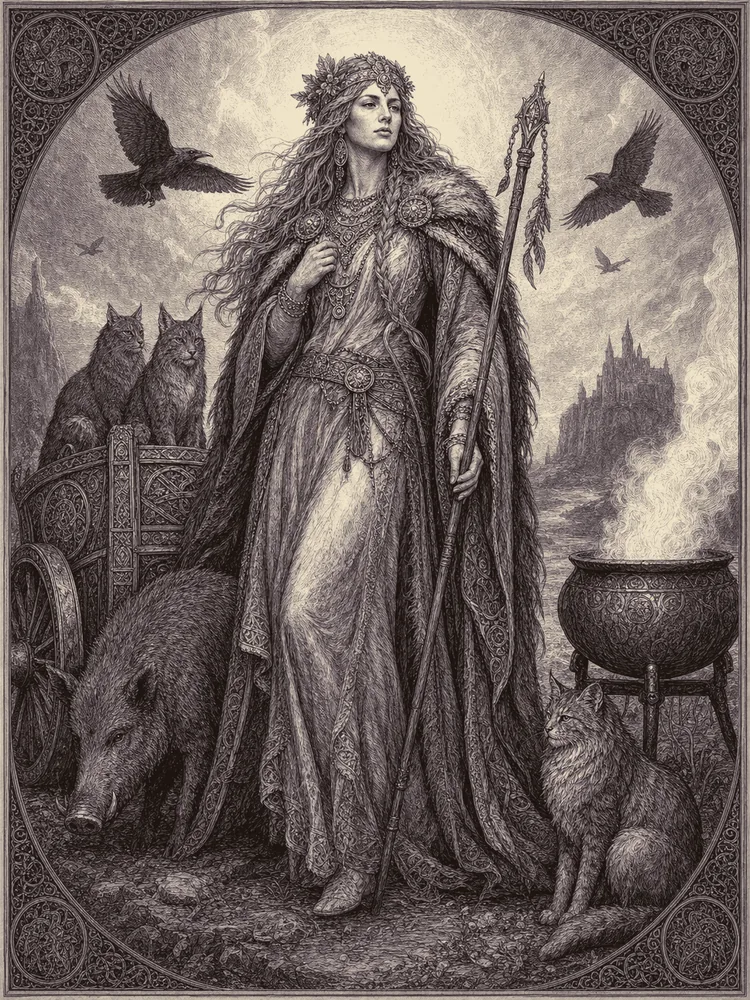
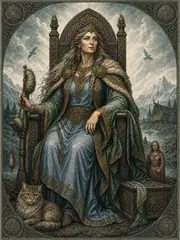
Freyja, plate

Freyja ("Lady") was the chief female god of the Vanir, twin sister of Freyr, daughter of Njord. She was the goddess of love and beauty, but also of war and of magic; her dominions overlapped substantially with those of Frigg the queen of the Aesir, and the two were sometimes confused, but the older sources keep them distinct. Freyja drove a chariot drawn by two cats and rode the boar Hildisvíni. She owned the marvelous necklace Brísingamen, won at the cost of spending a night each with the four dwarves who had made it (a transaction Loki had spied upon and reported to Odin, who took the necklace and required her to instigate a war between two earthly kings as ransom for its return). She had a magical falcon-cloak that gave the wearer the power of flight. She received half of those slain in battle (the other half going to Odin's Valhalla); her hall was Sessrúmnir in the field of Folkvangr.

She was the great teacher of seid, the form of magic that Odin had learned from her — magic of prophecy, of binding, of altering the unfolding of fate, considered shameful for men to practice but proper to women. She had been married to a god named Óðr, who had vanished on long journeys; she wandered the worlds searching for him and weeping golden tears (her tears, by the Eddic kennings, became gold on land and amber on the sea). Whether Óðr was her actual lost husband or whether the figure was a doubling of Odin himself is a question modern scholars have variously answered; the etymological identity of the names is suggestive.
Curator’s note

What the sources say, and what later tradition added. The sources for this bay

The principal sources are throughout the Poetic Edda (Lokasenna, Hyndluljóð, etc.) and Snorri's Prose Edda. The Brísingamen narrative is in Sörla þáttr and is alluded to in Húsdrápa. The shared dominions of Freyja and Frigg, and the question of whether they were originally one goddess later split or two distinct goddesses partly conflated, has been much debated; the Old High German Frīja (whence Friday) corresponds to one of them but the question of which is debated. Freyja's role as receiver of the slain is in Grímnismál 14.

Kin in the sources

Each tie is quoted from the entry that states it.

When the sources speak

Dated witnesses for The Norse and Germanic Gods. A date marks when the evidence was written down, not when the belief began. The whole timeline

2nd–1st millennia BCE
Indo-European language dispersals and regional Bronze Age cultures provide a remote comparative background, not a recoverable common canon.
c. 500 BCE–1 CE
Iron Age material culture, names, sanctuaries, and classical ethnography offer early but external evidence for Celtic and Germanic religions.
1st–4th centuries CE
Roman inscriptions and provincial cults preserve many Celtic, Germanic, and local divine names.
4th–8th centuries CE
Migration-period and early medieval conversion transform ritual institutions while heroic traditions continue.
8th–11th centuries CE
Viking Age poetry, runic evidence, archaeology, and Scandinavian conversion form the core context of Norse myth.
9th–12th centuries CE
Slavic, Baltic, and Finnic traditions enter chronicles and missionary accounts, often through hostile observers.
11th–14th centuries CE
Irish, Welsh, and Icelandic manuscripts preserve major narrative corpora in Christian literary environments.
12th–16th centuries CE
Saxo, saga compilers, Baltic chroniclers, and later antiquarians systematize or reinterpret older material.

Floor plan

The rooms follow one another in the order their peoples first appear in the written record.

  1. The Cradle of Citiesc. 3400 BCE to 395 CE. 115 works
  2. The Gift of the Nilec. 4000 BCE to 395 CE. 73 works
  3. The Olympian Orderc. 1600 BCE to 750 CE. 152 works
  4. The Persian Worldc. 2000 BCE to 1010 CE. 30 works
  5. The Levantine Borderlandsc. 1200 BCE to 500 CE. 20 works
  6. The Edges of Empirec. 2000 BCE to 1500 CE. 33 works
  7. The Etruscan Worldc. 900 BCE to 750 CE. 22 works
  8. The Roman Inheritancec. 1200 BCE to 500 CE. 58 works
  9. The Northern Inheritancec. 2000 BCE to 1600 CE. 131 works