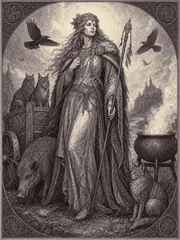
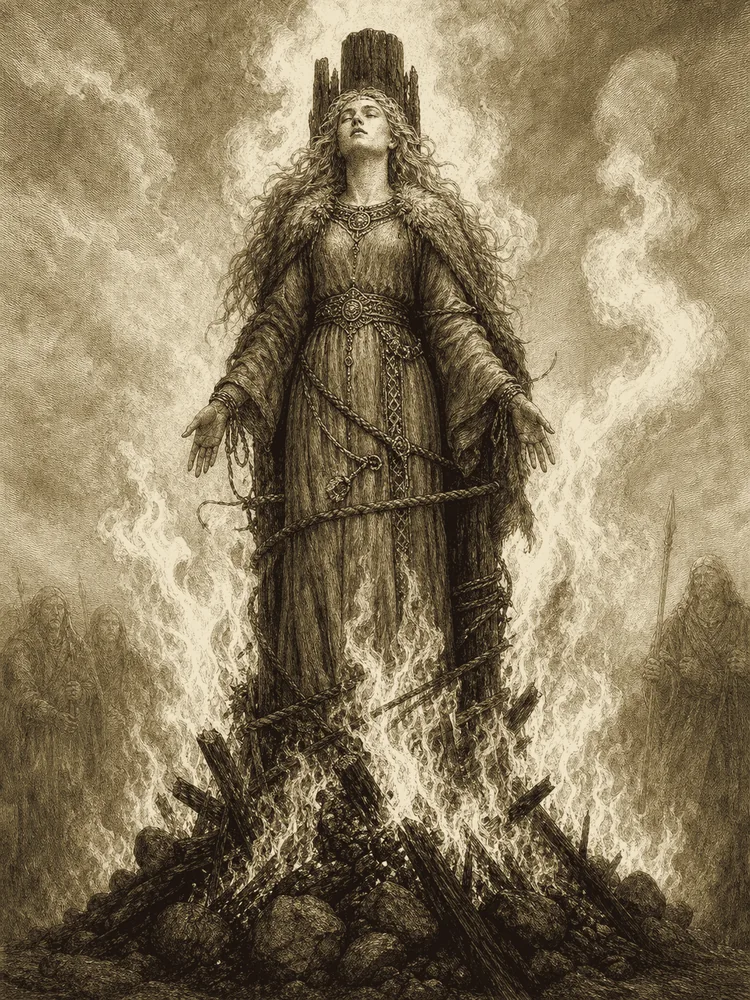

In the early days, before the war between the Aesir and the Vanir, there came to the hall of the Aesir a strange woman called Gullveig — "Gold-Drink" or "Gold-Power" — who practiced seiðr, the magic of the Vanir, and who was greedy for gold. The Aesir struck her with their spears and burnt her in their hall; three times they burnt her, three times she rose up from the flames, and she lived afterward as Heid, the witch, and went among mankind teaching the magic that no woman ought to know.
Her three killings and three resurrections were the spark that began the long war between the Aesir and the Vanir — for the Vanir, of whom Gullveig was, would not endure the murder of one of their own. The two kindreds of gods waged war thereafter for many seasons, until at last they made peace, exchanging hostages; the Vanir sent Njord, Freyr, and Freyja to dwell among the Aesir, and the Aesir sent Mímir and Hœnir to dwell among the Vanir. So the conflict that began with Gullveig's burning was at length resolved, but the resolution shaped the pantheon for ever after.
Whether Gullveig was actually Freyja under another name — whether the great goddess of the Vanir went disguised among the Aesir and was attacked, beginning thereby the war for her own people — was suggested already in antiquity, and remains a likely interpretation. The name Heid, "the bright one," is also a name applied to seiðr-wielding women throughout the sagas, and the figure may stand for the type of the powerful sorceress whom male warrior-society both required and feared.