A Compendium of the Ancient Gods
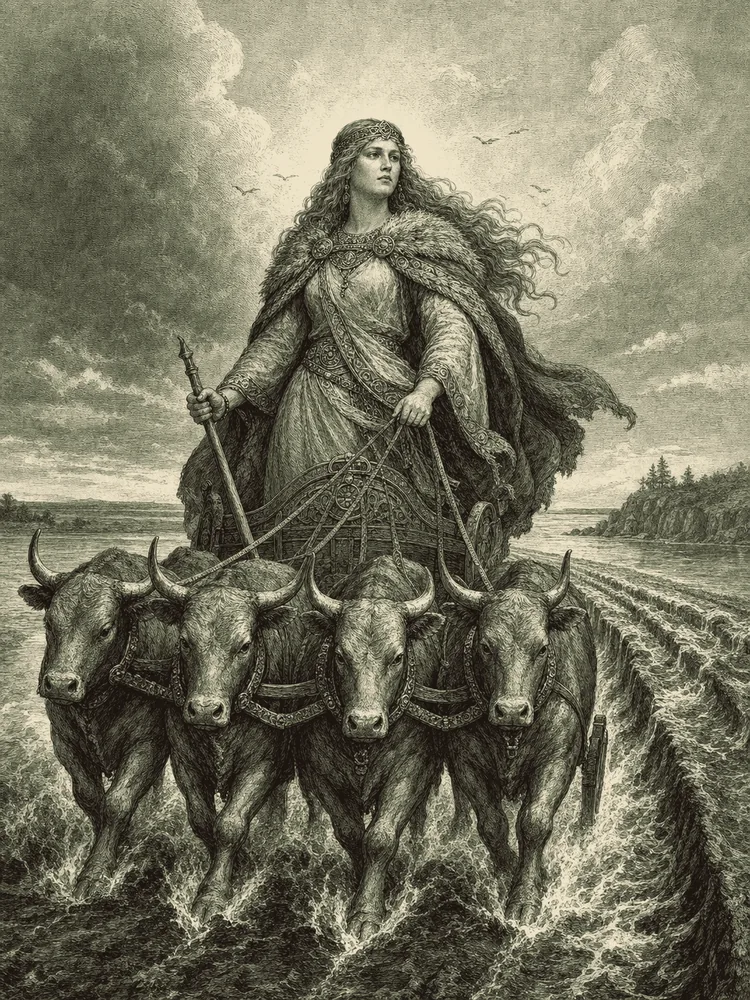
Gefjon, plate

Gefjon was a goddess of the Aesir kindred, but she dwelt much among the Vanir; she was a virgin (some sources said) and a patroness of those women who died unmarried, who passed after death to her keeping. Her great deed was the making of the Danish island of Zealand, which she carved from the body of the Swedish mainland by a stratagem of the gods.

King Gylfi of Sweden, having entertained a wandering woman well, promised her in jest as much land as four oxen could plow in a day and a night. The woman was Gefjon. She went away to the realm of the giants, lay with one of them, and bore four sons, whom she turned into four oxen of vast strength; and with these she returned to Sweden and yoked them to her plow. Through the night the oxen plowed, and where the plow cut, the land was lifted up; the great hollow of Lake Mälaren in Sweden is the place from which Gefjon took the earth, and the island of Zealand is the earth she took. So the geography of the Baltic was made by a goddess's wit.

Gefjon afterward married Skjǫld, the legendary first king of the Danes, and from their union descended the Skjǫldung dynasty — the kings of Denmark celebrated in Beowulf as the Scyldings. So the goddess who made the Danish island also became the ancestress of the Danish royal house, and through that house her name was kept in honor through the heroic age.

Curator’s note

What the sources say, and what later tradition added. The sources for this bay

Gefjon's plowing of Zealand is told in Gylfaginning chapter 1 (the prologue, set as if in the days of King Gylfi himself) and in Ynglinga saga chapter 5 (where Snorri attributes the story to Bragi inn gamli, a ninth-century skald). The story is one of the rare Norse myths with a clear topographical etiology, explaining a real geographical feature. The connection of Gefjon to virgins is given in Gylfaginning chapter 35; the marriage to Skjǫld and the Skjǫldung dynasty is in Ynglinga saga and in Saxo Grammaticus's Gesta Danorum (Book 1). Gefjon has plausibly been linked to the goddess Gefn, who is a name of Freyja in some Eddic poems; the relationship between the two names, like much of Norse goddess-theology, is debated.

When the sources speak

Dated witnesses for The Norse and Germanic Gods. A date marks when the evidence was written down, not when the belief began. The whole timeline

2nd–1st millennia BCE
Indo-European language dispersals and regional Bronze Age cultures provide a remote comparative background, not a recoverable common canon.
c. 500 BCE–1 CE
Iron Age material culture, names, sanctuaries, and classical ethnography offer early but external evidence for Celtic and Germanic religions.
1st–4th centuries CE
Roman inscriptions and provincial cults preserve many Celtic, Germanic, and local divine names.
4th–8th centuries CE
Migration-period and early medieval conversion transform ritual institutions while heroic traditions continue.
8th–11th centuries CE
Viking Age poetry, runic evidence, archaeology, and Scandinavian conversion form the core context of Norse myth.
9th–12th centuries CE
Slavic, Baltic, and Finnic traditions enter chronicles and missionary accounts, often through hostile observers.
11th–14th centuries CE
Irish, Welsh, and Icelandic manuscripts preserve major narrative corpora in Christian literary environments.
12th–16th centuries CE
Saxo, saga compilers, Baltic chroniclers, and later antiquarians systematize or reinterpret older material.

Floor plan

The rooms follow one another in the order their peoples first appear in the written record.

  1. The Cradle of Citiesc. 3400 BCE to 395 CE. 115 works
  2. The Gift of the Nilec. 4000 BCE to 395 CE. 73 works
  3. The Olympian Orderc. 1600 BCE to 750 CE. 152 works
  4. The Persian Worldc. 2000 BCE to 1010 CE. 30 works
  5. The Levantine Borderlandsc. 1200 BCE to 500 CE. 20 works
  6. The Edges of Empirec. 2000 BCE to 1500 CE. 33 works
  7. The Etruscan Worldc. 900 BCE to 750 CE. 22 works
  8. The Roman Inheritancec. 1200 BCE to 500 CE. 58 works
  9. The Northern Inheritancec. 2000 BCE to 1600 CE. 131 works