A Compendium of the Ancient Gods
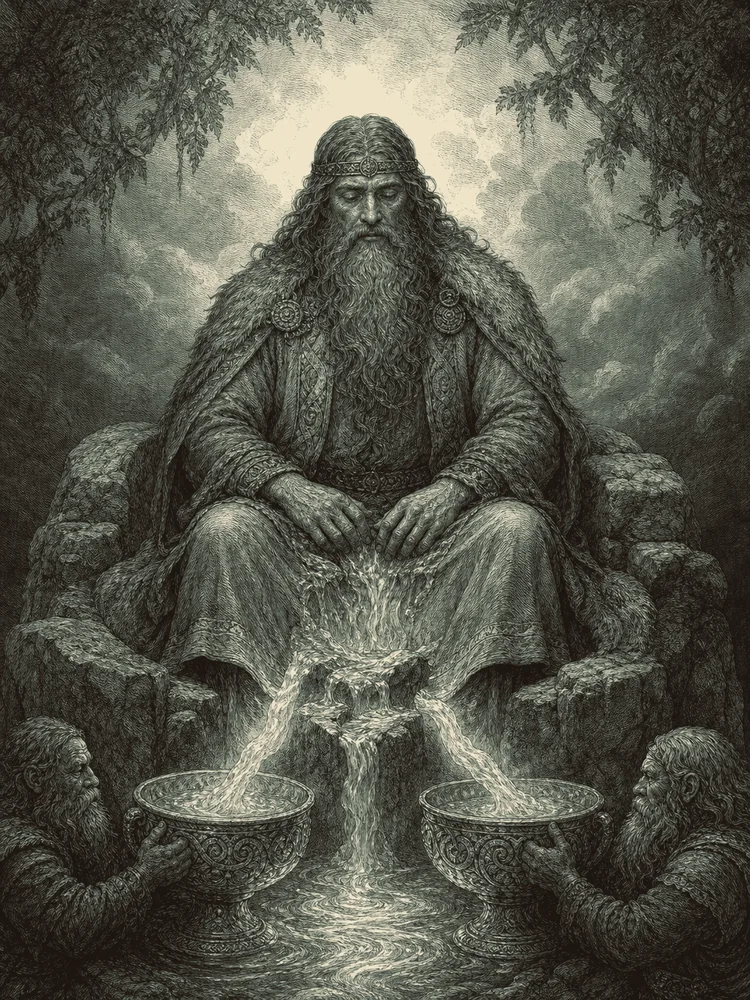
Kvasir, plate

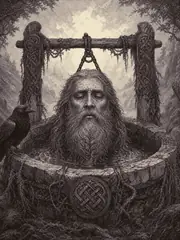
When the war between the Aesir and the Vanir was at last ended, the two kindreds of gods made their peace by spitting into a great vat — for the spittle of the gods was the visible sign of agreement — and from the spittle a man took shape, who was the wisest of all men. They called him Kvasir, and he traveled through the worlds answering questions, for there was no question that he could not answer. He had been made of the gods' own substance, and held within himself the wisdom of both the Aesir and the Vanir.

But two dwarves, Fjalar and Galar, invited Kvasir to their hall and slew him there, and caught his blood in two vats and a kettle. They mixed the blood with honey, and from this mixture was made the Mead of Poetry — the drink that gave to whoever tasted it the power of poetry and learning. Whoever drank a measure of the mead became a poet thereafter; whoever drank a small drop became a scholar; and the dwarves kept the mead hidden, and would not share it.

How the mead was won away from the dwarves — by the giant Suttung, whom they had paid in mead for sparing their lives after they had killed his father; and how Odin afterward stole it from Suttung's hall by trickery and seduction of his daughter Gunnlöd; and how Odin returned to Asgard with the mead held in his beak as he flew in the form of an eagle, and disgorged it into vats for the gods — is the great long story of how poetry came to gods and men. Some of the mead, in Odin's flight, was scattered carelessly behind him; that mead the worst poets get.
Curator’s note

What the sources say, and what later tradition added. The sources for this bay

Kvasir's birth from the gods' spittle, his death by the dwarves, and the making of the Mead of Poetry are recounted in Snorri's Skáldskaparmál chapters 4-6 — the most extensive treatment of the myth of poetry's origin in any Norse source. The story is alluded to in Hávamál 104-110 (Odin's stratagem) and in numerous skaldic kennings ("Kvasir's blood," "the Aesir's drink" as poetic kennings for poetry itself). The Vanir-Aesir reconciliation through spittle is mentioned in Ynglinga saga 4. The story has been read as an Indo-European myth of poetry-from-sacrifice (compare the Vedic soma) and as a specifically Germanic myth of the relation between poetic inspiration and the violent transgression of normal categories. The detail of the bad poets' mead — the part Odin spilled in flight — is a wry skaldic touch that exposes Snorri's affection for his subject.

Kin in the sources

Each tie is quoted from the entry that states it.

When the sources speak

Dated witnesses for The Norse and Germanic Gods. A date marks when the evidence was written down, not when the belief began. The whole timeline

2nd–1st millennia BCE
Indo-European language dispersals and regional Bronze Age cultures provide a remote comparative background, not a recoverable common canon.
c. 500 BCE–1 CE
Iron Age material culture, names, sanctuaries, and classical ethnography offer early but external evidence for Celtic and Germanic religions.
1st–4th centuries CE
Roman inscriptions and provincial cults preserve many Celtic, Germanic, and local divine names.
4th–8th centuries CE
Migration-period and early medieval conversion transform ritual institutions while heroic traditions continue.
8th–11th centuries CE
Viking Age poetry, runic evidence, archaeology, and Scandinavian conversion form the core context of Norse myth.
9th–12th centuries CE
Slavic, Baltic, and Finnic traditions enter chronicles and missionary accounts, often through hostile observers.
11th–14th centuries CE
Irish, Welsh, and Icelandic manuscripts preserve major narrative corpora in Christian literary environments.
12th–16th centuries CE
Saxo, saga compilers, Baltic chroniclers, and later antiquarians systematize or reinterpret older material.

Floor plan

The rooms follow one another in the order their peoples first appear in the written record.

  1. The Cradle of Citiesc. 3400 BCE to 395 CE. 115 works
  2. The Gift of the Nilec. 4000 BCE to 395 CE. 73 works
  3. The Olympian Orderc. 1600 BCE to 750 CE. 152 works
  4. The Persian Worldc. 2000 BCE to 1010 CE. 30 works
  5. The Levantine Borderlandsc. 1200 BCE to 500 CE. 20 works
  6. The Edges of Empirec. 2000 BCE to 1500 CE. 33 works
  7. The Etruscan Worldc. 900 BCE to 750 CE. 22 works
  8. The Roman Inheritancec. 1200 BCE to 500 CE. 58 works
  9. The Northern Inheritancec. 2000 BCE to 1600 CE. 131 works