A Compendium of the Ancient Gods
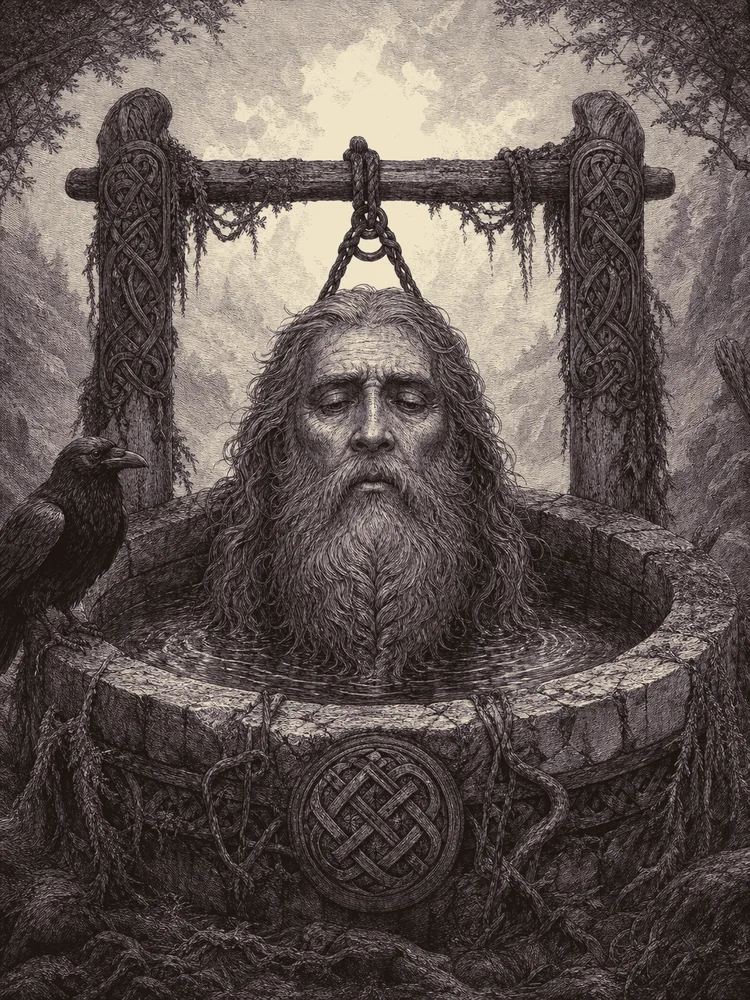
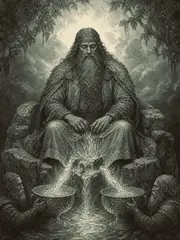
Mimir, plate

Mímir was the wisest of all beings, and his name in Old Norse means simply "the Rememberer" or "the Memorist." He kept watch over a well at the foot of the world-tree Yggdrasil, in the realm of the giants, and from this well Wisdom was drunk; the well took its name from him, the Well of Mímir. Odin himself, the chief of the gods, came to this well in his own search for wisdom, and Mímir would not give him to drink without payment: Odin must give one of his eyes, and let it sink into the well as a pledge. Odin agreed; one-eyed thereafter, he drank of the well and became the wisest of the gods.

When the war between the Aesir and the Vanir was settled by an exchange of hostages, Mímir was sent with the noble Hœnir to dwell among the Vanir as the Aesir's gift; but the Vanir, finding that Hœnir was a poor counselor without Mímir at his side, suspected they had been cheated, and beheaded Mímir, sending the head back to Asgard. Odin, receiving the head, embalmed it with herbs and chanted galdrar over it, that it might still speak; and ever after Mímir's head sat beside the well, giving counsel to Odin in the most secret matters.

It was to Mímir's head that Odin went on the eve of every great event; before Ragnarǫk itself, Odin would consult the head one final time. So the wisdom of Mímir, even in death, remained at the gods' service — and the eye that Odin had pledged was kept by Mímir, sunk in the depths of the well, the price for the wisdom the chief of the gods could never have purchased otherwise.
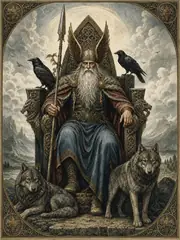
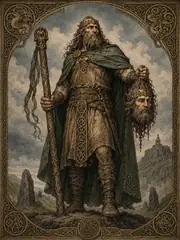
Curator’s note

What the sources say, and what later tradition added. The sources for this bay

Mímir appears in Vǫluspá 28 (Odin's eye in the well), Sigrdrífumál 14 (the head and its counsel), Snorri's Gylfaginning chapter 15 and Ynglinga saga chapter 4 (the war and the beheading), and Hávamál 140 ("the wise words I learned from the famous son of Bölthorn, Bestla's father" — possibly identifying Mímir as Odin's maternal uncle). The motif of the speaking severed head has parallels elsewhere in Indo-European mythology (Bran the Blessed in the Welsh Mabinogi, the head of Orpheus) and may be a shared inheritance. The well at Yggdrasil's roots is one of the three wells of the world-tree (the others being the Well of Urd at the gods' meeting-place and the well Hvergelmir from which all rivers flow). Modern scholarship (Lotte Motz, John Lindow) has explored the layered traditions about Mímir; he may originally have been a personification of the well itself rather than its guardian.

Kin in the sources

Each tie is quoted from the entry that states it.

When the sources speak

Dated witnesses for The Norse and Germanic Gods. A date marks when the evidence was written down, not when the belief began. The whole timeline

2nd–1st millennia BCE
Indo-European language dispersals and regional Bronze Age cultures provide a remote comparative background, not a recoverable common canon.
c. 500 BCE–1 CE
Iron Age material culture, names, sanctuaries, and classical ethnography offer early but external evidence for Celtic and Germanic religions.
1st–4th centuries CE
Roman inscriptions and provincial cults preserve many Celtic, Germanic, and local divine names.
4th–8th centuries CE
Migration-period and early medieval conversion transform ritual institutions while heroic traditions continue.
8th–11th centuries CE
Viking Age poetry, runic evidence, archaeology, and Scandinavian conversion form the core context of Norse myth.
9th–12th centuries CE
Slavic, Baltic, and Finnic traditions enter chronicles and missionary accounts, often through hostile observers.
11th–14th centuries CE
Irish, Welsh, and Icelandic manuscripts preserve major narrative corpora in Christian literary environments.
12th–16th centuries CE
Saxo, saga compilers, Baltic chroniclers, and later antiquarians systematize or reinterpret older material.

Floor plan

The rooms follow one another in the order their peoples first appear in the written record.

  1. The Cradle of Citiesc. 3400 BCE to 395 CE. 115 works
  2. The Gift of the Nilec. 4000 BCE to 395 CE. 73 works
  3. The Olympian Orderc. 1600 BCE to 750 CE. 152 works
  4. The Persian Worldc. 2000 BCE to 1010 CE. 30 works
  5. The Levantine Borderlandsc. 1200 BCE to 500 CE. 20 works
  6. The Edges of Empirec. 2000 BCE to 1500 CE. 33 works
  7. The Etruscan Worldc. 900 BCE to 750 CE. 22 works
  8. The Roman Inheritancec. 1200 BCE to 500 CE. 58 works
  9. The Northern Inheritancec. 2000 BCE to 1600 CE. 131 works