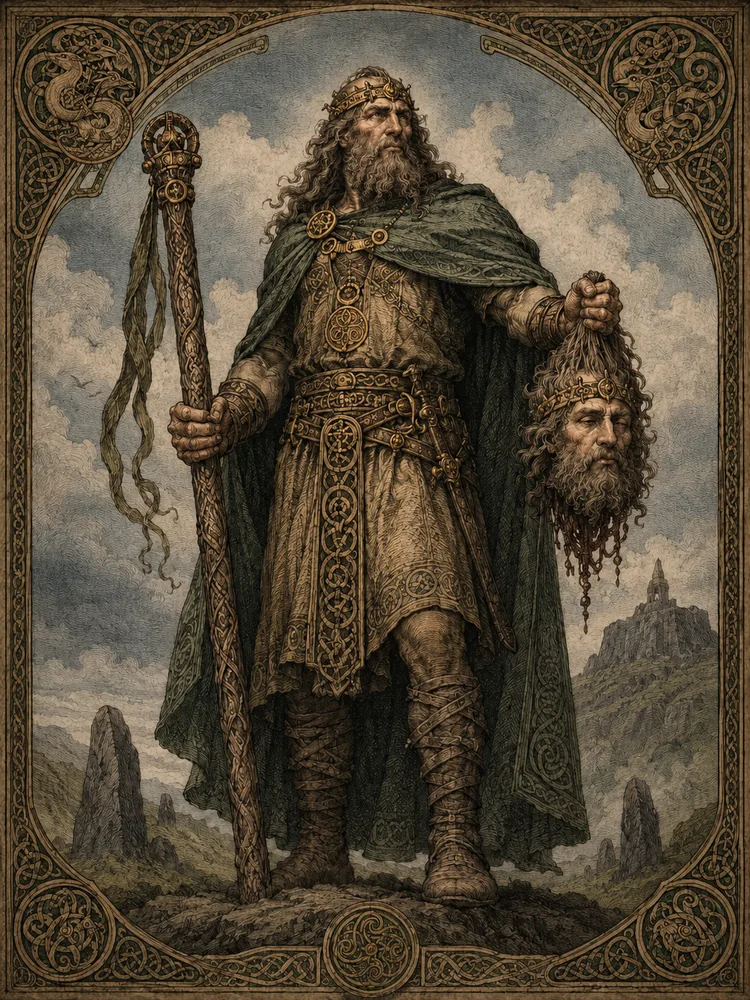
Bran the Blessed (Welsh Brân Fendigaid, "Bran the Blessed," or Brân ap Llŷr, "Bran son of Llŷr") was a giant-king of Britain in the Second Branch of the Mabinogi, brother of Branwen and Manawydan. He gave his sister Branwen in marriage to Matholwch king of Ireland; the marriage went badly (Matholwch's people abused Branwen, making her a kitchen-drudge); Bran led an invasion of Ireland to rescue her. The British host, with Bran himself wading the Irish Sea (his giant-stature making boats unnecessary for him), defeated the Irish in a great battle, but Bran was wounded by a poisoned spear and ordered his men to cut off his head and carry it back to Britain.
The severed head — in the most curious passage of medieval Welsh literature — continued to converse with Bran's followers for years afterwards, presiding over a long feasting-hall in which the company forgot the passage of time and lived in a kind of suspended joy, until at last (an appointed door being opened) memory of grief returned, and they buried Bran's head at the White Hill (later the site of the Tower of London), facing France, that it might guard Britain against invasion. So long as the head remained buried, Britain would not be conquered. King Arthur was said in some traditions to have dug up the head, in arrogance at requiring no other protection — and the consequences of his deed reverberate (in some readings) through the subsequent troubles of Britain. The legend of the ravens at the Tower of London — that if the ravens leave the Tower, the kingdom will fall — is sometimes connected to the Bran tradition (Bran in Welsh means raven), though the historical connection of the modern Tower-ravens to the medieval narrative is loose at best.