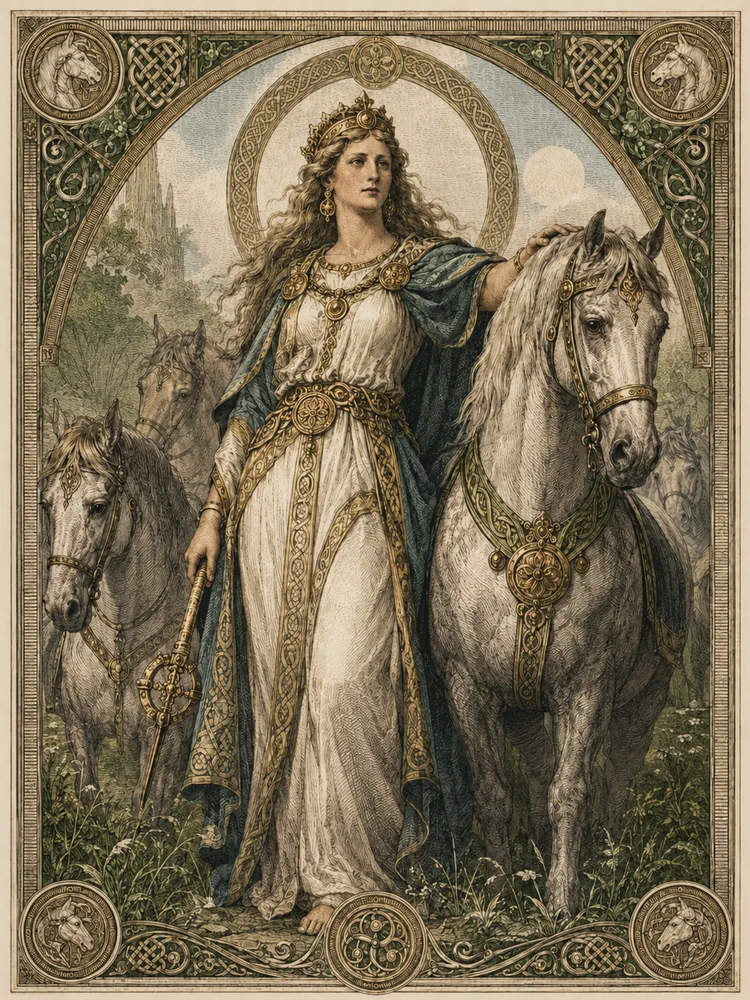
Epona ("the Horse-Goddess," from Gaulish *epos, "horse") was the principal female deity of the continental Gaulish pantheon as Romanized inscriptional evidence reveals her. She was a goddess of horses, of mares with foals, of horsemanship, of the cavalry — and the Roman cavalry, which drew heavily on Gaulish recruits, took her cult with them across the empire, with dedications to Epona attested from Britain to North Africa. She is the only Gaulish deity whose festival was incorporated into the Roman calendar (December 18), in recognition of her cavalry function. Iconographically she was depicted seated sidesaddle on a mare, often with a basket of fruit or grain at her side, sometimes accompanied by foals, sometimes by dogs.
Her relation to the Welsh Rhiannon and the Irish Macha (a goddess of similar function in the Ulster Cycle) is suggestive of a wider Celtic horse-goddess complex; the further connection to the Indo-European pattern (the Vedic Aśvinī, the Greek Demeter-Erinys-as-mare) makes Epona one of the more clearly inherited Indo-European Celtic deities. She had no developed mythology in the surviving sources; we know her almost entirely from cult-evidence.
When the sources speak
Dated witnesses for The Celtic Mythologies. A date marks when the evidence was written down, not when the belief began. The whole timeline
- 2nd–1st millennia BCE
- Indo-European language dispersals and regional Bronze Age cultures provide a remote comparative background, not a recoverable common canon.
- c. 500 BCE–1 CE
- Iron Age material culture, names, sanctuaries, and classical ethnography offer early but external evidence for Celtic and Germanic religions.
- 1st–4th centuries CE
- Roman inscriptions and provincial cults preserve many Celtic, Germanic, and local divine names.
- 4th–8th centuries CE
- Migration-period and early medieval conversion transform ritual institutions while heroic traditions continue.
- 8th–11th centuries CE
- Viking Age poetry, runic evidence, archaeology, and Scandinavian conversion form the core context of Norse myth.
- 9th–12th centuries CE
- Slavic, Baltic, and Finnic traditions enter chronicles and missionary accounts, often through hostile observers.
- 11th–14th centuries CE
- Irish, Welsh, and Icelandic manuscripts preserve major narrative corpora in Christian literary environments.
- 12th–16th centuries CE
- Saxo, saga compilers, Baltic chroniclers, and later antiquarians systematize or reinterpret older material.