A Compendium of the Ancient Gods
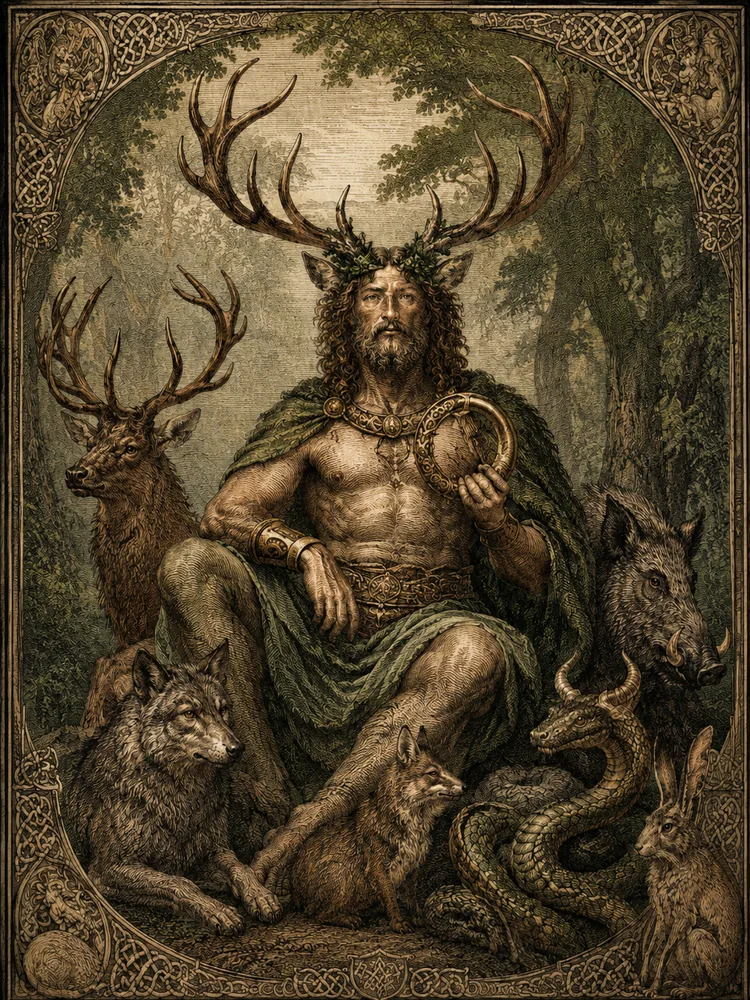
Cernunnos, plate

Cernunnos ("the Horned One," from Gaulish *karnon, "horn") was the antlered god of the Gaulish pantheon, depicted with the antlers of a stag, often seated cross-legged in a meditative posture, surrounded by animals (a stag at one side, a great horned serpent at the other, sometimes a dog or wolf, sometimes a bull). He was a god of the wild, of animals, of fertility, of the nether-world. The most famous depiction is on the silver Gundestrup Cauldron (c. 100 BCE, found in a Danish bog in 1891 and now in the Copenhagen National Museum, the masterpiece of pre-Roman Celtic art), where the antlered figure sits cross-legged amid animals, holding a torc in one hand and a horned serpent in the other. He is named only on a single Roman-era inscription from Paris (the Pillar of the Boatmen, 1st c. CE) and a few other monuments, but his iconographic distinctiveness has made him among the most recognizable Celtic deities.

The figure has had a remarkable modern afterlife, principally through the modern Wiccan and neo-pagan movements, where Cernunnos has been reconstituted as the "Horned God" of a generalized nature-religion, partly on Continental-Celtic evidence and partly on British folk-traditions of horned figures (Herne the Hunter, the Christian-period demonological iconography of horned devils). The historical Cernunnos was a specific Celtic deity with a specific cult; the modern Horned God is a creative reconstruction that draws on him but is not identical with him.

Curator’s note

What the sources say, and what later tradition added. The sources for this bay

The principal sources are the Pillar of the Boatmen (Paris, 1st c. CE) and the Gundestrup Cauldron (now in the National Museum of Denmark, Copenhagen). Modern scholarly literature includes Bober, "Cernunnos: Origin and Transformation of a Celtic Divinity" (American Journal of Archaeology, 1951); Fitzpatrick-Matthews, "The Gundestrup Cauldron" (1996). The modern Wiccan/neo-pagan reception is treated by Hutton, The Triumph of the Moon (1999).

When the sources speak

Dated witnesses for The Celtic Mythologies. A date marks when the evidence was written down, not when the belief began. The whole timeline

2nd–1st millennia BCE
Indo-European language dispersals and regional Bronze Age cultures provide a remote comparative background, not a recoverable common canon.
c. 500 BCE–1 CE
Iron Age material culture, names, sanctuaries, and classical ethnography offer early but external evidence for Celtic and Germanic religions.
1st–4th centuries CE
Roman inscriptions and provincial cults preserve many Celtic, Germanic, and local divine names.
4th–8th centuries CE
Migration-period and early medieval conversion transform ritual institutions while heroic traditions continue.
8th–11th centuries CE
Viking Age poetry, runic evidence, archaeology, and Scandinavian conversion form the core context of Norse myth.
9th–12th centuries CE
Slavic, Baltic, and Finnic traditions enter chronicles and missionary accounts, often through hostile observers.
11th–14th centuries CE
Irish, Welsh, and Icelandic manuscripts preserve major narrative corpora in Christian literary environments.
12th–16th centuries CE
Saxo, saga compilers, Baltic chroniclers, and later antiquarians systematize or reinterpret older material.

Floor plan

The rooms follow one another in the order their peoples first appear in the written record.

  1. The Cradle of Citiesc. 3400 BCE to 395 CE. 115 works
  2. The Gift of the Nilec. 4000 BCE to 395 CE. 73 works
  3. The Olympian Orderc. 1600 BCE to 750 CE. 152 works
  4. The Persian Worldc. 2000 BCE to 1010 CE. 30 works
  5. The Levantine Borderlandsc. 1200 BCE to 500 CE. 20 works
  6. The Edges of Empirec. 2000 BCE to 1500 CE. 33 works
  7. The Etruscan Worldc. 900 BCE to 750 CE. 22 works
  8. The Roman Inheritancec. 1200 BCE to 500 CE. 58 works
  9. The Northern Inheritancec. 2000 BCE to 1600 CE. 131 works