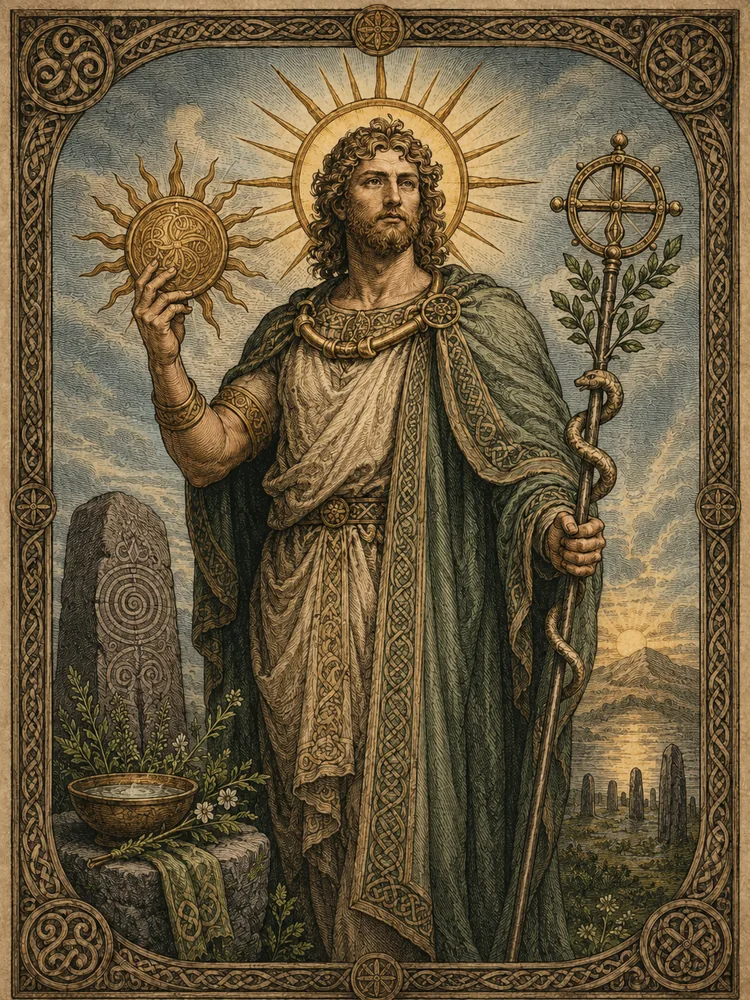
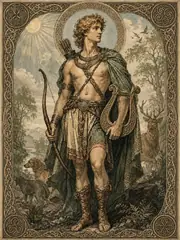
Belenos ("the Bright One") was a Gaulish solar deity associated with healing waters, attested in inscriptions across the Continental Celtic territory and in Britain. He was identified by the Romans with Apollo (whose solar associations had become standard by the imperial period); his great sanctuary was at Aquileia at the head of the Adriatic, where his cult was particularly strong. The May 1 festival of Beltane — one of the four great Irish quarter-days, with Imbolc, Lughnasadh, and Samhain — has been etymologically connected to Belenos's name, with Beltane meaning "Belenos's fire"; the connection has been variously assessed in modern scholarship and is plausible but not certain. The Bel- name root in many Celtic divine names (Belisama, Belatucadrus, etc.) suggests a pervasive solar-deity-name pattern.
 Before thisCernunnos
 Next on the wallTaranis
Curator’s note
What the sources say, and what later tradition added. The sources for this bay
Belenos is attested in over 50 inscriptions, mostly from Aquileia and the eastern Alps, plus a few from Britain. The Beltane etymology is in Cormac's Glossary (10th c.) and is supported by some modern scholarship (e.g., Olmsted, The Gods of the Celts and the Indo-Europeans, 1994), though others derive Beltane from a different Celtic root meaning simply "bright fire."
Kin in the sources
Each tie is quoted from the entry that states it.
 Named as the same god asApollo
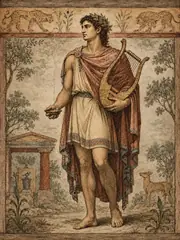
He was identified by the Romans with Apollo
The same god in other rooms
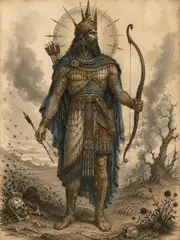
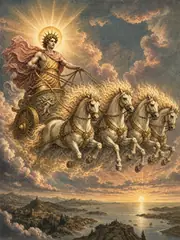
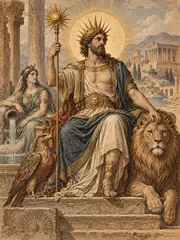
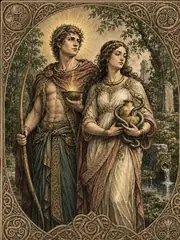
The ancient sources themselves name these as one god under different names. See Resheph, Helios, Apollo, Simios, Aplu, Belenos, Maponos and Grannus and Sirona hung together
When the sources speak
Dated witnesses for The Celtic Mythologies. A date marks when the evidence was written down, not when the belief began. The whole timeline
- 2nd–1st millennia BCE
- Indo-European language dispersals and regional Bronze Age cultures provide a remote comparative background, not a recoverable common canon.
- c. 500 BCE–1 CE
- Iron Age material culture, names, sanctuaries, and classical ethnography offer early but external evidence for Celtic and Germanic religions.
- 1st–4th centuries CE
- Roman inscriptions and provincial cults preserve many Celtic, Germanic, and local divine names.
- 4th–8th centuries CE
- Migration-period and early medieval conversion transform ritual institutions while heroic traditions continue.
- 8th–11th centuries CE
- Viking Age poetry, runic evidence, archaeology, and Scandinavian conversion form the core context of Norse myth.
- 9th–12th centuries CE
- Slavic, Baltic, and Finnic traditions enter chronicles and missionary accounts, often through hostile observers.
- 11th–14th centuries CE
- Irish, Welsh, and Icelandic manuscripts preserve major narrative corpora in Christian literary environments.
- 12th–16th centuries CE
- Saxo, saga compilers, Baltic chroniclers, and later antiquarians systematize or reinterpret older material.