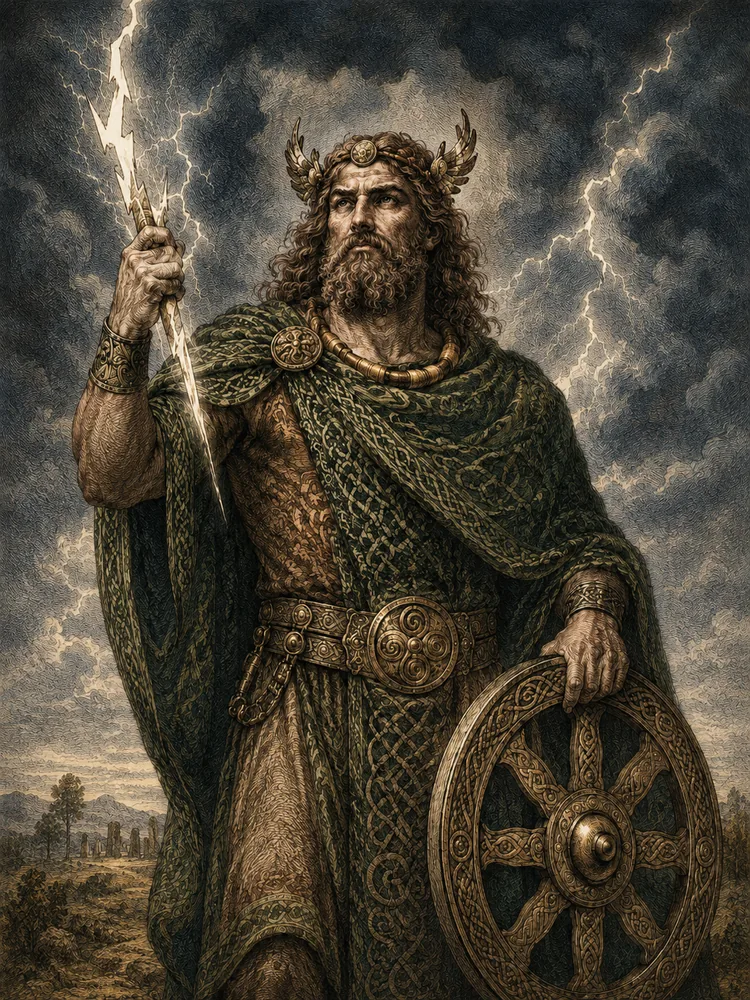
Taranis ("the Thunderer," from Gaulish *taran-, "thunder") was the Gaulish god of thunder and the sky, named by Lucan in the Pharsalia (1.444) as one of the three principal Gaulish gods alongside Esus and Teutates. His attribute was the wheel — a peculiar iconographic feature of his cult, with small wheel-amulets recovered from Celtic burial sites, and the great Gundestrup Cauldron showing a wheel-bearing god who has been identified as Taranis. The wheel may have represented thunder (the rolling sound) or the solar disk (Taranis being identified by some Roman commentators with Jupiter, who had both thunder and sky associations). The Romans identified Taranis with Jupiter; Lucan reports a particularly grim Gaulish cult-practice in which sacrificial victims were burned alive in great wicker effigies for Taranis — an account that has had its own modern reception (the term "wicker man" derives from Caesar's similar report at Bellum Gallicum 6.16, possibly itself the source of Lucan's testimony).
 Before thisBelenos
 Next on the wallTeutates
Curator’s note
What the sources say, and what later tradition added. The sources for this bay
Lucan, Pharsalia 1.444–445; Caesar, Bellum Gallicum 6.16 (the wicker-man); various Roman-period inscriptions to Iupiter Taranucus, Iupiter Taranis. The wheel-iconography is widespread in Gaulish votive deposits. Modern scholarship: Maier, Dictionary of Celtic Religion and Culture (1997). The historicity of large-scale Gaulish human sacrifice is debated; it is consistent with Roman-period testimony but the Romans had political reasons to portray the Gauls as barbaric, and modern archaeology has found some confirmation but not on the scale Lucan suggests.
Kin in the sources
Each tie is quoted from the entry that states it.
 Companion ofEsus
as one of the three principal Gaulish gods alongside Esus and Teutates
- Companion ofTeutates
as one of the three principal Gaulish gods alongside Esus and Teutates
When the sources speak
Dated witnesses for The Celtic Mythologies. A date marks when the evidence was written down, not when the belief began. The whole timeline
- 2nd–1st millennia BCE
- Indo-European language dispersals and regional Bronze Age cultures provide a remote comparative background, not a recoverable common canon.
- c. 500 BCE–1 CE
- Iron Age material culture, names, sanctuaries, and classical ethnography offer early but external evidence for Celtic and Germanic religions.
- 1st–4th centuries CE
- Roman inscriptions and provincial cults preserve many Celtic, Germanic, and local divine names.
- 4th–8th centuries CE
- Migration-period and early medieval conversion transform ritual institutions while heroic traditions continue.
- 8th–11th centuries CE
- Viking Age poetry, runic evidence, archaeology, and Scandinavian conversion form the core context of Norse myth.
- 9th–12th centuries CE
- Slavic, Baltic, and Finnic traditions enter chronicles and missionary accounts, often through hostile observers.
- 11th–14th centuries CE
- Irish, Welsh, and Icelandic manuscripts preserve major narrative corpora in Christian literary environments.
- 12th–16th centuries CE
- Saxo, saga compilers, Baltic chroniclers, and later antiquarians systematize or reinterpret older material.