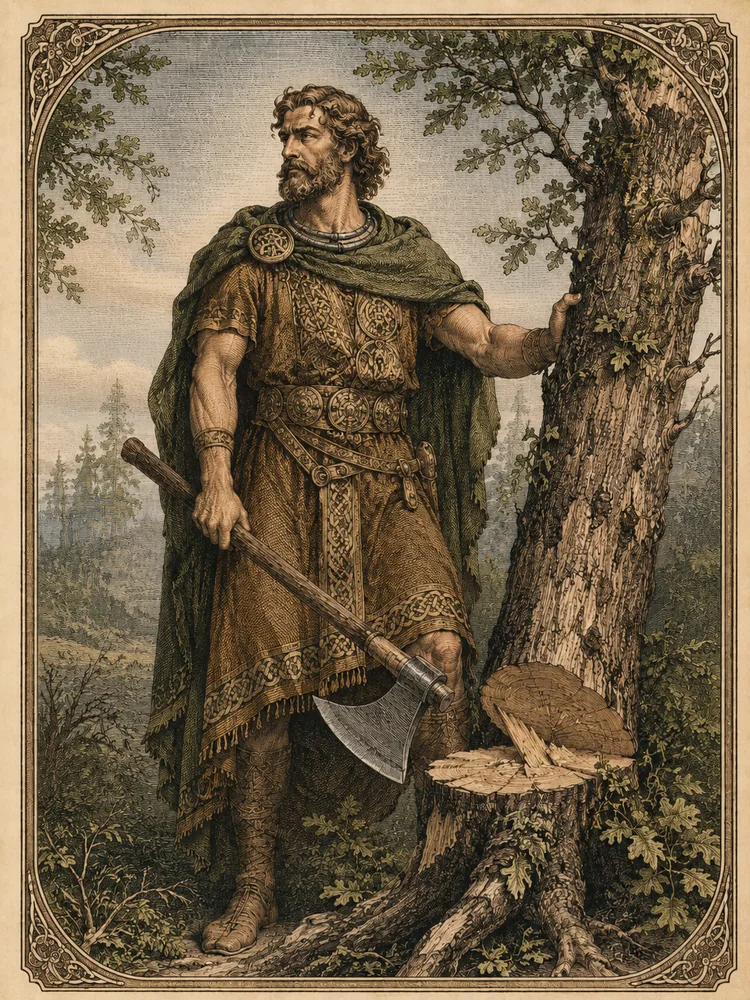
Esus was the third of Lucan's named Gaulish gods (Pharsalia 1.444), depicted on the Pillar of the Boatmen (Paris, 1st c. CE) and on a relief from Trier as a bearded woodsman cutting down a willow tree, with a bull and three cranes (or herons) in the branches above him. The image has been the subject of much modern interpretation; the iconography of bull-with-three-cranes (Tarvos Trigaranos, attested in a separate inscription) suggests a connected myth involving the felling of a tree under which a bull and three birds had gathered. The full narrative is irrecoverable; what survives is the iconographic complex and Lucan's bare naming of the god. The Roman-period scholiasts associated Esus with hanging-sacrifices, which has invited comparison with Odin's hanging on the World-Tree (treated above), but the comparison is suggestive rather than securely established.
 Before thisTeutates
 Next on the wallSucellus
Curator’s note
What the sources say, and what later tradition added. The sources for this bay
Lucan, Pharsalia 1.444; Pillar of the Boatmen (Paris, 1st c. CE, now in the Cluny Museum); the Trier relief. The Esus-Odin comparison is in Bonfante, "Esus-Odhinn" (1953) and in subsequent scholarship; the case is interesting but speculative. The Tarvos Trigaranos iconography is treated by Duval, Les dieux de la Gaule (1957).
Kin in the sources
Each tie is quoted from the entry that states it.
 Compared withOdin
which has invited comparison with Odin's hanging on the World-Tree
When the sources speak
Dated witnesses for The Celtic Mythologies. A date marks when the evidence was written down, not when the belief began. The whole timeline
- 2nd–1st millennia BCE
- Indo-European language dispersals and regional Bronze Age cultures provide a remote comparative background, not a recoverable common canon.
- c. 500 BCE–1 CE
- Iron Age material culture, names, sanctuaries, and classical ethnography offer early but external evidence for Celtic and Germanic religions.
- 1st–4th centuries CE
- Roman inscriptions and provincial cults preserve many Celtic, Germanic, and local divine names.
- 4th–8th centuries CE
- Migration-period and early medieval conversion transform ritual institutions while heroic traditions continue.
- 8th–11th centuries CE
- Viking Age poetry, runic evidence, archaeology, and Scandinavian conversion form the core context of Norse myth.
- 9th–12th centuries CE
- Slavic, Baltic, and Finnic traditions enter chronicles and missionary accounts, often through hostile observers.
- 11th–14th centuries CE
- Irish, Welsh, and Icelandic manuscripts preserve major narrative corpora in Christian literary environments.
- 12th–16th centuries CE
- Saxo, saga compilers, Baltic chroniclers, and later antiquarians systematize or reinterpret older material.