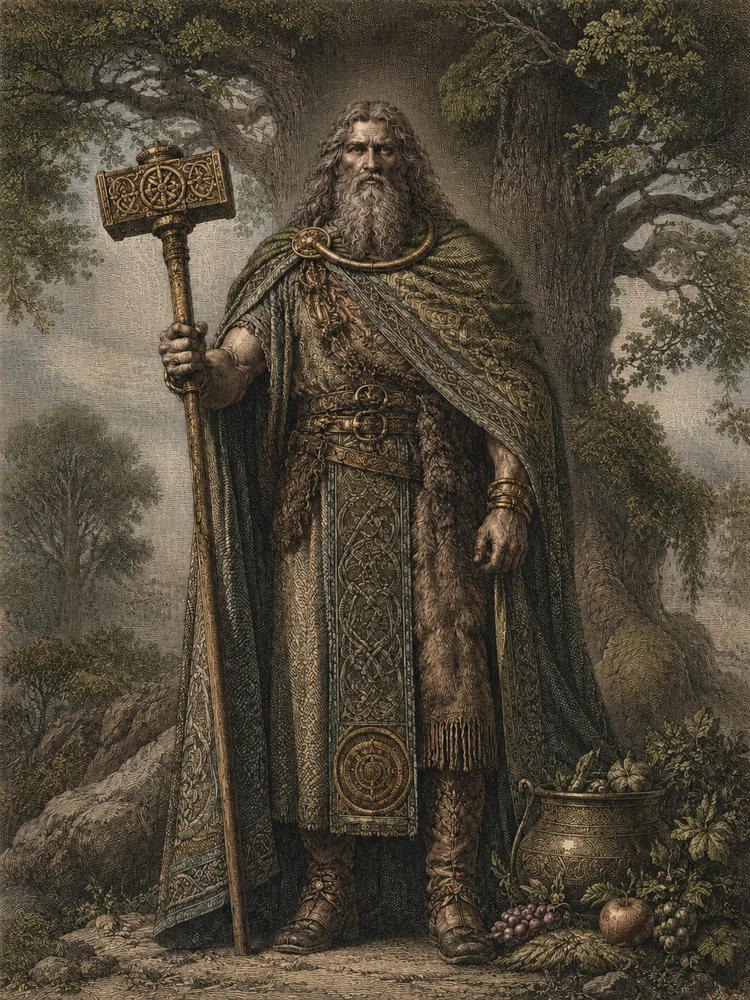
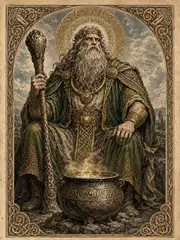
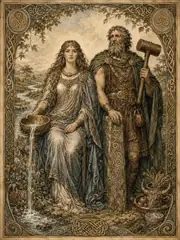
Sucellus ("the Good Striker," from Gaulish *su-cellos) was the hammer-bearing father-god of the Gaulish pantheon, attested in many Romano-Gallic statues and inscriptions, depicted as a bearded mature man holding a long-handled hammer (sometimes mallet-headed) in one hand and a small barrel or olla (a vessel) in the other, often accompanied by a goddess Nantosvelta. He was identified by the Roman interpretatio with various Roman gods — Silvanus, Dis Pater, sometimes Jupiter — but his iconography was distinctively Gaulish and not directly paralleled in any Roman cult. He has been compared with the Irish Dagda (similarly hammer-equivalent — the Dagda had his great club rather than hammer, but the function as father-god with a great striking implement is parallel), and the case for an inherited Celtic father-god of this type is strong.
His cult appears to have been particularly strong in eastern Gaul and the Rhineland; over 200 attestations are known. No mythological narrative concerning him survives; we know him entirely from his iconography and his inscriptions.
When the sources speak
Dated witnesses for The Celtic Mythologies. A date marks when the evidence was written down, not when the belief began. The whole timeline
- 2nd–1st millennia BCE
- Indo-European language dispersals and regional Bronze Age cultures provide a remote comparative background, not a recoverable common canon.
- c. 500 BCE–1 CE
- Iron Age material culture, names, sanctuaries, and classical ethnography offer early but external evidence for Celtic and Germanic religions.
- 1st–4th centuries CE
- Roman inscriptions and provincial cults preserve many Celtic, Germanic, and local divine names.
- 4th–8th centuries CE
- Migration-period and early medieval conversion transform ritual institutions while heroic traditions continue.
- 8th–11th centuries CE
- Viking Age poetry, runic evidence, archaeology, and Scandinavian conversion form the core context of Norse myth.
- 9th–12th centuries CE
- Slavic, Baltic, and Finnic traditions enter chronicles and missionary accounts, often through hostile observers.
- 11th–14th centuries CE
- Irish, Welsh, and Icelandic manuscripts preserve major narrative corpora in Christian literary environments.
- 12th–16th centuries CE
- Saxo, saga compilers, Baltic chroniclers, and later antiquarians systematize or reinterpret older material.