A Compendium of the Ancient Gods
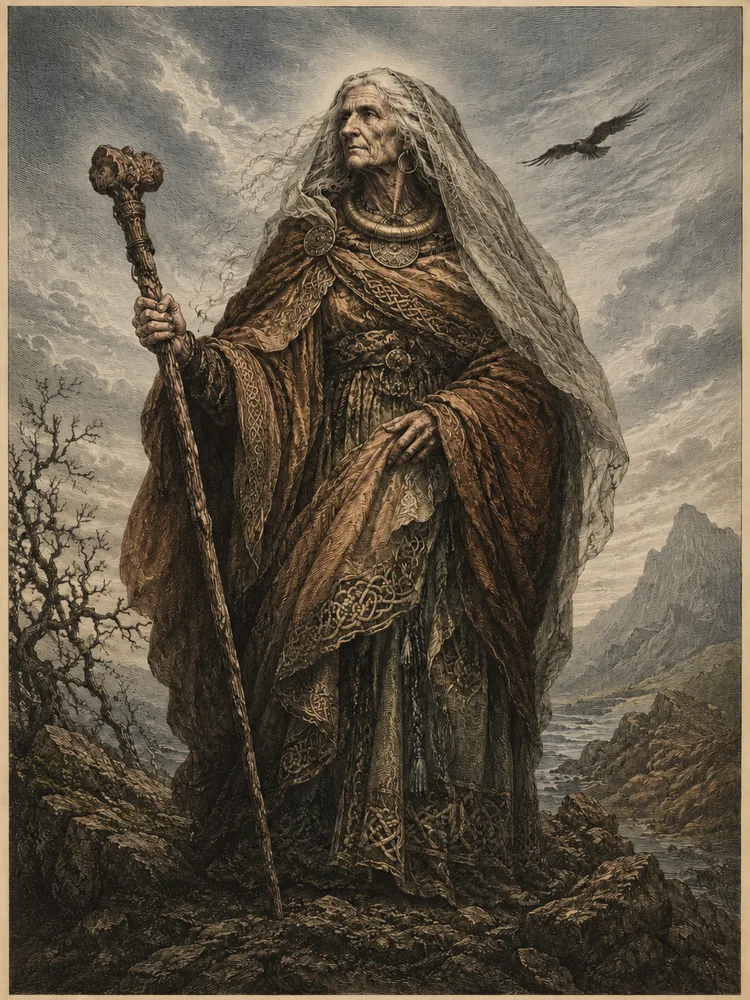
The Cailleach, plate

Older than the gods of the Tuatha Dé Danann, older than any named figure in the Celtic mythology, was the Cailleach — the Veiled One, the Old Hag, the Crone — who walked the hills of Ireland and Scotland in the first days, building the mountains as she went, dropping stones from her apron to make the standing-stones and burial-cairns that lay scattered across the land. Where she stepped, the earth was shaped; where she let fall a rock, a cairn rose; where she emptied her apron, a hill stood thereafter. She was the land itself in the form of an old woman.

The Cailleach was a goddess of winter. Each year she returned with the first frost, ruled the cold months, and held the world in her grip until the coming of Brigid at Imbolc (the first of February) drove her from the land. In some traditions, she became Brigid by drinking from the well of youth at the year's turning; in others, she remained the Cailleach throughout, but withdrew into the hills until autumn called her back. The two goddesses were thus aspects of one cycle: Brigid the bright spring, Cailleach the dark winter, the year revolving between them.

Many local Cailleachs were named in folklore: the Cailleach Bhéarra of West Cork, who lived through seven youths and seven old ages; the Cailleach Bhuidhe of the Scottish Highlands, who herded the deer; the Cailleach na Mointeach (the Old Woman of the Moors) on the Isle of Lewis. She was associated with particular mountains — Ben Nevis, the Paps of Anu in Kerry, Slieve Gullion. She washed her great tartan plaid in the Whirlpool of Corryvreckan between Jura and Scarba, and the noise of the wash was the autumn storms. The figure is one of the oldest and longest-surviving in the Celtic religious imagination, persisting in folk tradition until the twentieth century in remoter parts of Ireland and the Scottish Highlands.
Curator’s note

What the sources say, and what later tradition added. The sources for this bay

The Cailleach is documented in Irish and Scottish folk tradition collected from the seventeenth century onward; the Cailleach Bhéarra appears in the medieval Irish poem "The Lament of the Old Woman of Beare" (Ninth or tenth century) and in Mesca Ulad. The fullest scholarly treatment is Gearóid Ó Crualaoich, The Book of the Cailleach (2003). The figure has been read as a survival of pre-Celtic earth-goddess religion, as a personification of seasonal winter, and as the Celtic version of the broader Indo-European "old woman of the cosmos" type. The transformation Brigid-Cailleach at Imbolc is preserved in numerous folk customs that survived into the twentieth century, particularly the rite of weather divination on Brigid's Day (1 February) by which one judged whether the Cailleach's winter would be long.

Kin in the sources

Each tie is quoted from the entry that states it.

When the sources speak

Dated witnesses for The Celtic Mythologies. A date marks when the evidence was written down, not when the belief began. The whole timeline

2nd–1st millennia BCE
Indo-European language dispersals and regional Bronze Age cultures provide a remote comparative background, not a recoverable common canon.
c. 500 BCE–1 CE
Iron Age material culture, names, sanctuaries, and classical ethnography offer early but external evidence for Celtic and Germanic religions.
1st–4th centuries CE
Roman inscriptions and provincial cults preserve many Celtic, Germanic, and local divine names.
4th–8th centuries CE
Migration-period and early medieval conversion transform ritual institutions while heroic traditions continue.
8th–11th centuries CE
Viking Age poetry, runic evidence, archaeology, and Scandinavian conversion form the core context of Norse myth.
9th–12th centuries CE
Slavic, Baltic, and Finnic traditions enter chronicles and missionary accounts, often through hostile observers.
11th–14th centuries CE
Irish, Welsh, and Icelandic manuscripts preserve major narrative corpora in Christian literary environments.
12th–16th centuries CE
Saxo, saga compilers, Baltic chroniclers, and later antiquarians systematize or reinterpret older material.

Floor plan

The rooms follow one another in the order their peoples first appear in the written record.

  1. The Cradle of Citiesc. 3400 BCE to 395 CE. 115 works
  2. The Gift of the Nilec. 4000 BCE to 395 CE. 73 works
  3. The Olympian Orderc. 1600 BCE to 750 CE. 152 works
  4. The Persian Worldc. 2000 BCE to 1010 CE. 30 works
  5. The Levantine Borderlandsc. 1200 BCE to 500 CE. 20 works
  6. The Edges of Empirec. 2000 BCE to 1500 CE. 33 works
  7. The Etruscan Worldc. 900 BCE to 750 CE. 22 works
  8. The Roman Inheritancec. 1200 BCE to 500 CE. 58 works
  9. The Northern Inheritancec. 2000 BCE to 1600 CE. 131 works