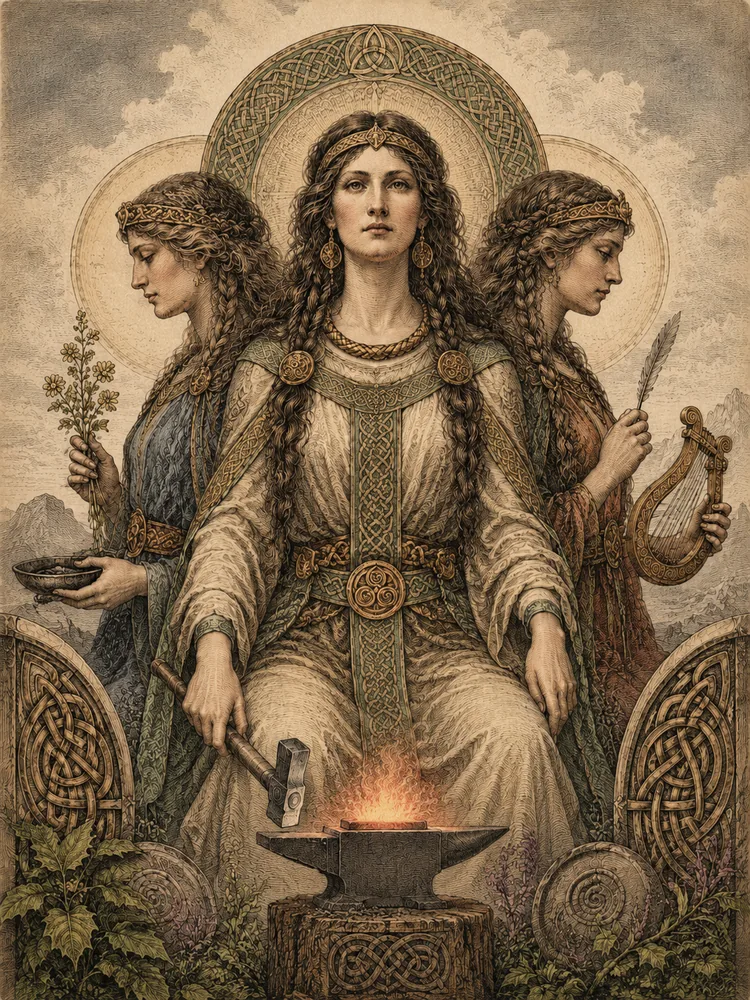
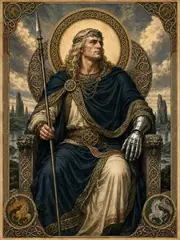
Brigid ("the Exalted One," sometimes spelled Brigit, Brighid; in modern Irish Bríd) was the goddess of smithcraft, of healing, and of poetry — three offices that the Irish tradition treated as a single complex, the three crafts that produced what was best made and most permanent in human existence. She was a daughter of the Dagda. She was, by Cormac's Glossary (a 10th-century lexicographical compilation), a triple goddess — three sisters all named Brigid, presiding respectively over poetry, healing, and metalwork — though the more usual treatment is of one goddess with three offices.
Her cult passed remarkably smoothly into the Christian period through the figure of Saint Brigid of Kildare (c. 451–525, the date of her birth being February 1, the same as the goddess's festival of Imbolc, the spring quarter-day). The historical Saint Brigid was, by the testimony of her early hagiographers, a real Christian abbess; but her cult absorbed a great many features of the older goddess (the perpetual flame at her abbey, tended by nineteen nuns and the saint herself; the association with healing wells; the dedication of Imbolc as her feast-day; many local traditions of milk and butter and weather-divination). The two Brigids are now nearly impossible to disentangle; the Christian saint and the pagan goddess have in folk practice been a single continuous figure for fifteen centuries, with the religious overlay shifting beneath the cult-survivals.