A Compendium of the Ancient Gods
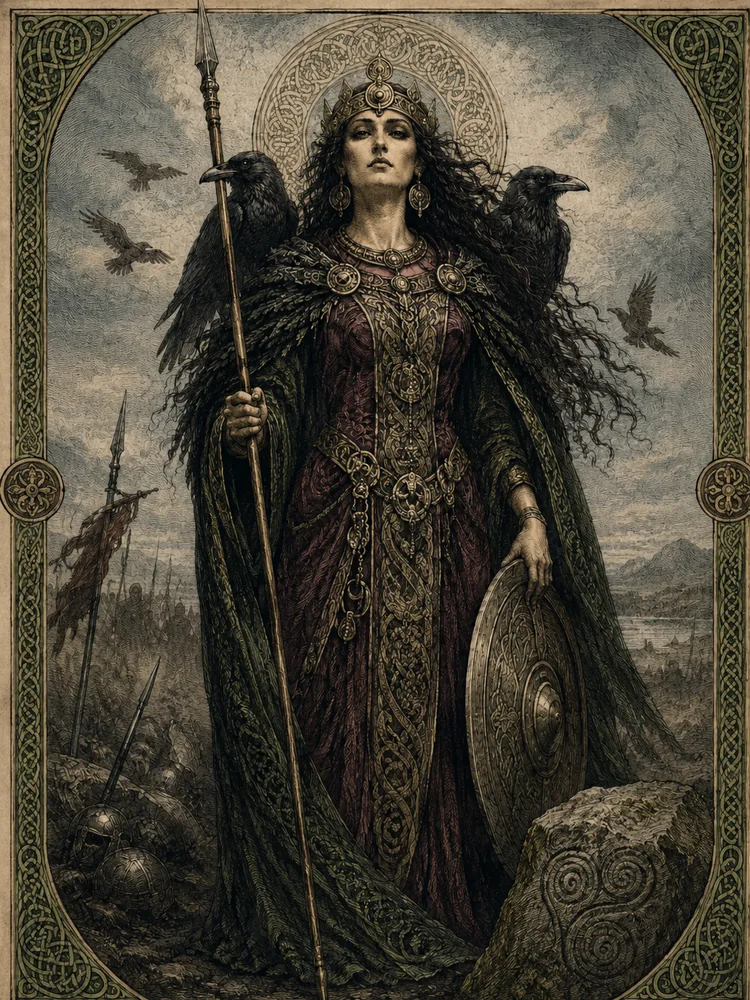
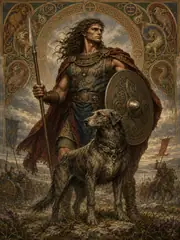
Morrígan, plate

The Morrígan ("the Phantom Queen" or "the Great Queen") was the Irish goddess of battle, of sovereignty (in a particular sense — sovereignty as represented by the goddess who married or selected each rightful king), and of prophetic vision. She often appeared in triple form, herself and two others (Badb and Macha; or, in some traditions, the three sisters Morrígan, Macha, and Nemain) — a triple-goddess pattern of considerable Indo-European antiquity. Her favored shapes were those of the crow, the eel, the wolf, and the heifer; she changed shape often in narrative, particularly when she encountered the great hero Cú Chulainn (treated below), with whom she had a complicated relationship: she desired him, was rejected, fought him, healed him, prophesied for him, and finally — at his death — perched in crow-form on his shoulder as the sign that he was indeed dead.

Her tryst with the Dagda before the Second Battle of Mag Tuired, told under the Dagda's entry above, illustrates her sovereignty-aspect: it is by her bestowal of favor (sexual, prophetic, military) that the Tuatha Dé win the battle. The figure of the goddess of sovereignty whose ritual marriage with the king secured his rule has been recovered by modern scholarship from many strands of Irish tradition (Gerald of Wales reports an Ulster king's literal mating with a white mare in his coronation, a procedure that the Irish themselves may have considered already long obsolete by Gerald's time, but that preserved the older pattern). The Morrígan's continental Gaulish parallels are uncertain; the Romano-British Cathubodua ("battle crow") attested in inscriptions corresponds to one element of her complex.
Curator’s note

What the sources say, and what later tradition added. The sources for this bay

The principal sources are the Ulster Cycle (especially the Táin Bó Cúailnge) and Cath Maige Tuired. The triple-goddess pattern is established in modern scholarship (W. M. Hennessy, "The Ancient Irish Goddess of War," 1870, was foundational). Gerald of Wales's report of the Ulster king-and-mare ritual is in his Topographia Hibernica 3.25 (c. 1185); whether his account preserves a genuine memory or is anti-Irish polemical fantasy has been debated.

Kin in the sources

Each tie is quoted from the entry that states it.

When the sources speak

Dated witnesses for The Celtic Mythologies. A date marks when the evidence was written down, not when the belief began. The whole timeline

2nd–1st millennia BCE
Indo-European language dispersals and regional Bronze Age cultures provide a remote comparative background, not a recoverable common canon.
c. 500 BCE–1 CE
Iron Age material culture, names, sanctuaries, and classical ethnography offer early but external evidence for Celtic and Germanic religions.
1st–4th centuries CE
Roman inscriptions and provincial cults preserve many Celtic, Germanic, and local divine names.
4th–8th centuries CE
Migration-period and early medieval conversion transform ritual institutions while heroic traditions continue.
8th–11th centuries CE
Viking Age poetry, runic evidence, archaeology, and Scandinavian conversion form the core context of Norse myth.
9th–12th centuries CE
Slavic, Baltic, and Finnic traditions enter chronicles and missionary accounts, often through hostile observers.
11th–14th centuries CE
Irish, Welsh, and Icelandic manuscripts preserve major narrative corpora in Christian literary environments.
12th–16th centuries CE
Saxo, saga compilers, Baltic chroniclers, and later antiquarians systematize or reinterpret older material.

Floor plan

The rooms follow one another in the order their peoples first appear in the written record.

  1. The Cradle of Citiesc. 3400 BCE to 395 CE. 115 works
  2. The Gift of the Nilec. 4000 BCE to 395 CE. 73 works
  3. The Olympian Orderc. 1600 BCE to 750 CE. 152 works
  4. The Persian Worldc. 2000 BCE to 1010 CE. 30 works
  5. The Levantine Borderlandsc. 1200 BCE to 500 CE. 20 works
  6. The Edges of Empirec. 2000 BCE to 1500 CE. 33 works
  7. The Etruscan Worldc. 900 BCE to 750 CE. 22 works
  8. The Roman Inheritancec. 1200 BCE to 500 CE. 58 works
  9. The Northern Inheritancec. 2000 BCE to 1600 CE. 131 works