A Compendium of the Ancient Gods
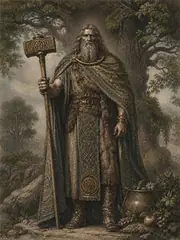
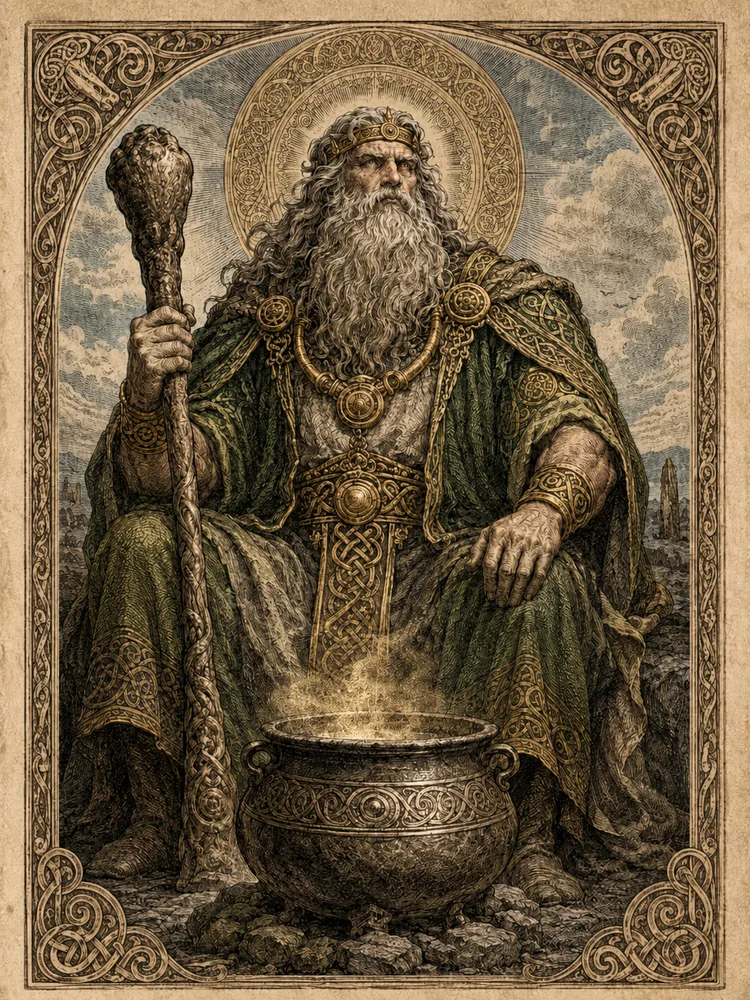
Dagda, plate

The Dagda ("the Good God," his name an epithet rather than a personal name; he was also called Eochaid Ollathair, "Eochaid the Allfather") was the principal male god of the Tuatha Dé Danann, the great-bellied, prodigiously-strong, druidic-wisdom-bearing king of the divine race. He was the husband of the Morrígan and father of (among others) Brigid, Aengus the love-god, and the warrior Cermait. He had three great possessions: the cauldron Coire Ansic, from which no company ever went unsatisfied (the prototype of the western tradition's many cauldrons of plenty, descended ultimately to the Holy Grail); the great club Lorg Mór, which killed nine men with one end and resurrected them with the other; and the harp Uaithne, which played itself when called and could induce sleep, weeping, or laughter according to the music's mode.

He had a famous tryst with the Morrígan at the river Unius before the Second Battle of Mag Tuired, the great battle in which the Tuatha Dé defeated the Fomorians (their monstrous enemies). The Morrígan promised her assistance in the battle and, having promised, gave her favors to the Dagda; the prophesied victory followed. The Dagda's character was a mixture of the dignified and the comic; he was both the august Allfather of his race and the great-bellied god whose appetites — culinary, sexual — were the matter of frequent humorous narrative. The earliest medieval texts seem reasonably comfortable with this combination, though later Christian editors sometimes treat the Dagda's earthier aspects with embarrassment.
Curator’s note

What the sources say, and what later tradition added. The sources for this bay

The principal source is Cath Maige Tuired (The Second Battle of Mag Tuired, 11th-c. manuscript redaction of older material). Whitley Stokes's edition and translation (Revue Celtique 12, 1891) is the standard. The Dagda's continental Gaulish equivalent has been variously identified — sometimes with Sucellus, the hammer-bearing god (treated below) — but the case is not certain.

Kin in the sources

Each tie is quoted from the entry that states it.

When the sources speak

Dated witnesses for The Celtic Mythologies. A date marks when the evidence was written down, not when the belief began. The whole timeline

2nd–1st millennia BCE
Indo-European language dispersals and regional Bronze Age cultures provide a remote comparative background, not a recoverable common canon.
c. 500 BCE–1 CE
Iron Age material culture, names, sanctuaries, and classical ethnography offer early but external evidence for Celtic and Germanic religions.
1st–4th centuries CE
Roman inscriptions and provincial cults preserve many Celtic, Germanic, and local divine names.
4th–8th centuries CE
Migration-period and early medieval conversion transform ritual institutions while heroic traditions continue.
8th–11th centuries CE
Viking Age poetry, runic evidence, archaeology, and Scandinavian conversion form the core context of Norse myth.
9th–12th centuries CE
Slavic, Baltic, and Finnic traditions enter chronicles and missionary accounts, often through hostile observers.
11th–14th centuries CE
Irish, Welsh, and Icelandic manuscripts preserve major narrative corpora in Christian literary environments.
12th–16th centuries CE
Saxo, saga compilers, Baltic chroniclers, and later antiquarians systematize or reinterpret older material.

Floor plan

The rooms follow one another in the order their peoples first appear in the written record.

  1. The Cradle of Citiesc. 3400 BCE to 395 CE. 115 works
  2. The Gift of the Nilec. 4000 BCE to 395 CE. 73 works
  3. The Olympian Orderc. 1600 BCE to 750 CE. 152 works
  4. The Persian Worldc. 2000 BCE to 1010 CE. 30 works
  5. The Levantine Borderlandsc. 1200 BCE to 500 CE. 20 works
  6. The Edges of Empirec. 2000 BCE to 1500 CE. 33 works
  7. The Etruscan Worldc. 900 BCE to 750 CE. 22 works
  8. The Roman Inheritancec. 1200 BCE to 500 CE. 58 works
  9. The Northern Inheritancec. 2000 BCE to 1600 CE. 131 works