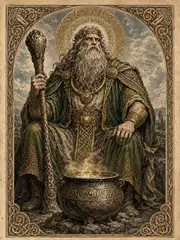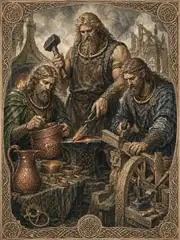
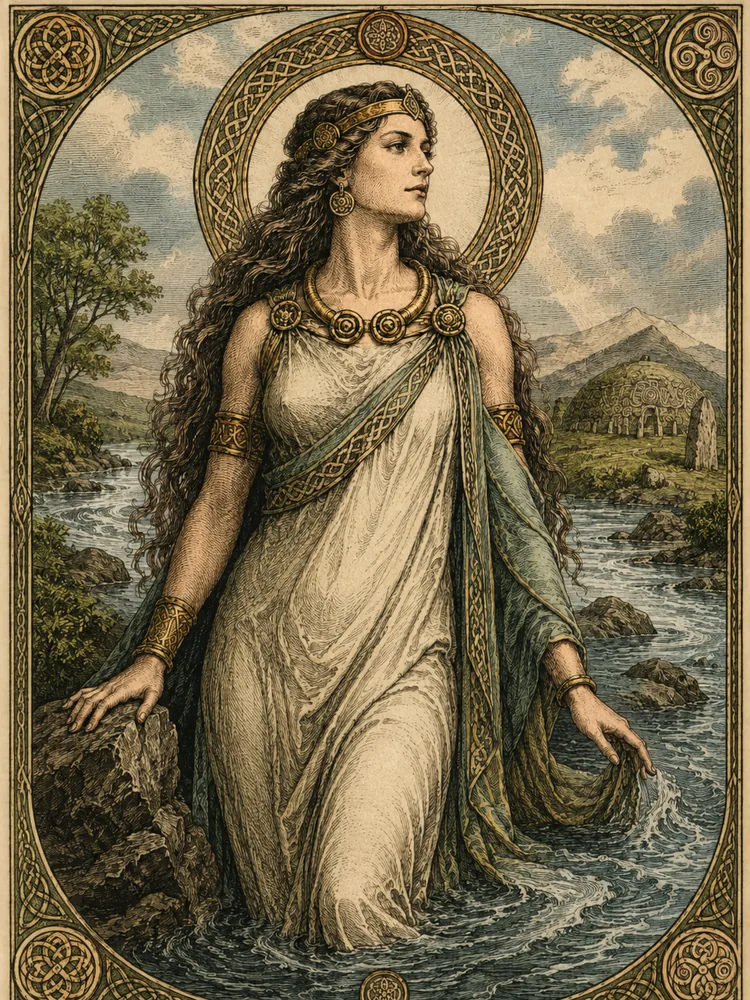
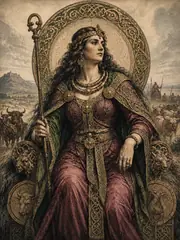
Boann was a goddess of the Tuatha Dé Danann, wife of the smith Elcmar (or, in some versions, the river-god Nechtan), and lover of the Dagda. By the Dagda she conceived a son, Aengus Óg, the god of love. To conceal the conception from her husband, the Dagda used his power as lord of the seasons to keep the sun standing in the sky for nine months; what seemed a single day to Elcmar was the whole period of Boann's pregnancy, and Aengus was born without his foster-father knowing.
Boann came afterward to the Well of Segais, the source of all wisdom, in the realm of her husband Nechtan, who alone might approach it. The well was guarded by hazel-trees, whose nuts dropped into its water and were eaten by salmon — the salmon of wisdom — that swam in the well. Boann walked widdershins (against the direction of the sun) around the well to break the tabu, and the well rose up against her in a great surge, bearing her away. She fled before the rising water, but the water followed her; her thigh, hand, and eye were taken from her by the chasing flood. Where the water flowed, it became the river Boyne, which still bears her name; and Boann lived afterward as the river itself, the goddess become the water she had transgressed against.
The Boyne is the river of the great Neolithic passage-tomb at Brú na Bóinne (Newgrange), which the medieval Irish identified as the home of the Dagda and Boann's son Aengus. The geography of the Boyne valley is thus one of the oldest sacred landscapes of Ireland, sanctified by its goddess-river before the coming of the Celts and continuing under Celtic interpretation through the entire medieval period.