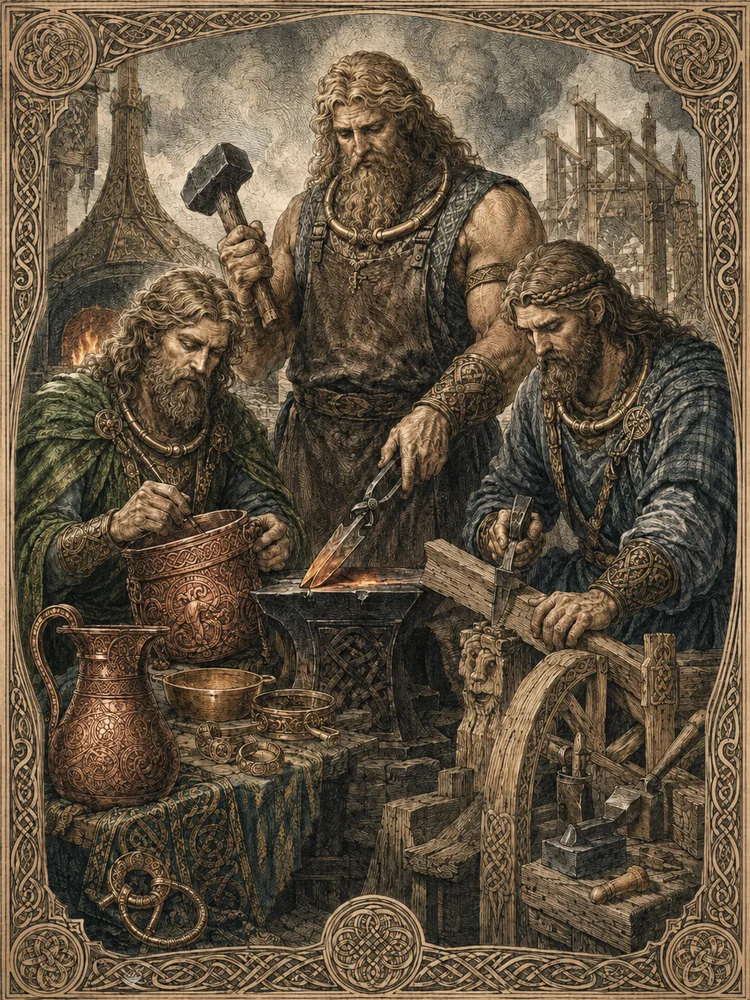
The three craftsmen of the Tuatha Dé Danann were Goibniu the smith, Credne the bronze-worker, and Luchta the wright, and together they made the weapons that won the Second Battle of Mag Tuired. Goibniu wrought the heads of spears with three blows of his hammer; Luchta cut the shafts with three strokes of his axe; Credne fitted the ferrules and rivets in three motions of his hand. So a complete weapon was made in nine motions of the three craftsmen working in concert, and the weapons of the Tuatha were so abundant in the battle that the Fomoiri could not stand against them.
Goibniu had also a further gift: he kept the Feast of Goibniu, at which the Tuatha drank ale that bestowed eternal youth and freedom from disease upon them, so that no warrior might grow old or sicken. The brewing of this ale was Goibniu's other craft — he was as much a brewer as a smith, and the two arts were felt by the Celts to be related, as workings upon transformative substances by fire. Luchta the wright is sometimes given the additional epithet Saoir, "the Carpenter," and was held to be the maker of all wooden objects of perfection. Credne, less famous, was the worker of bronze in particular and of the precious metals more generally; the gold and silver hoards of the Iron Age sites of Ireland were said by the medieval Irish to have been Credne's making.
The three were sometimes referred to collectively as the Trí Dée Dána, the Three Gods of Skill — though this title was also applied to other triads, including the sons of Tuirenn (Brian, Iuchar, and Iucharba). Their craftsmen-status places them in a wider Indo-European pattern of divine smiths and artisans: the Vedic Tvashtri, the Greek Hephaestus, the Norse Wayland, the Roman Vulcan. Goibniu in particular, with his magic ale and his role as forger of perfect weapons, seems to be a regional reflex of an old Indo-European smith-deity.