A Compendium of the Ancient Gods
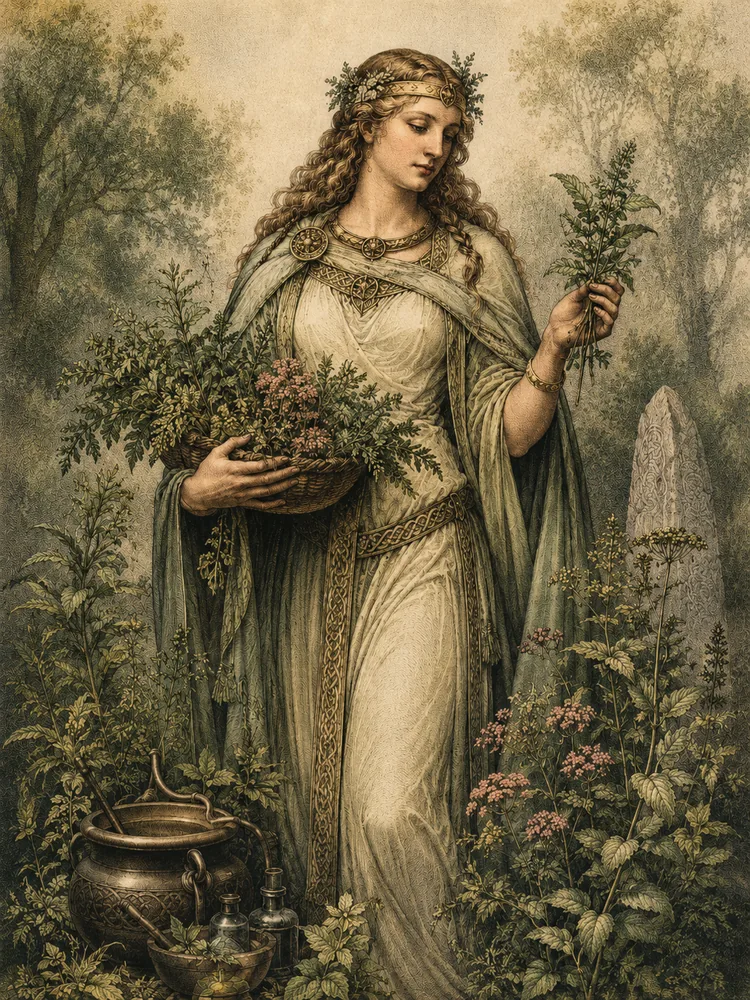
Airmed, plate

Airmed was the daughter of Dian Cécht and the sister of Miach. After her brother's murder by their jealous father, Airmed wept upon his grave; and from her tears, or from the body itself, three hundred and sixty-five herbs sprang up, each a healing herb, each marking a different joint or organ of the body that it would cure. Airmed gathered them all carefully, arranging them upon her green cloak according to their proper places — the herb for the eye in one position, the herb for the heart in another, the herb for the bone in a third — so that all the medical knowledge of the world might be preserved.

Then Dian Cécht, still in his jealousy, came and overturned the cloak. The herbs scattered, and their proper order was lost. So no man since has known the full medicine of the body; only those few herbs whose virtues Airmed had committed to memory before the cloak was upset survive in human knowledge. The rest are still upon the earth, but their meanings are forgotten, and we look at fields of healing-plants without knowing what they could do.

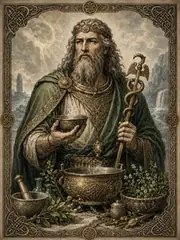
Airmed afterward kept her place among the Tuatha as one of the lesser physicians, working alongside her father (with whom, the saga does not say, she was reconciled or estranged). She presided over the Well of Slaine in some accounts, chanting the healing-spells over the dipped warriors. She is an unusual figure in the Celtic tradition: a goddess whose myth is one of an attempted preservation that failed, and who carries forever the memory of what was lost.
Curator’s note

What the sources say, and what later tradition added. The sources for this bay

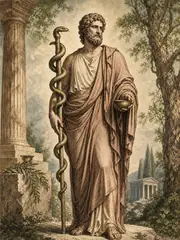
Airmed's herbs are described briefly in Cath Maige Tuired (the same saga as her father's). The detail of the cloak is not in all manuscript versions and may be a later embellishment, but it appears in the standard text printed by Whitley Stokes (1891). The motif of medicine-as-recovered-fragment, with the implication that whole healing knowledge once existed and has been lost, has parallels in many traditions; the Greek Asclepius's death by Zeus's thunderbolt for raising the dead, with the implication that medicine was thereby limited to its present scope, is a structural parallel.

Kin in the sources

Each tie is quoted from the entry that states it.

When the sources speak

Dated witnesses for The Celtic Mythologies. A date marks when the evidence was written down, not when the belief began. The whole timeline

2nd–1st millennia BCE
Indo-European language dispersals and regional Bronze Age cultures provide a remote comparative background, not a recoverable common canon.
c. 500 BCE–1 CE
Iron Age material culture, names, sanctuaries, and classical ethnography offer early but external evidence for Celtic and Germanic religions.
1st–4th centuries CE
Roman inscriptions and provincial cults preserve many Celtic, Germanic, and local divine names.
4th–8th centuries CE
Migration-period and early medieval conversion transform ritual institutions while heroic traditions continue.
8th–11th centuries CE
Viking Age poetry, runic evidence, archaeology, and Scandinavian conversion form the core context of Norse myth.
9th–12th centuries CE
Slavic, Baltic, and Finnic traditions enter chronicles and missionary accounts, often through hostile observers.
11th–14th centuries CE
Irish, Welsh, and Icelandic manuscripts preserve major narrative corpora in Christian literary environments.
12th–16th centuries CE
Saxo, saga compilers, Baltic chroniclers, and later antiquarians systematize or reinterpret older material.

Floor plan

The rooms follow one another in the order their peoples first appear in the written record.

  1. The Cradle of Citiesc. 3400 BCE to 395 CE. 115 works
  2. The Gift of the Nilec. 4000 BCE to 395 CE. 73 works
  3. The Olympian Orderc. 1600 BCE to 750 CE. 152 works
  4. The Persian Worldc. 2000 BCE to 1010 CE. 30 works
  5. The Levantine Borderlandsc. 1200 BCE to 500 CE. 20 works
  6. The Edges of Empirec. 2000 BCE to 1500 CE. 33 works
  7. The Etruscan Worldc. 900 BCE to 750 CE. 22 works
  8. The Roman Inheritancec. 1200 BCE to 500 CE. 58 works
  9. The Northern Inheritancec. 2000 BCE to 1600 CE. 131 works