A Compendium of the Ancient Gods
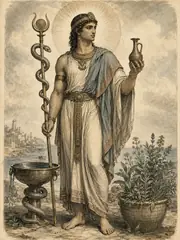
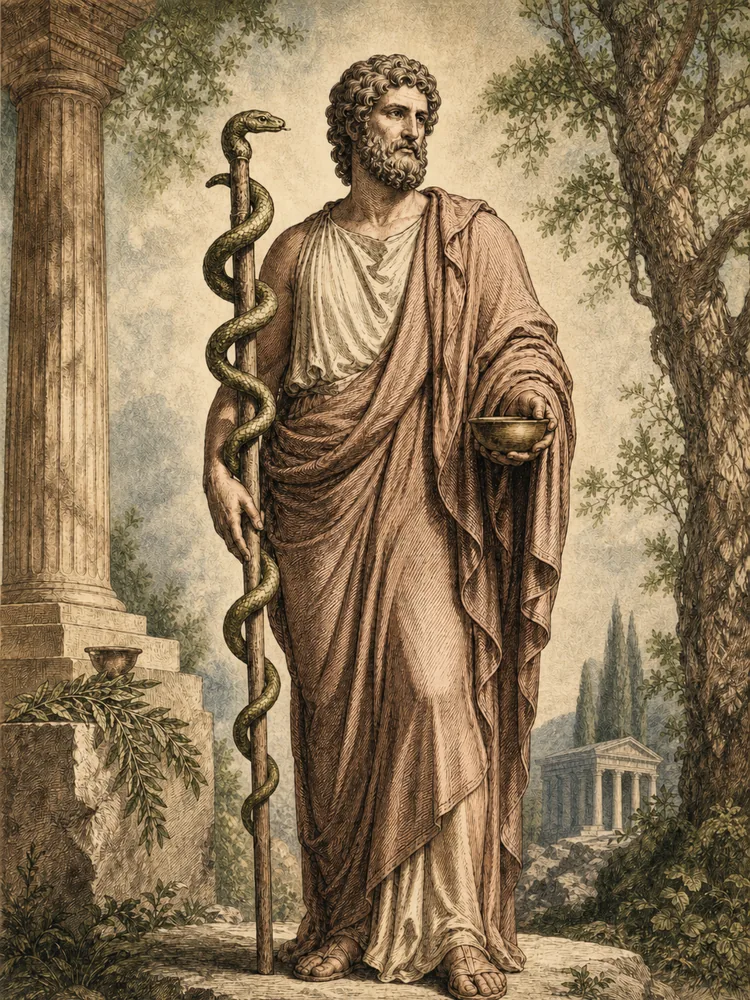
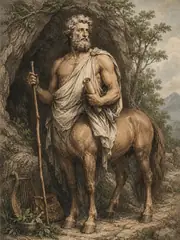
Asclepius, plate

Asclepius was a son of Apollo by the mortal Coronis; his mother died before his birth (struck by Artemis's arrows for her unfaithfulness to Apollo, having taken up with the mortal Ischys while pregnant by the god), but Apollo snatched the unborn child from her body on the funeral pyre and entrusted him to the wise centaur Chiron to be raised. From Chiron, Asclepius learned the healing arts, and he became the greatest physician the world had known — surpassing his teacher in skill, raising even the dead by means of the Gorgon's blood (which Athena had given him in two vials, that from one side of Medusa's body conferring death and from the other side life). His resurrection of mortals so disturbed the cosmic order — for if mortals could be brought back from the dead, Hades's realm would be depopulated and the boundary between gods and men would be effaced — that Zeus struck Asclepius with a thunderbolt to prevent the further dissolution. Apollo, in his grief and anger, killed the Cyclopes who had forged Zeus's thunderbolts (and was himself banished from Olympus for a year as punishment). Asclepius, after his death, was honored as a god of healing.

His cult, originally local (at Trikka in Thessaly, his supposed birthplace, and at Epidaurus in the Argolid, his most famous sanctuary), spread throughout the Greek and Roman world from the late fifth century BCE onward, and became one of the most widespread and beloved cults of antiquity. His sanctuaries — the Asklepieia — functioned as healing-shrines, where the sick came to spend the night in the abaton ("the place not to be entered" except by patients) in the practice of incubation: the patient slept, the god appeared in a dream, and the dream-prescription was followed by the temple-priests in the morning. The records of cures inscribed at Epidaurus, Pergamon, and elsewhere give a remarkable picture of ancient medicine and ancient hope. His sacred animal was the snake (the harmless yellow rat-snake, identified by zoologists as Zamenis longissimus, was kept in the Asklepieia and is still called the Aesculapian snake); his attribute was the serpent-twined staff that survives as the modern symbol of medicine. Hippocrates, the father of secular medicine in the late fifth century BCE, was reckoned a descendant of Asclepius and the rival schools of his island Cos and the Asklepieion's school at Cnidus contended for the leadership of Greek medical learning.
Curator’s note

What the sources say, and what later tradition added. The sources for this bay

Asclepius's birth and career are in Pindar, Pythian 3 (the principal early source); Apollodorus 3.10.3–4; Ovid, Metamorphoses 2.542–633 (the Coronis episode). The cult at Epidaurus is documented archaeologically (with extensive remains including the Tholos, the Abaton, the great theater) and in inscriptions (the Iamata, or healing-records, are particularly important). The arrival of Asclepius's cult at Athens in 420 BCE (during the great plague) and at Rome in 293 BCE are recorded events; the snake brought from Epidaurus to Rome in 293 was met by the Romans at the Tiber Island and there established the Roman Asclepius's principal sanctuary. The genuine medical tradition associated with the Asklepieia was substantial; Galen and other major ancient physicians had connections with these sanctuaries.

Kin in the sources

Each tie is quoted from the entry that states it.

The same god in other rooms

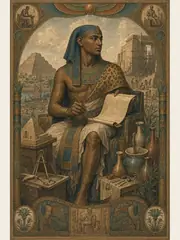
The ancient sources themselves name these as one god under different names. See Eshmun, Imhotep and Asclepius hung together

When the sources speak

Dated witnesses for The Sea, the Wild and the Wind. A date marks when the evidence was written down, not when the belief began. The whole timeline

c. 1600–1100 BCE
Mycenaean palace tablets in Linear B record offerings and divine names, but little continuous myth.
c. 1100–800 BCE
Post-palatial oral traditions and changing cult landscapes precede the surviving alphabetic epics.
late 8th–7th centuries BCE
The Iliad, Odyssey, Hesiodic Theogony and Works and Days give influential but non-exclusive divine orders.
7th–6th centuries BCE
Homeric Hymns, lyric poetry, colonization, and local sanctuary traditions multiply regional narratives.
6th–5th centuries BCE
Orphic, Pythagorean, and mystery materials develop alternative cosmogonies and afterlife doctrines.
5th century BCE
Athenian tragedy and comedy recast heroic houses and divine justice for civic audiences.
4th century BCE
Philosophers, antiquarians, and local historians interpret or criticize inherited myth.
323–31 BCE
Hellenistic poets and scholars systematize variants across an enlarged Greek world.

Floor plan

The rooms follow one another in the order their peoples first appear in the written record.

  1. The Cradle of Citiesc. 3400 BCE to 395 CE. 115 works
  2. The Gift of the Nilec. 4000 BCE to 395 CE. 73 works
  3. The Olympian Orderc. 1600 BCE to 750 CE. 152 works
  4. The Persian Worldc. 2000 BCE to 1010 CE. 30 works
  5. The Levantine Borderlandsc. 1200 BCE to 500 CE. 20 works
  6. The Edges of Empirec. 2000 BCE to 1500 CE. 33 works
  7. The Etruscan Worldc. 900 BCE to 750 CE. 22 works
  8. The Roman Inheritancec. 1200 BCE to 500 CE. 58 works
  9. The Northern Inheritancec. 2000 BCE to 1600 CE. 131 works