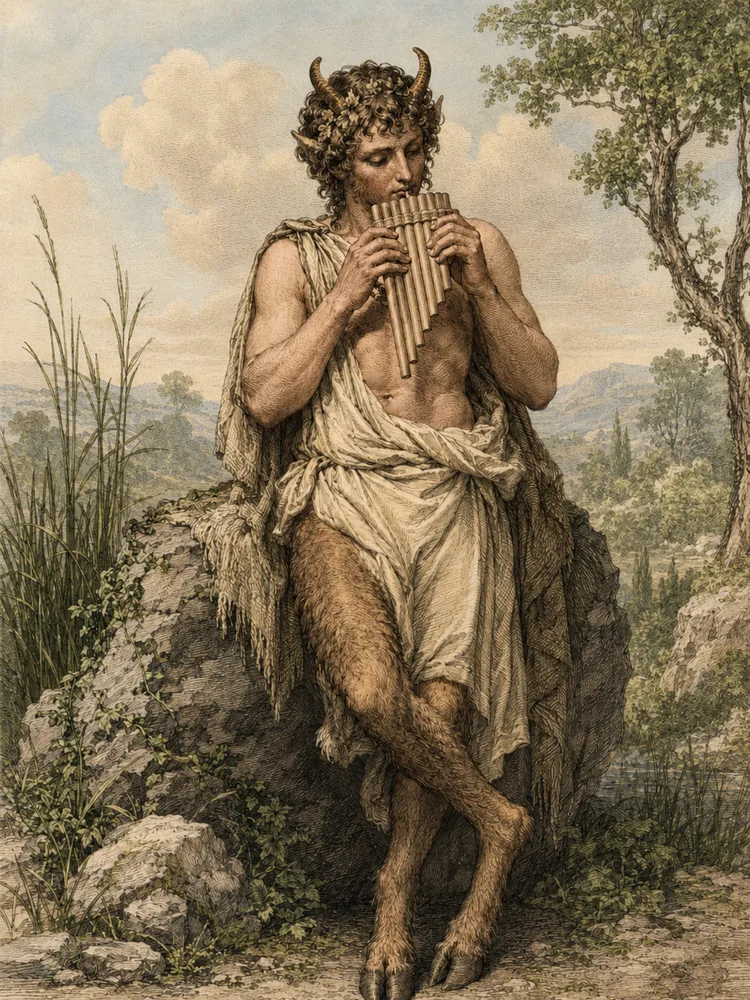
Pan was the god of pastures, of shepherds and goatherds, of wild and rocky places, of the mountainous interior of the Peloponnese (especially Arcadia, his proper home). He was a son of Hermes by various mothers (the nymph Dryope is most often given), and was born with the lower body and horns and ears of a goat — so unprepossessing in appearance that his mother fled at the sight of him, but Hermes wrapped him in a hare-skin and brought him up to Olympus where the gods (and especially Dionysus, with whose train Pan associated) found him delightful. He chased nymphs through the woods, played his syrinx (the panpipes — named for the nymph Syrinx, who in fleeing his pursuit was transformed into a bed of reeds, from which Pan made the instrument that bore her name), and was the bringer of "panic," the sudden inexplicable terror that fell upon men and herds in the lonely places (named for his power, and originally meaning the fear that Pan sent).
His cult was originally local to Arcadia, but it spread throughout Greece after the battle of Marathon in 490 BCE, when (as Herodotus tells us) the runner Pheidippides, on his way to Sparta to seek aid against the Persians, encountered Pan on Mount Parthenion; the god complained that the Athenians neglected him despite his goodwill toward them; Pheidippides reported the encounter; the Athenians, after their victory at Marathon, established Pan's cult on the Acropolis in gratitude. Thereafter Pan's small cave-shrines spread across the Greek mainland and the islands.
The most poignant Pan-narrative is also the strangest. The historian Plutarch, writing in the late first century of our era, reports a curious tale: in the time of Tiberius (early first century CE), a ship sailing from Greece to Italy was becalmed near the islands off Paxos, and the helmsman heard a great voice calling from the shore: "Tell them when you reach Palodes that the Great Pan is dead." The helmsman, when the ship came opposite Palodes, called out the message; and from the shore arose a great wailing, as of many voices in lamentation. The pagan reading was that one of the great gods had died (an unprecedented event); the Christian reading, current from at least the second century, was that the report dated from the moment of the Crucifixion and signaled the end of the pagan world. The truth of the report is unrecoverable; but the tale's combination of credulity and pathos, its glimpse of a religion sensing its own mortality, has retained its hold on the imagination for nineteen centuries.