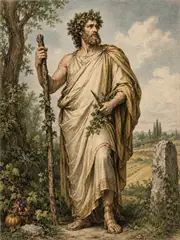
A Compendium of the Ancient Gods
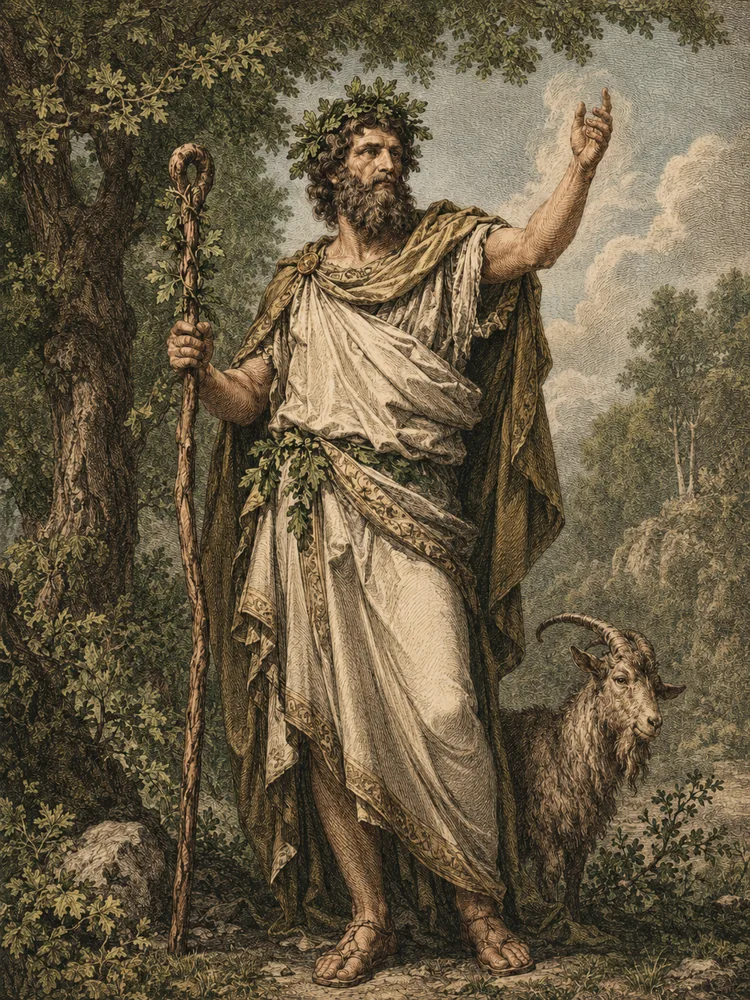
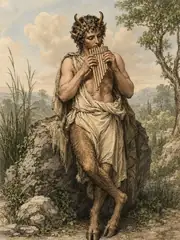
Faunus, plate

Faunus was the Italian god of the wild countryside — of woodland, of pasture, of the spirits of the forest — and was identified by the Romans with the Greek Pan, though his original Italic character was somewhat different. He was, in the Roman antiquarian genealogy, the grandson of Saturn (through Picus), the son of Picus and Canens, and the father of Latinus, the king of Latium who received Aeneas; he was thus made an ancestor of the Roman people by a constructive genealogy. He had two sides. As a wild-countryside god, he was the giver of fertility to flocks and the protector of shepherds; his festival the Lupercalia (February 15), one of the oldest Roman festivals, involved the sacrifice of goats and dogs at the Lupercal cave (where the she-wolf had suckled Romulus and Remus), and the running of priests called Luperci through the streets, naked but for goatskin loincloths, striking onlookers (especially women, who held it lucky) with strips of the sacrificial goat-hide. The festival's antiquity was proverbial; its rites were preserved into the late Empire and were finally suppressed only in 494 CE.

As a prophetic god, Faunus was less Pan-like and more distinctively Italian. He gave oracles in dreams; suppliants slept in his sacred grove on goatskins, hoping for prophecy; Vergil places one such consultation at the heart of the Aeneid, when Latinus consults his ancestor Faunus and is told that his daughter Lavinia must be given not to a local prince but to a foreign suitor (Aeneas). Faunus also gave audible prophecies in lonely places — the Greek panic of voices in the woods was, to a Roman, the voice of Faunus, and could be either ominous or auspicious as the listener interpreted it. He had a female counterpart, Fauna (or Faula), in some traditions his sister, in others his wife or daughter, sometimes identified with the Bona Dea of the women's mysteries (treated below).
Curator’s note

What the sources say, and what later tradition added. The sources for this bay

The principal sources are Vergil, Aeneid 7.81–106 (the consultation by Latinus); Ovid, Fasti 2.193–474 (the Lupercalia and the Faunus-and-Hercules tale); Horace, Odes 1.4, 1.17, 3.18 (Faunus in the lyric register); Livy 1.5 (the Lupercalia as oldest Roman festival). The Lupercalia's antiquity is generally accepted; its actual origin (Etruscan? Italic? Pre-Indo-European?) is debated. The 494 CE suppression was a famous late-pagan moment, recorded in the letters of Pope Gelasius I.

Kin in the sources

Each tie is quoted from the entry that states it.

The same god in other rooms

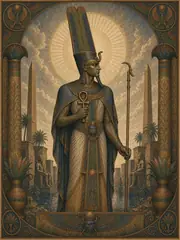
The ancient sources themselves name these as one god under different names. See Amun, Min, Pan and Faunus hung together

When the sources speak

Dated witnesses for The Indigenous Italic Gods. A date marks when the evidence was written down, not when the belief began. The whole timeline

c. 1000–750 BCE
Iron Age communities of Latium and neighboring peoples develop the cult landscapes later absorbed into Roman tradition.
traditional 753 BCE
Roman foundation chronology places Romulus and the first civic institutions at the beginning of the city’s sacred history.
traditional 7th–6th centuries BCE
The regal period is credited with priesthoods, calendars, temples, and the organization of public rites.
509–264 BCE
Republican expansion incorporates Latin, Sabine, Etruscan, and Italian cults through treaty, migration, and evocatio.
264–146 BCE
Mediterranean conquest accelerates Greek interpretation and the importation or redefinition of foreign gods.
204 BCE
The Magna Mater is formally brought from Pessinus during the Second Punic War.
1st century BCE
Varro, Cicero, and other antiquarians document rites and divine names amid civil war and institutional change.
27 BCE–14 CE
Augustan restoration monumentalizes selected ancestral cults and rewrites Roman sacred history.

Floor plan

The rooms follow one another in the order their peoples first appear in the written record.

  1. The Cradle of Citiesc. 3400 BCE to 395 CE. 115 works
  2. The Gift of the Nilec. 4000 BCE to 395 CE. 73 works
  3. The Olympian Orderc. 1600 BCE to 750 CE. 152 works
  4. The Persian Worldc. 2000 BCE to 1010 CE. 30 works
  5. The Levantine Borderlandsc. 1200 BCE to 500 CE. 20 works
  6. The Edges of Empirec. 2000 BCE to 1500 CE. 33 works
  7. The Etruscan Worldc. 900 BCE to 750 CE. 22 works
  8. The Roman Inheritancec. 1200 BCE to 500 CE. 58 works
  9. The Northern Inheritancec. 2000 BCE to 1600 CE. 131 works