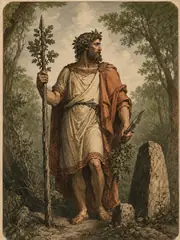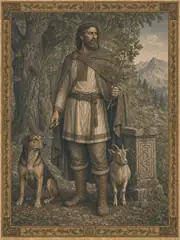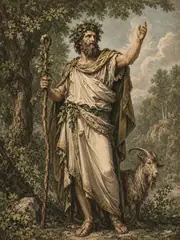
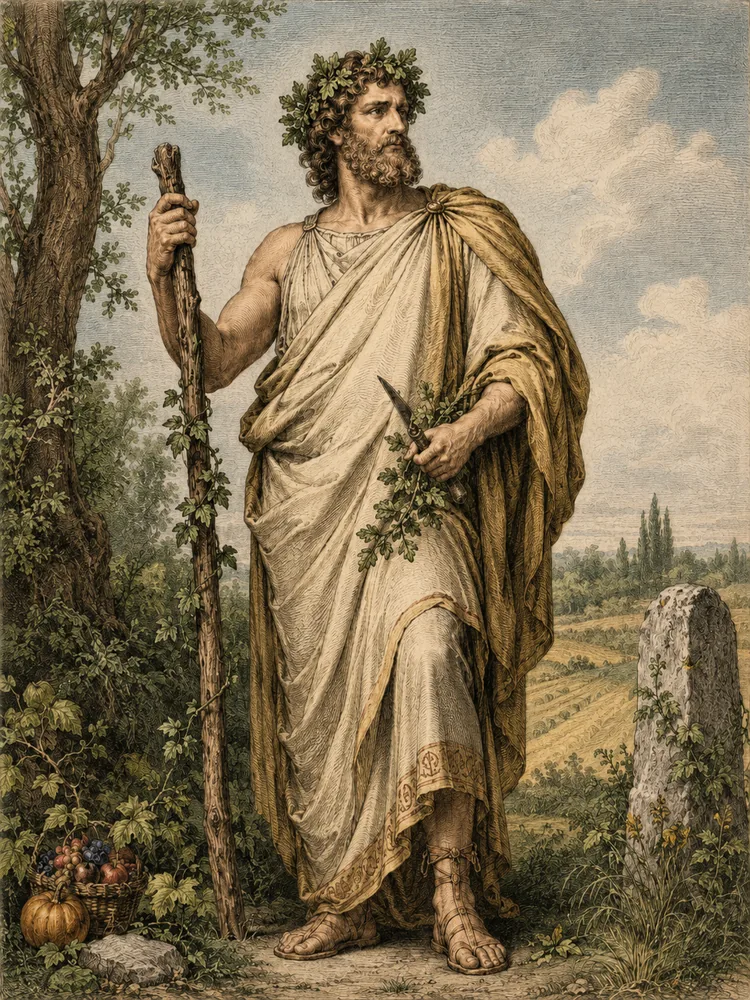

Silvanus was the god of woods and fields (his name comes from silva, "forest"), of cultivated borders, of the wild margins of human settlement. He was distinct from Faunus, though his domain overlapped: where Faunus was the wild god proper, Silvanus stood at the threshold between the wild and the cultivated, the boundary-divinity of the woodlot at the edge of the field, the orchard wall, the property-line where the worked land met the unworked. He had three traditional aspects — Silvanus domesticus (of the household and the cultivated land), Silvanus agrestis (of the fields and pastures), and Silvanus orientalis (of the wild forest) — and these triple aspects were honored together. He was depicted as a bearded countryman, often holding a pruning-knife or a young pine-tree, with a faithful dog at his side; he was the patron of foresters, woodcutters, and rural workers, and his cult was particularly strong in the provinces (where dedicatory inscriptions to Silvanus from the lower social orders survive in great numbers).
He had no developed narrative mythology in the Roman literary tradition; he was a god of cult rather than of story. His sacrifices were normally offered in the open air (his sex made him forbidden to women at his rites, whose participation would have offended his propriety); his offerings were milk, grapes, ears of grain, and the firstfruits of the harvest. He was a small god with a large following — the kind of deity whose modest cult sustained the practical religion of the countryside, far from the great urban temples of the major gods.