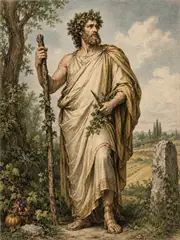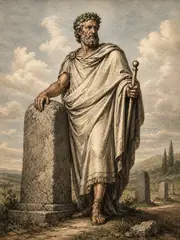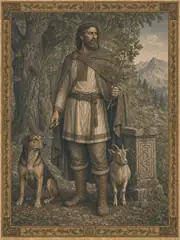
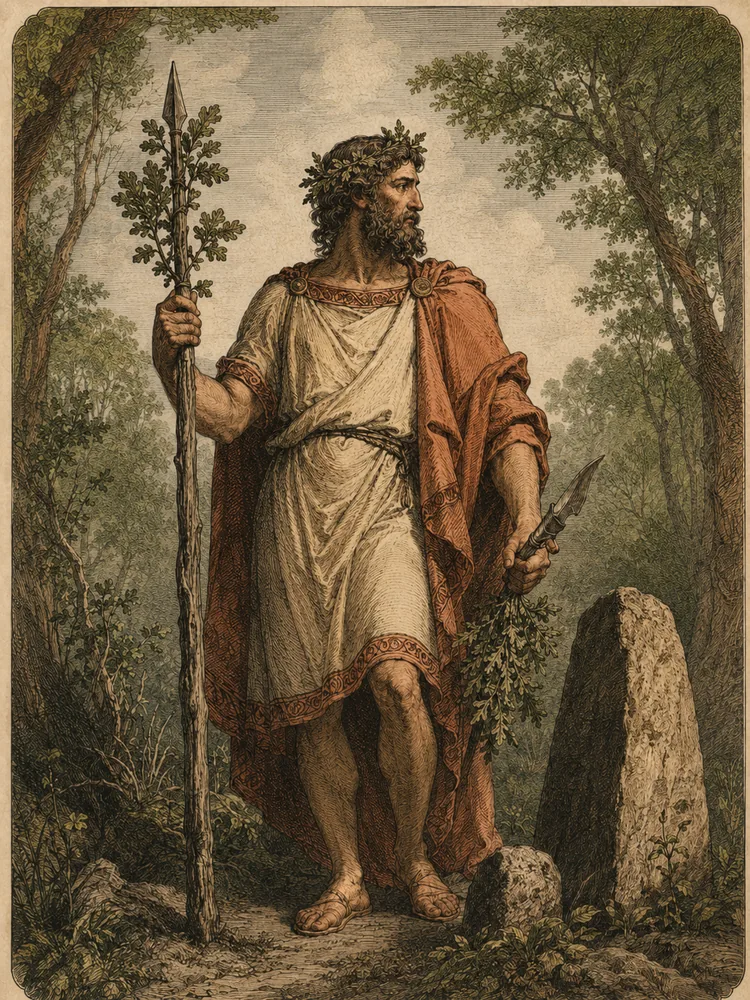
Selvans was the Etruscan god of forests, boundaries, and the wild edge between the cultivated land and the unbroken wilderness. He was the deity of those liminal spaces where the human world gave way to the world of nature; his images stood at the boundaries of fields and properties, and at the entrances to the great forests that covered much of central Italy in the early period. The Roman Silvanus is directly inherited from him; the name is the same, with only the Latin sound-shifts altering the form.
Selvans was depicted as a youthful, often unbearded man, wearing a wolfskin or other forest-garment, sometimes carrying a shepherd's staff or a billhook, sometimes accompanied by a dog. He had no great public temple — for his proper place was outside the cities, on the boundaries — but rather a network of small wayside shrines, each marking a particular sacred grove or boundary-tree or spring. The pious wayfarer would pause at such a shrine to make a small offering (a strip of cloth tied to a branch, a handful of fruit, a libation of milk) before continuing.
His worship was linked to the rite of the boundary-stone. When a property line was established, a stone was placed in the ground at the corner with offerings buried beneath it — burnt fruits, wine, and small votive objects, dedicated to Selvans (and sometimes to Terminus, the more specifically Roman boundary-deity). To move such a stone was the deepest of impieties, an offense against Selvans himself; ancient law-codes (preserved in Roman tradition but going back to Etruscan custom) made the moving of a boundary-stone a religious crime, punished by the offending property-owner being declared sacer — that is, devoted to the god whom he had offended, and so beyond the protection of human law.
After the Romanization, Selvans-Silvanus continued to be worshipped through the entire Roman period; he was particularly the deity of the Italian peasantry, less affected by Greek mythological influence than the great urban gods, and his rustic cult survived in folk practice well into the early Christian period. The medieval Italian forest-spirits (silvani, silvestri) descend in name from him directly, and the figure of the wild forest-man — half-human, half-bestial, dweller of the unbroken woods — preserves traces of the old Etruscan god into the modern era.