A Compendium of the Ancient Gods
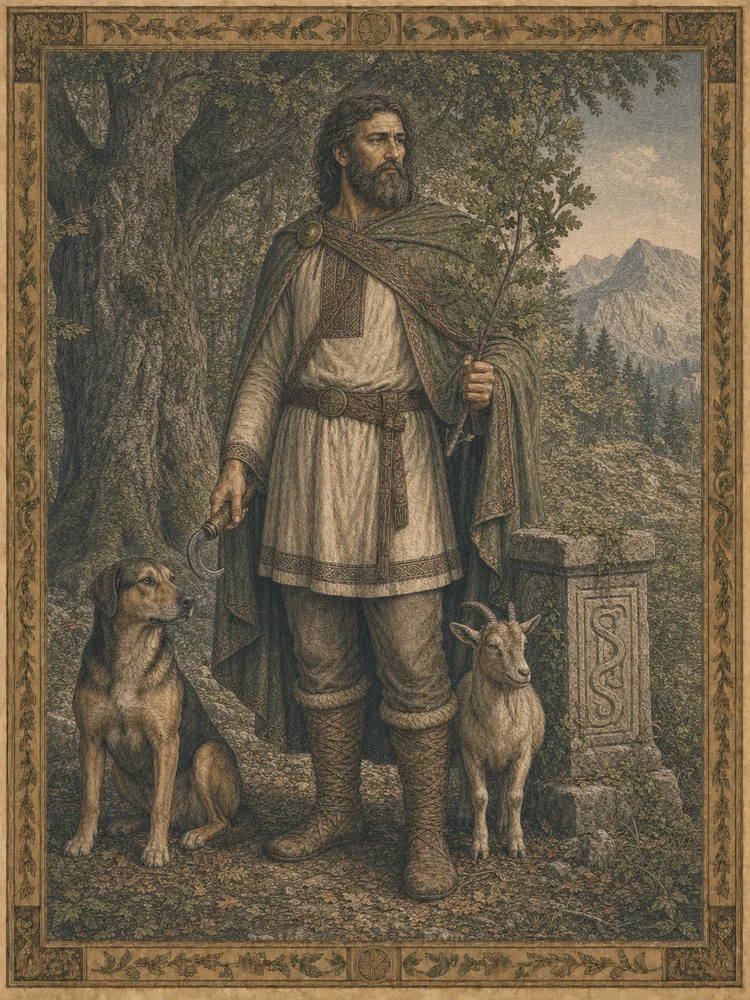
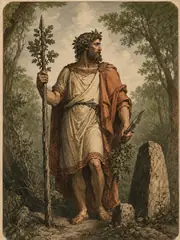
Vidasus, plate

Vidasus was an Illyrian forest-god, the deity of the wild and the wooded mountain country that covered much of the western Balkans before its modern deforestation. He was identified in Roman inscriptions with Silvanus — the Italian-Roman forest-god treated in our fourth volume — and the syncretism was thorough enough that the joint dedication 'Silvano et Vidaso' became standard in the provinces of Dalmatia and Pannonia. The Illyrian name was preserved alongside the Latin one, indicating that the indigenous cult had not been simply replaced by the Roman but had been recognized as the local form of the same divine reality.

Vidasus is depicted in surviving reliefs as a youthful, often unbearded figure wearing a wolfskin or animal-pelt cap, holding a forest-billhook or a shepherd's staff, sometimes accompanied by a dog. The iconography is essentially the same as that of the Italian Silvanus, and the religious content was probably closely similar: the patronage of the boundaries between the cultivated and the wild, the protection of those who worked at the edges (shepherds, hunters, woodcutters, charcoal-burners), and the guardianship of the sacred groves and wild springs.

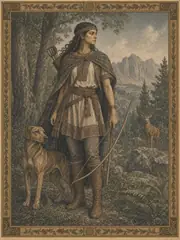
His paired goddess in the Illyrian context was Thana (treated in the next entry), a huntress-goddess of similar function. The two were often invoked together — 'Silvano Vidaso et Thanae' in joint dedications — as a divine forest-pair, the male and female aspects of the wild that the local population depended on for resources and that they propitiated for safety. The pair is structurally similar to the Roman Silvanus and Diana, but with distinctly Illyrian names retained alongside the Roman identifications.

After the Christianization of Illyria, Vidasus's cult was substantially absorbed into the various forest-saint traditions of medieval Christianity (Saint Eustace in particular, the patron of huntsmen, took on much of his iconographic vocabulary). The folk traditions of the western Balkans preserved elements of forest-cult into the modern period, with sacred trees, holy springs, and ritual hunts all carrying echoes of the older indigenous religion.
Curator’s note

What the sources say, and what later tradition added. The sources for this bay

Vidasus is documented in numerous inscriptions from Dalmatia and Pannonia (CIL III 4099, 4100, 8369, 10460, and others); the standard collection is the Corpus Inscriptionum Latinarum III. The standard treatment is in Stipcevic's The Illyrians and in Duje Rendic-Miocevic's articles on Illyrian religion. The Silvanus-Vidasus syncretism is discussed in Mary Beard, John North, and Simon Price's Religions of Rome (1998), Vol. 2, and in the various works on Roman provincial religion.

Kin in the sources

Each tie is quoted from the entry that states it.

The same god in other rooms

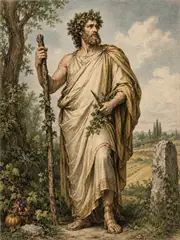
The ancient sources themselves name these as one god under different names. See Vidasus, Selvans and Silvanus hung together

When the sources speak

Dated witnesses for The Illyrian Pantheon. A date marks when the evidence was written down, not when the belief began. The whole timeline

2nd–1st millennia BCE
Bronze and Iron Age regional cultures establish the archaeological backgrounds later labeled Thracian, Illyrian, Iberian, Caucasian, and Libyan.
8th–6th centuries BCE
Greek and Phoenician colonization creates new inscriptional, artistic, and commercial contact zones.
6th–4th centuries BCE
Classical authors begin describing frontier peoples and translating local gods into Greek categories.
3rd–1st centuries BCE
Hellenistic kingdoms, Carthage, and Rome intensify political and cultic exchange.
1st century BCE–3rd century CE
Roman provincial rule produces dedications, coins, reliefs, and interpretive equations across the Balkans, Iberia, Caucasus, and North Africa.
4th–7th centuries CE
Christianization and imperial change end or transform many public cult institutions while names persist in texts and places.
medieval period
Georgian chronicles and epic traditions, Iberian memory, and North African historical sources reshape pre-Christian inheritances.
1st millennium BCE
Regional Iron Age communities form the archaeological setting later called Illyrian.

Floor plan

The rooms follow one another in the order their peoples first appear in the written record.

  1. The Cradle of Citiesc. 3400 BCE to 395 CE. 115 works
  2. The Gift of the Nilec. 4000 BCE to 395 CE. 73 works
  3. The Olympian Orderc. 1600 BCE to 750 CE. 152 works
  4. The Persian Worldc. 2000 BCE to 1010 CE. 30 works
  5. The Levantine Borderlandsc. 1200 BCE to 500 CE. 20 works
  6. The Edges of Empirec. 2000 BCE to 1500 CE. 33 works
  7. The Etruscan Worldc. 900 BCE to 750 CE. 22 works
  8. The Roman Inheritancec. 1200 BCE to 500 CE. 58 works
  9. The Northern Inheritancec. 2000 BCE to 1600 CE. 131 works