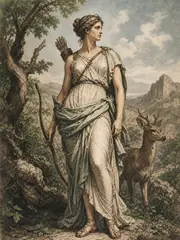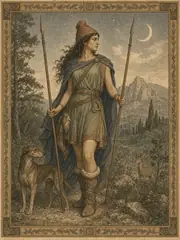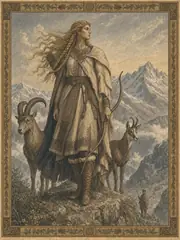
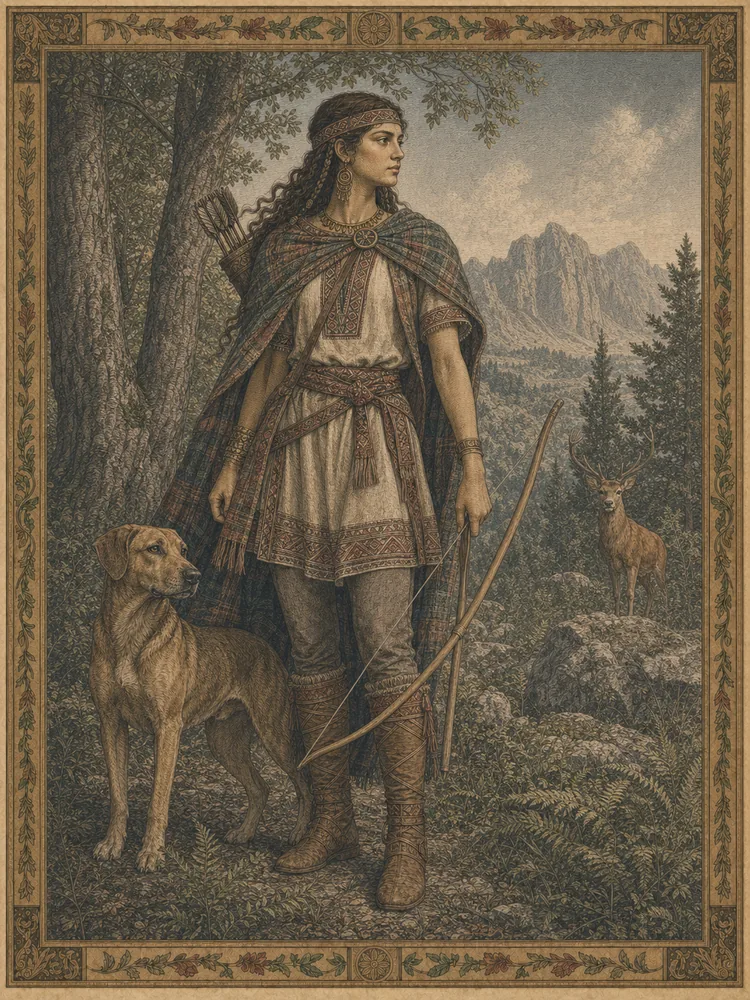
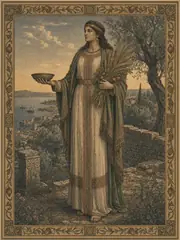
Thana was the Illyrian goddess of the hunt, the wild animals, and the woodland glades — the female counterpart of Vidasus, with whom she was paired in the joint dedications 'Silvano et Thanae' or 'Silvano Vidaso et Thanae.' She was identified with the Roman Diana in the syncretizing inscriptions of the imperial period, and her cult-image in surviving reliefs depicts her in the typical Diana-type — a young huntress in short tunic, with bow and quiver, accompanied by a hound — but with the indigenous Illyrian name preserved.
The cult was widespread throughout Dalmatia and Pannonia, with dedications recovered from sites across the western Balkans. The Illyrian name Thana shows close kinship with the Etruscan-Roman Diana (suggesting a shared Indo-European etymological root, perhaps from a proto-form *diwana, 'the divine'); the connection is one of the clearest cases of religious-vocabulary continuity across Italic and Illyrian Indo-European traditions.
Her function as patroness of the hunt placed her in a wide network of female hunting-divinities across the Mediterranean and Indo-European world: the Greek Artemis, the Roman Diana, the Thracian Bendis (treated in the previous book), the Caucasian Dali (treated in Book IV below). The hunting goddess is one of the most pervasive divine types in Indo-European religion, and the Illyrian Thana is a regional manifestation that preserves its local character within the wider pattern.
After the Christianization of Illyria, Thana's cult was absorbed (like Vidasus's) into the folk-religious traditions and into the iconography of various female saints. The medieval Croatian and Bosnian folk-cult of Saint Catherine and other female saints, with elements of forest-and-hunt symbolism, preserves some traces of the older Thana-cult, transferred onto the Christian framework. The figure herself, however, was lost from active worship by the late ancient period.