A Compendium of the Ancient Gods
Eia, plate

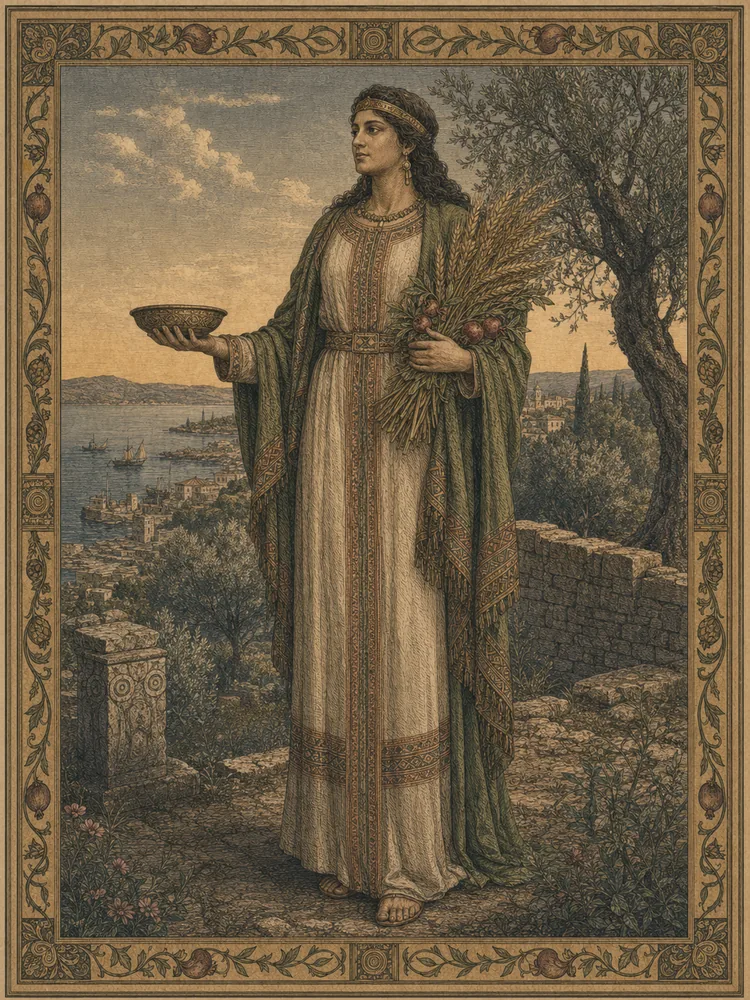
Eia (sometimes Heia) was a local Illyrian goddess particular to the Histrian peninsula in the northern Adriatic — modern Istria, on the territory of Croatia. Her cult was concentrated at Pula and at the smaller Histrian centers; the dedicatory inscriptions to her are not numerous (perhaps a dozen are known) but they are concentrated in this region and confirm her status as a regional civic deity. The Romans identified her sometimes with Bona Dea (the Roman 'Good Goddess' of fertility and women's mysteries) and sometimes with Tellus (the earth-mother), reflecting the breadth of her functions.

Her name Eia is of uncertain etymology — possibly a Histrian-Illyrian word for 'mother' or 'lady,' possibly a name from a still older pre-Indo-European Adriatic substrate. The Histrians themselves were Indo-European but had occupied territory previously inhabited by older populations whose languages and religions are largely unknown; some of the Histrian deities (Eia is among the candidates) may preserve elements from this older substrate, transmitted to the Iron Age Histrians and from them to the Romans.

The Eia-cult illustrates the proliferation of local female deities in the Illyrian-Adriatic region. Each city, each tribe, each locality had its own tutelary goddess — the Roman provincial inscriptions preserve dozens of names — and Eia was Histria's, with no clear cultic links to the other regional figures (Allat-Diana, Thana, Bona Dea) beyond the broad pattern of female protectors of the locality. The pattern reflects the political fragmentation of pre-Roman Illyria: each polity had its own divinity, and the Roman administrative consolidation only partly merged these local cults.

The cult was extinguished with the Christianization of Histria. The Pula cathedral and the various Christian basilicas of the region were built over earlier sanctuaries, including (probably) one or more Eia-sanctuaries; the cult-site continuity is real but the cult-content was wholly replaced. Eia's name is preserved in the Roman inscriptions, but she has no medieval afterlife in Christian saint-cult that can be specifically traced to her.

Curator’s note

What the sources say, and what later tradition added. The sources for this bay

Eia is documented in Histrian-Roman inscriptions; the standard reference is the Inscriptiones Italiae X (the volume covering Histria) and the supplementary volumes. The standard treatment is in Robert Matijasic's various studies of Histrian Roman archaeology and in the older Brunsmid-Saria Pauly-Wissowa entries. The pre-Indo-European substrate hypothesis is treated cautiously in modern Indo-European studies; the matter is essentially undecidable on present evidence.

When the sources speak

Dated witnesses for The Illyrian Pantheon. A date marks when the evidence was written down, not when the belief began. The whole timeline

2nd–1st millennia BCE
Bronze and Iron Age regional cultures establish the archaeological backgrounds later labeled Thracian, Illyrian, Iberian, Caucasian, and Libyan.
8th–6th centuries BCE
Greek and Phoenician colonization creates new inscriptional, artistic, and commercial contact zones.
6th–4th centuries BCE
Classical authors begin describing frontier peoples and translating local gods into Greek categories.
3rd–1st centuries BCE
Hellenistic kingdoms, Carthage, and Rome intensify political and cultic exchange.
1st century BCE–3rd century CE
Roman provincial rule produces dedications, coins, reliefs, and interpretive equations across the Balkans, Iberia, Caucasus, and North Africa.
4th–7th centuries CE
Christianization and imperial change end or transform many public cult institutions while names persist in texts and places.
medieval period
Georgian chronicles and epic traditions, Iberian memory, and North African historical sources reshape pre-Christian inheritances.
1st millennium BCE
Regional Iron Age communities form the archaeological setting later called Illyrian.

Floor plan

The rooms follow one another in the order their peoples first appear in the written record.

  1. The Cradle of Citiesc. 3400 BCE to 395 CE. 115 works
  2. The Gift of the Nilec. 4000 BCE to 395 CE. 73 works
  3. The Olympian Orderc. 1600 BCE to 750 CE. 152 works
  4. The Persian Worldc. 2000 BCE to 1010 CE. 30 works
  5. The Levantine Borderlandsc. 1200 BCE to 500 CE. 20 works
  6. The Edges of Empirec. 2000 BCE to 1500 CE. 33 works
  7. The Etruscan Worldc. 900 BCE to 750 CE. 22 works
  8. The Roman Inheritancec. 1200 BCE to 500 CE. 58 works
  9. The Northern Inheritancec. 2000 BCE to 1600 CE. 131 works