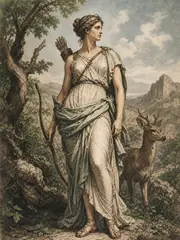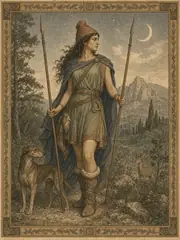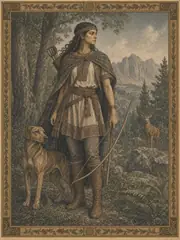
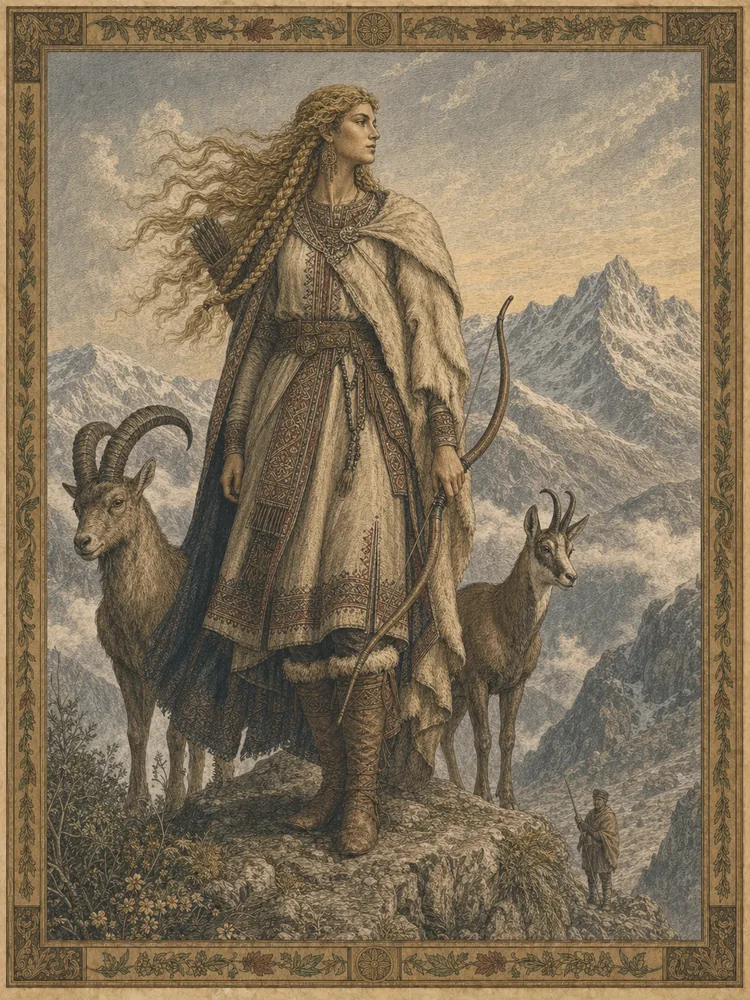
Dali was the goddess of the hunt and of the wild animals among the mountain peoples of the Caucasus — particularly the Svans, who occupied the high valleys of the Greater Caucasus range in northwestern Georgia, and to a lesser degree among the other highland peoples (the Khevsurs, the Tushetians, and others). She was depicted as a beautiful young woman with golden hair (sometimes the hair was specifically said to be made of golden thread, sometimes simply the color of gold), pale skin, naked or wearing the skin of a hunted animal, dwelling alone in the high mountains, mistress of the chamois, the ibex, and the other wild creatures of the heights.
She was a dangerous and ambivalent figure. The hunters of the Svan villages had to gain her favor before the hunt — by proper rituals, by avoiding the hunt during certain forbidden days, by treating the killed animals with the proper respect — but Dali could also become the lover of a hunter she favored. The hunter who became Dali's lover was given supernatural success in the hunt, but he had to keep the relationship secret and observe a number of taboos; if he violated the taboos (especially by sleeping with a mortal woman during the period of his association with Dali), he would be killed by the goddess in a fit of jealousy, often by being thrown from a cliff or torn by the horns of his own quarry. The folk-traditions of Svaneti preserve dozens of such hunter-and-Dali stories, with the basic pattern (favor, taboo, violation, death) repeated with regional and individual variations.
The figure is one of the most distinctive of the Caucasian religious traditions and has parallels with various Mediterranean and Indo-European huntress-goddesses (the Greek Artemis, the Roman Diana, the Thracian Bendis, the Illyrian Thana). What distinguishes Dali is the specifically dangerous-lover aspect — the goddess as mortal hunter's seducer, with the relationship constituting both his greatest gift and his greatest peril. The pattern has parallels with the Celtic banshee-traditions (where the supernatural female lover similarly demanded death-taboos) and with various other Indo-European supernatural-lover narratives, but the Caucasian form is preserved in unusual completeness because of the late survival of folk-tradition in the highland regions.
Dali's cult was officially extinguished by the Christianization of Georgia, but it survived in folk-tradition for many centuries. The Svan folk-songs and oral narratives, collected in the nineteenth and twentieth centuries by ethnographers (particularly the Russian-Georgian missions of the late imperial and Soviet periods), preserve the Dali-tradition in great detail. By the late twentieth century, the active religious veneration of Dali had largely ceased even in Svaneti, but the figure is preserved in the literary and ethnographic record, and has been adopted by modern Georgian writers (especially the poet Galaktion Tabidze) as a symbol of the mysterious feminine power of the high mountains.