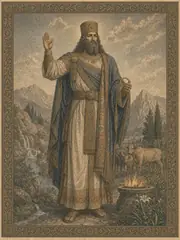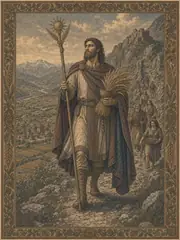
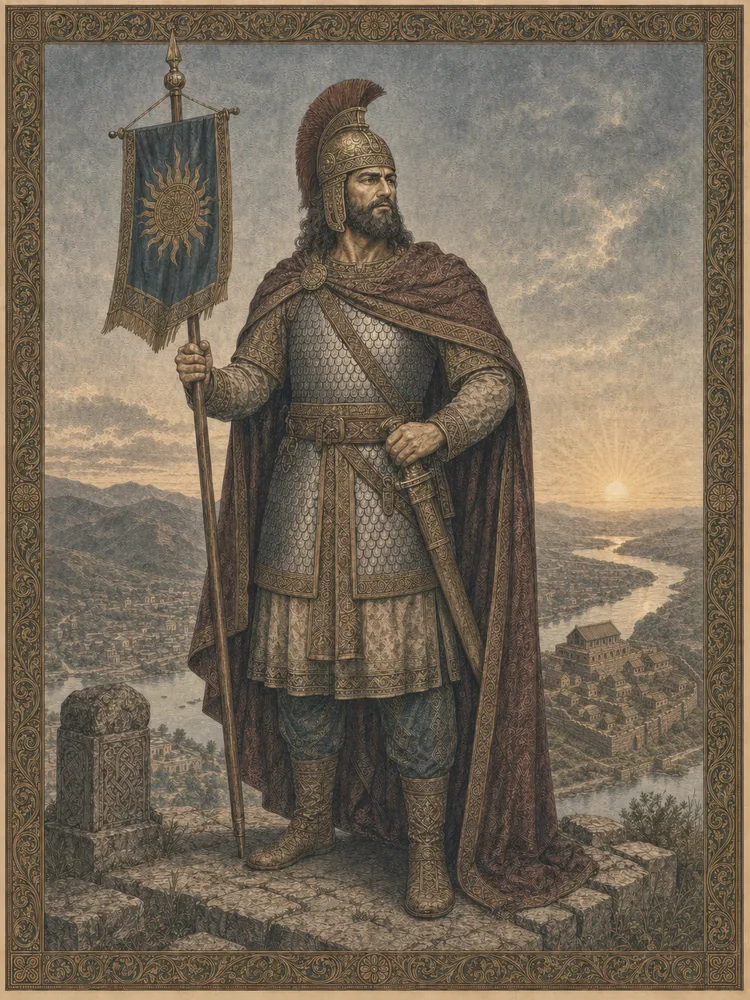

Armazi (or Armaz) was a high-god of the ancient Georgian religion, particularly venerated as the chief deity of the kingdom of Iberia (the eastern Georgian state, with its capital at Mtskheta) in the late centuries before our era and the early centuries of our era. The name is plainly Iranian — Armazi is from Old Persian Aramazda or Avestan Ahura Mazda, with the typical Caucasian phonetic adaptations — and the figure represents one of the clearest cases of religious-cultural transmission from Iran into the Caucasus during the period of Achaemenid and Parthian influence on the region.
The cult of Armazi was established at the great fortress-city of Armaztsikhe (named for the deity) on the high cliff overlooking the Aragvi-Kura confluence near Mtskheta. The site has been extensively excavated; the great cult-complex of Armazi consisted of temples, royal residences, treasuries, and a sacred precinct with the chief cult-image of the deity — a great gold-and-bronze figure of which fragments have been recovered. The cult continued under successive Georgian dynasties through the late ancient period, with Armazi serving as the divine warrant of Iberian kingship.
The Christianization of Iberia under King Mirian III in the early fourth century of our era was, in the medieval Georgian tradition, the moment of Armazi's destruction. The Conversion of Kartli (the foundational Christian-Georgian historical text, dating in its present form from the medieval period but preserving older traditions) recounts that when Mirian was converted by Saint Nino, he ordered the destruction of the Armazi statue at the cult-site; the statue, struck by lightning at Saint Nino's prayer, was thrown down and shattered. The episode is the foundational moment of Georgian Christianity, and Armazi's destruction is the symbolic act by which the older religion was renounced.
The cult-site itself, however, was not abandoned. The Christian authorities built churches at Armaztsikhe, and the location became one of the great pilgrimage centers of medieval Georgian Christianity. The continuity of sacred place across religious transition is real here, even though the deity's name was abandoned and the worship reoriented. Armazi himself, as a divine figure, was lost from active veneration; his name is preserved in the medieval Georgian Christian texts (always as the chief idol that was overthrown) and in the modern toponymy (the modern village of Armazi preserves the name of the ancient sanctuary).