A Compendium of the Ancient Gods
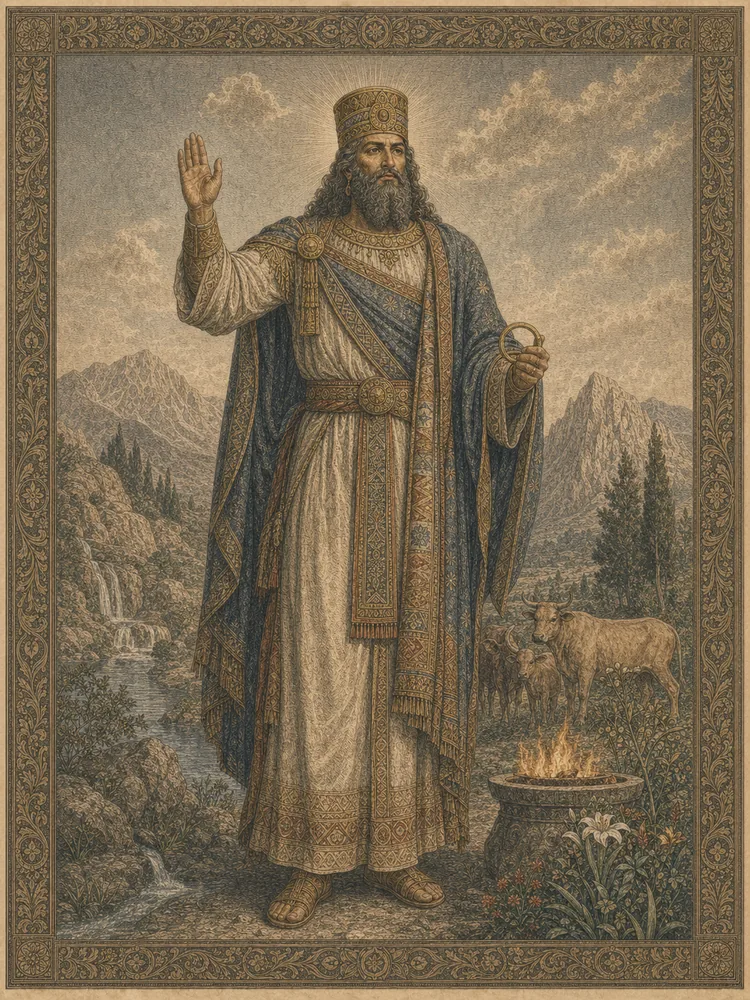
Ahura Mazda, plate

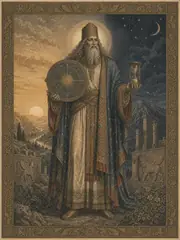
Ahura Mazda — "the Wise Lord," or, taking the elements of his name in their fullest sense, "the Lord of Wisdom" — was the supreme being of the religion that Zarathushtra reformed and proclaimed perhaps three thousand years ago in eastern Iran. He was the creator of the sky and the earth, of the waters and the plants, of the cattle and the just man; he was the source of all that is true, all that is right, all that is alive in the proper sense. He had no equal among the powers of the world, and no rival among the gods of the older Iranian pantheon (whom Zarathushtra had either subordinated to him as yazatas, lesser divinities, or denounced as daevas, demons). He stood alone at the head of creation, surrounded by his Holy Immortals — the Amesha Spentas — who were aspects of his own being, modes of his creative thought, the seven facets through which his single will worked upon the world.

His chief attribute was wisdom. He saw, the Gathas tell us, with the eyes of the mind into the future and the past; he knew what each man's choice would be before the man chose; he had foreseen the entire history of the world — the war of good and evil, the long struggle, the eventual triumph of the good — before he had created so much as a single thing. And yet the foreknowledge did not abolish the choice: each man must still choose between truth and the lie, and the choice was real, however many times Ahura Mazda might have foreseen it.

Ahura Mazda's chief attribute, after wisdom, was generosity. He had given the world its goodness; he gave to each righteous man, after death, the Best Existence (Vahishta Ahu — paradise, the word from which the Persian behesht and the Hebrew bahesht and ultimately the English garden-of-paradise descend); he gave to the priestly class the haoma-rite by which the worshipper communed with him; he gave to the king the Khvarenah, the divine glory of legitimate rule. From him flowed every good thing, and toward him every act of righteousness was directed.

The Achaemenid kings — Darius I, Xerxes, Artaxerxes — invoked Ahura Mazda by name in their inscriptions as the god by whose grace they ruled. "Ahuramazda is the great god," the Behistun inscription of Darius begins, "who created this earth, who created yonder sky, who created man, who created happiness for man, who made Darius king." Through the seven centuries of the Achaemenid and Sasanian empires, Ahura Mazda was the god of the Iranian state and of the Iranian people, and the religion of the Wise Lord was carried to every corner of the empire from the Indus to the Aegean.
Curator’s note

What the sources say, and what later tradition added. The sources for this bay

Ahura Mazda is the central figure of the Zoroastrian Avesta. The Gathas (Yasna 28-34, 43-51, 53), the seventeen hymns attributed to Zarathushtra himself, are addressed largely to him; he is invoked throughout the Yashts, the Yasna, and the Vendidad. The Pahlavi Bundahishn (chapters 1-3) gives the standard Sasanian account of Ahura Mazda's creation of the world. External witnesses are extensive: the Achaemenid inscriptions (Behistun, Persepolis, Naqsh-i-Rustam) name Ahuramazda repeatedly; Greek sources (Plutarch's De Iside et Osiride 46-47, Diogenes Laertius 1.8) preserve Hellenistic-period accounts. The standard modern scholarship is Mary Boyce's three-volume A History of Zoroastrianism (1975-1991); Boyce's textbooks (Zoroastrians: Their Religious Beliefs and Practices, 1979) are accessible introductions. The etymology of the name (ahura "lord" + mazda "wise, wisdom") is straightforward; the cognate Vedic asura is closely related, though the Indian asuras would later become demonic adversaries of the devas in a parallel but reversed development.

Kin in the sources

Each tie is quoted from the entry that states it.

The same god in other rooms

The ancient sources themselves name these as one god under different names. See Ahura Mazda and Armazi hung together

When the sources speak

Dated witnesses for Ahura Mazda and the Cosmic Dualism. A date marks when the evidence was written down, not when the belief began. The whole timeline

late 2nd–early 1st millennium BCE, debated
The Old Avestan Gathas and Yasna Haptanghaiti emerge in an eastern Iranian ritual-poetic setting; Zarathustra’s date remains disputed.
1st millennium BCE
Younger Avestan hymns, ritual texts, and legal-purity materials develop over a long period of oral transmission.
c. 550–330 BCE
Achaemenid inscriptions invoke Ahuramazda in imperial royal ideology; their relationship to later Zoroastrian orthodoxy requires care.
330 BCE–224 CE
Hellenistic and Parthian eras preserve Iranian cults through sparse and regionally varied evidence.
224–651 CE
Sasanian institutions sponsor priestly learning and the redactional organization associated with the Avesta and Zand.
7th–10th centuries CE
After the Islamic conquest, Middle Persian books record cosmology, law, exegesis, and summaries of lost material.
c. 9th century CE
The Bundahišn, Dēnkard, Wizīdagīhā ī Zādspram, and related works preserve systematic late antique and early Islamic syntheses.
c. 977–1010 CE
Ferdowsi composes the Shāhnāmeh from epic and royal traditions with both pre-Islamic and Islamic-period mediation.

Floor plan

The rooms follow one another in the order their peoples first appear in the written record.

  1. The Cradle of Citiesc. 3400 BCE to 395 CE. 115 works
  2. The Gift of the Nilec. 4000 BCE to 395 CE. 73 works
  3. The Olympian Orderc. 1600 BCE to 750 CE. 152 works
  4. The Persian Worldc. 2000 BCE to 1010 CE. 30 works
  5. The Levantine Borderlandsc. 1200 BCE to 500 CE. 20 works
  6. The Edges of Empirec. 2000 BCE to 1500 CE. 33 works
  7. The Etruscan Worldc. 900 BCE to 750 CE. 22 works
  8. The Roman Inheritancec. 1200 BCE to 500 CE. 58 works
  9. The Northern Inheritancec. 2000 BCE to 1600 CE. 131 works