
A Compendium of the Ancient Gods
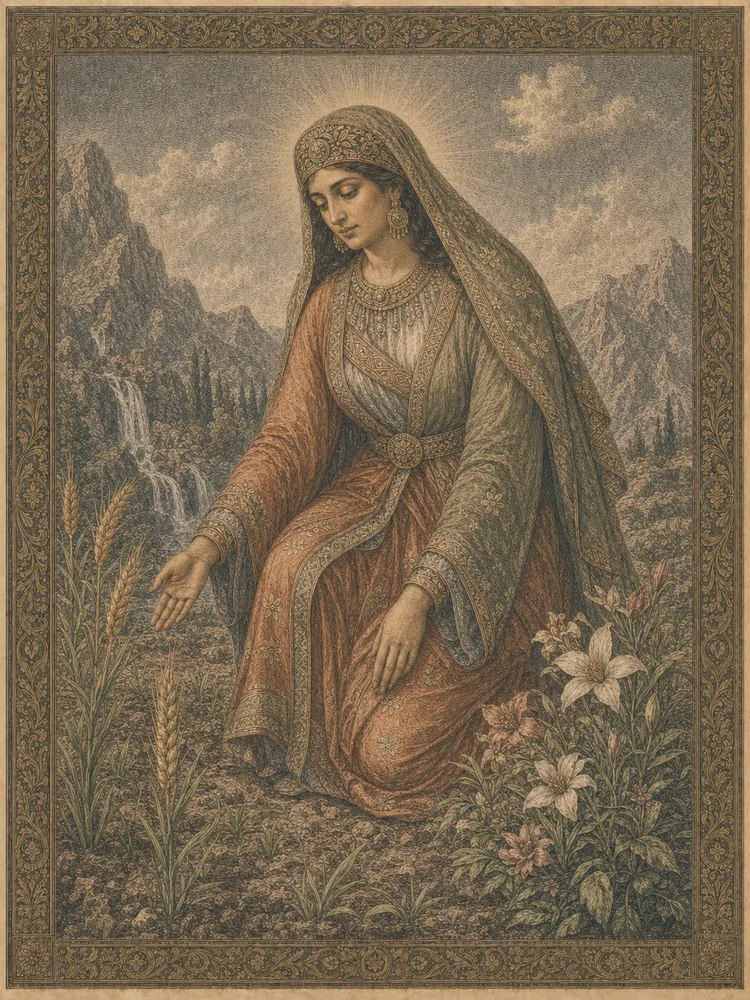
Spenta Armaiti, plate

Spenta Armaiti — "Holy Devotion," or "Bountiful Right-Mindedness" — was the only female Amesha Spenta among the seven, and the patroness of the earth itself. She was sometimes called the daughter of Ahura Mazda, sometimes his consort; the relationship was understood differently in different periods, but in all of them she was the maternal principle of the divine, the source of nurturing care, the patroness of the cultivator who tilled the good earth.

Her element was the earth — Mother Earth, the soil that received the seed and gave the harvest, the ground in which men were buried, the body of the world. The Zoroastrian was particularly concerned with not polluting the earth: dead bodies were not permitted to be buried in the soil (for the corpse was contaminated and would defile the earth), and the famous Iranian dakhmas — the Towers of Silence, where the dead were exposed for the vultures to consume — were a direct consequence of the desire to spare Spenta Armaiti from the contamination of corpses. The agricultural worker — the man who plowed and planted and harvested — was particularly her servant, and the cultivation of the soil was for the Zoroastrian a sacred act, second only to the priestly fire-tending.

Spenta Armaiti's special virtue was devotion — the devout, attentive, loving care of the things one was responsible for. The good wife, the good farmer, the good householder — those who took care of what they had with attentive love — were her embodied servants. She was sometimes invoked also as the patroness of motherhood and of the bond between parent and child, though these functions overlapped with the yazata Anahita (treated below).

Her day in the calendar was the fifth day of the month, and her month was the twelfth, the last of the year. Her opposite was Tarōmaiti, "the Demon of Heretical Mindfulness," who was understood as the spirit of contempt for what should be cared for, of contempt for the earth, of arrogance against the duties of devotion. The Zoroastrian who spurned the earth or his domestic responsibilities was a follower of Tarōmaiti against Spenta Armaiti, and so a follower of the Lie.


Curator’s note

What the sources say, and what later tradition added. The sources for this bay

Spenta Armaiti is invoked throughout the Avesta. Her role as patroness of the earth is in Yasht 16, in numerous passages of the Yasna, and in Bundahishn 26. Her relationship to Ahura Mazda (daughter, consort, both, neither) varies in the texts; the most explicit "daughter" passages are in the Pahlavi books. The cognate Vedic Aramati "devotion" confirms Indo-Iranian antiquity. The dakhma practice and its theological grounding in the protection of Spenta Armaiti is described in Vendidad chapters 6 and 8; Modi's Religious Ceremonies and Customs of the Parsees (1922) is a classic ethnographic treatment of how the doctrine was lived.

Kin in the sources

Each tie is quoted from the entry that states it.

When the sources speak

Dated witnesses for The Amesha Spentas. A date marks when the evidence was written down, not when the belief began. The whole timeline

late 2nd–early 1st millennium BCE, debated
The Old Avestan Gathas and Yasna Haptanghaiti emerge in an eastern Iranian ritual-poetic setting; Zarathustra’s date remains disputed.
1st millennium BCE
Younger Avestan hymns, ritual texts, and legal-purity materials develop over a long period of oral transmission.
c. 550–330 BCE
Achaemenid inscriptions invoke Ahuramazda in imperial royal ideology; their relationship to later Zoroastrian orthodoxy requires care.
330 BCE–224 CE
Hellenistic and Parthian eras preserve Iranian cults through sparse and regionally varied evidence.
224–651 CE
Sasanian institutions sponsor priestly learning and the redactional organization associated with the Avesta and Zand.
7th–10th centuries CE
After the Islamic conquest, Middle Persian books record cosmology, law, exegesis, and summaries of lost material.
c. 9th century CE
The Bundahišn, Dēnkard, Wizīdagīhā ī Zādspram, and related works preserve systematic late antique and early Islamic syntheses.
c. 977–1010 CE
Ferdowsi composes the Shāhnāmeh from epic and royal traditions with both pre-Islamic and Islamic-period mediation.

Floor plan

The rooms follow one another in the order their peoples first appear in the written record.

  1. The Cradle of Citiesc. 3400 BCE to 395 CE. 115 works
  2. The Gift of the Nilec. 4000 BCE to 395 CE. 73 works
  3. The Olympian Orderc. 1600 BCE to 750 CE. 152 works
  4. The Persian Worldc. 2000 BCE to 1010 CE. 30 works
  5. The Levantine Borderlandsc. 1200 BCE to 500 CE. 20 works
  6. The Edges of Empirec. 2000 BCE to 1500 CE. 33 works
  7. The Etruscan Worldc. 900 BCE to 750 CE. 22 works
  8. The Roman Inheritancec. 1200 BCE to 500 CE. 58 works
  9. The Northern Inheritancec. 2000 BCE to 1600 CE. 131 works