
A Compendium of the Ancient Gods
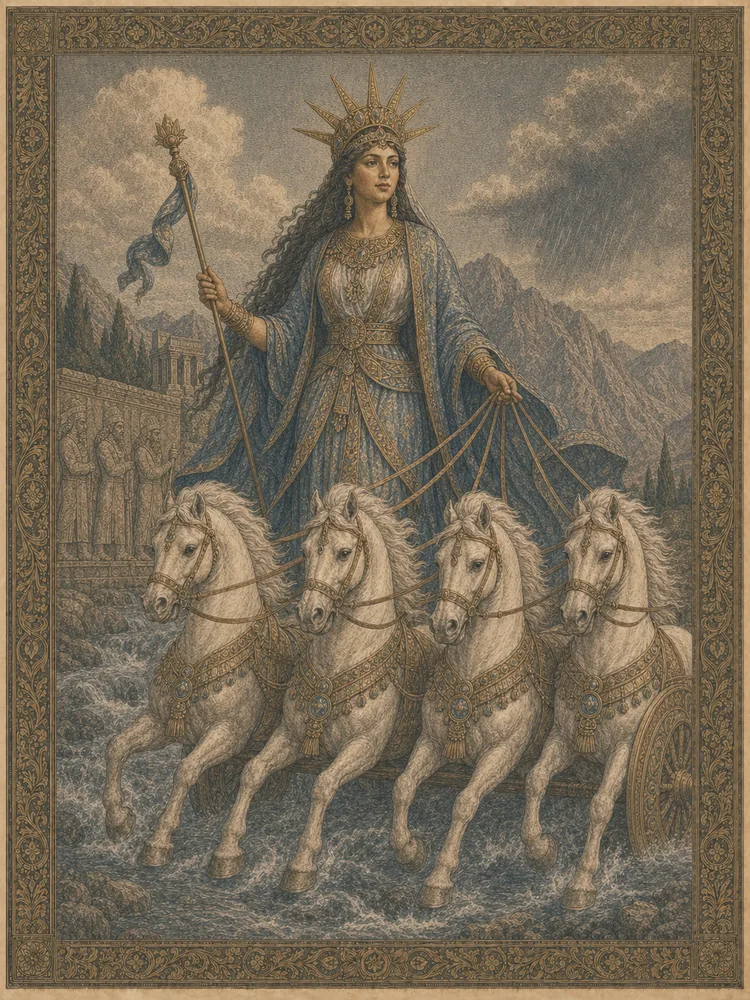
Anahita, plate

Anahita — fully Aredvi Sura Anahita, "the Moist, the Strong, the Pure" — was the great Iranian water-goddess, the source of all rivers, the giver of fertility and birth, the patroness of women and warriors alike. Her great Avestan hymn (Yasht 5, the Aban Yasht) describes her riding in a chariot drawn by four white horses (representing wind, rain, cloud, and sleet), wearing a golden crown set with eight rays and a hundred stars, dressed in gold-embroidered robes and adorned with a beaver-skin cape. She poured out the waters of the heavenly sea Vourukasha down upon the earth, and from this single source flowed all the seas, all the rivers, all the springs of the world.

Her cult was particularly developed in Achaemenid times under Artaxerxes II (404-358 BCE), who introduced statues of Anahita into temples throughout the Persian empire — a remarkable departure from the older aniconic Iranian religion, and a sign of the syncretism with the great Mesopotamian goddess Ishtar that was occurring in this period. Greek sources reflect the assimilation: Strabo and others identified Anahita with the Greek Aphrodite, the Mesopotamian Ishtar, and the Anatolian Cybele. The cult-images were probably derivative of Mesopotamian models, and the elaborate rites of Anahita resembled those of Ishtar in many respects.

Anahita was particularly invoked by women — for safe childbirth, for abundant milk, for the welfare of the family. But she was also a warrior-goddess, invoked by kings and heroes for victory in battle; the Aban Yasht catalogs the great heroes of the Iranian heroic age (Yima, Thraetaona, Keresaspa, and others) who had each invoked Anahita and received from her the boon they sought. So she had a triple character: water-mother, women's goddess, and warrior's patroness.

Her cult survived the conversion to Islam, transposed into Iranian folk religion as the patroness of certain springs (especially the spring at Bishapur and the great spring near Kangavar in western Iran). The temple at Kangavar — sometimes identified as the Temple of Anahita, though the identification is contested — has remains visible today, a great hilltop platform in the Median heartland, and was perhaps the largest sanctuary of Anahita in the Achaemenid and Parthian periods.
Curator’s note

What the sources say, and what later tradition added. The sources for this bay

Anahita is the central figure of Yasht 5, the Aban Yasht, the great Avestan hymn to her — over thirty kardas (sections) of considerable poetic richness. The Achaemenid royal inscriptions of Artaxerxes II (e.g., A2Sa, A2Sd, the Susa palace inscription) invoke Anahita by name; the introduction of statue-cults under this king is reported in Berossus (preserved in Clement of Alexandria's Protrepticus 5.65) and confirmed by the archaeological record. Strabo (11.14.16, 12.3.37, 16.1.4) describes Anahita's cult in Armenia, Pontus, and Cappadocia. The standard scholarly study is Mary Boyce's articles in the Encyclopaedia Iranica and her chapter in History (Vol. 2). The Kangavar temple, often called the Temple of Anahita, was excavated by Mehdi Rahbar and others; the identification is plausible but not definitively proven.

Kin in the sources

Each tie is quoted from the entry that states it.

When the sources speak

Dated witnesses for The Yazatas. A date marks when the evidence was written down, not when the belief began. The whole timeline

late 2nd–early 1st millennium BCE, debated
The Old Avestan Gathas and Yasna Haptanghaiti emerge in an eastern Iranian ritual-poetic setting; Zarathustra’s date remains disputed.
1st millennium BCE
Younger Avestan hymns, ritual texts, and legal-purity materials develop over a long period of oral transmission.
c. 550–330 BCE
Achaemenid inscriptions invoke Ahuramazda in imperial royal ideology; their relationship to later Zoroastrian orthodoxy requires care.
330 BCE–224 CE
Hellenistic and Parthian eras preserve Iranian cults through sparse and regionally varied evidence.
224–651 CE
Sasanian institutions sponsor priestly learning and the redactional organization associated with the Avesta and Zand.
7th–10th centuries CE
After the Islamic conquest, Middle Persian books record cosmology, law, exegesis, and summaries of lost material.
c. 9th century CE
The Bundahišn, Dēnkard, Wizīdagīhā ī Zādspram, and related works preserve systematic late antique and early Islamic syntheses.
c. 977–1010 CE
Ferdowsi composes the Shāhnāmeh from epic and royal traditions with both pre-Islamic and Islamic-period mediation.

Floor plan

The rooms follow one another in the order their peoples first appear in the written record.

  1. The Cradle of Citiesc. 3400 BCE to 395 CE. 115 works
  2. The Gift of the Nilec. 4000 BCE to 395 CE. 73 works
  3. The Olympian Orderc. 1600 BCE to 750 CE. 152 works
  4. The Persian Worldc. 2000 BCE to 1010 CE. 30 works
  5. The Levantine Borderlandsc. 1200 BCE to 500 CE. 20 works
  6. The Edges of Empirec. 2000 BCE to 1500 CE. 33 works
  7. The Etruscan Worldc. 900 BCE to 750 CE. 22 works
  8. The Roman Inheritancec. 1200 BCE to 500 CE. 58 works
  9. The Northern Inheritancec. 2000 BCE to 1600 CE. 131 works