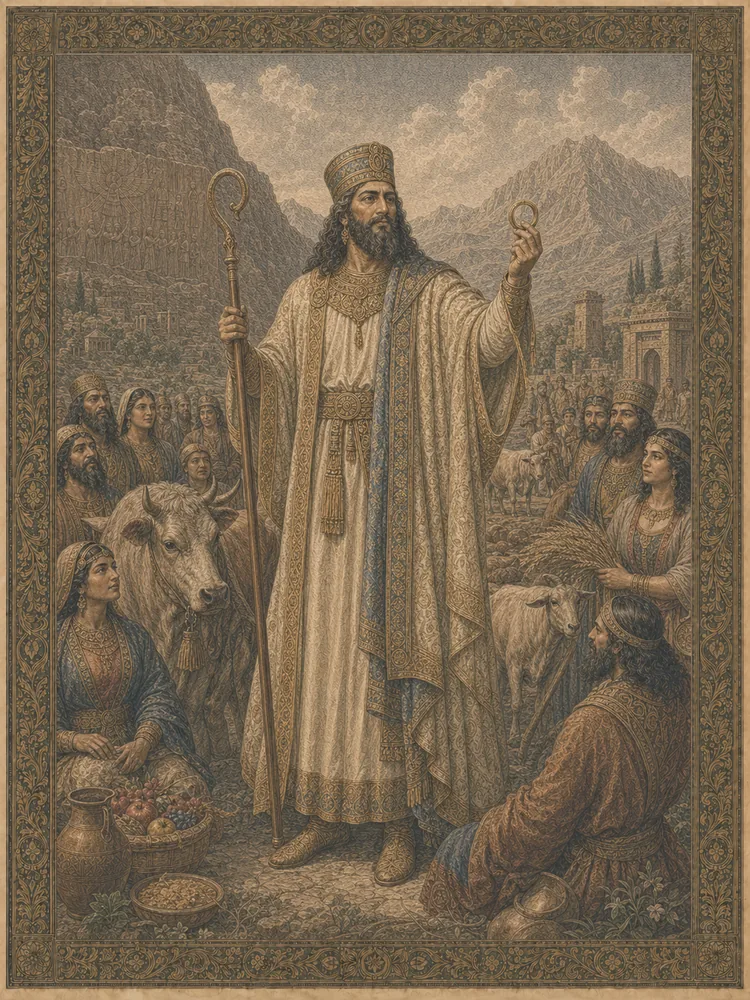
Yima, son of Vivanghvant, was the first king of the world. In the Iranian heroic tradition he was an extraordinary figure: the first ruler, the first sacrificer, the first to receive the Khvarenah in fullness, the first to bring civilization to humankind. Under his reign, the world was a paradise. Death did not exist; cold did not afflict men; the cattle and the flocks did not sicken; men did not grow old; the earth was filled to overflowing with the abundance of food and the abundance of children. Yima reigned for many centuries, and at three different times he had to enlarge the earth itself — by passing his golden ring and his golden whip over it, and the earth grew by a third each time — to accommodate the increasing population.
But the time came when Ahura Mazda warned Yima of a coming catastrophe: a winter of extraordinary severity (the malkosh, often interpreted as a Younger Dryas-like glacial event) was to fall upon the world, and most of life would perish. Yima was instructed to build a vara — a great enclosure underground, a refuge in which the seeds of every plant, the eggs of every bird, the offspring of every animal, and the choicest of men and women were to be preserved. So Yima built the vara according to Ahura Mazda's specifications: of nine streets, with windows that gave their own light, with the perfect creatures of the world preserved in pairs. There they waited out the great winter, and after it the world was repopulated from Yima's vara.
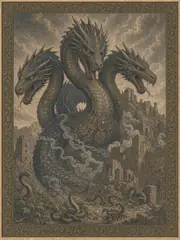
But Yima fell. He had been given the rule of the world by Ahura Mazda, but in his pride he came to believe himself the equal of the divine. He told a lie — "the lie that wastes the cattle," the worst form of falsehood — and the Khvarenah departed from him in three flashes, each caught by a different yazata. Without the Khvarenah, Yima was no longer king. He was deposed, and afterward (in the version preserved in the Shahnameh) was killed by Aži Dahāka the dragon, who sawed him in two with a fish-saw. So the first king fell, and the world entered the age of mixed good and evil that we still inhabit.
Yima passed into the Persian heroic tradition as Jamshid, hero of the Shahnameh, the great Persian national epic of Ferdowsi (composed c. 977-1010 of our era). In Ferdowsi's telling, Jamshid was the second king of the Pishdadian dynasty, the inventor of weapons, of weaving, of medicine, of architecture, of the dividing of society into four estates; he ruled in glory for seven hundred years before his fall, and his fall was caused by his proud demand that men worship him as a god. The Shahnameh's Jamshid is recognizably Yima of the Avesta, but elaborated in literary detail and preserved through the Islamic centuries as a symbol of the dangers of royal hubris.