A Compendium of the Ancient Gods
Aži Dahāka, plate

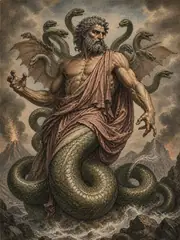
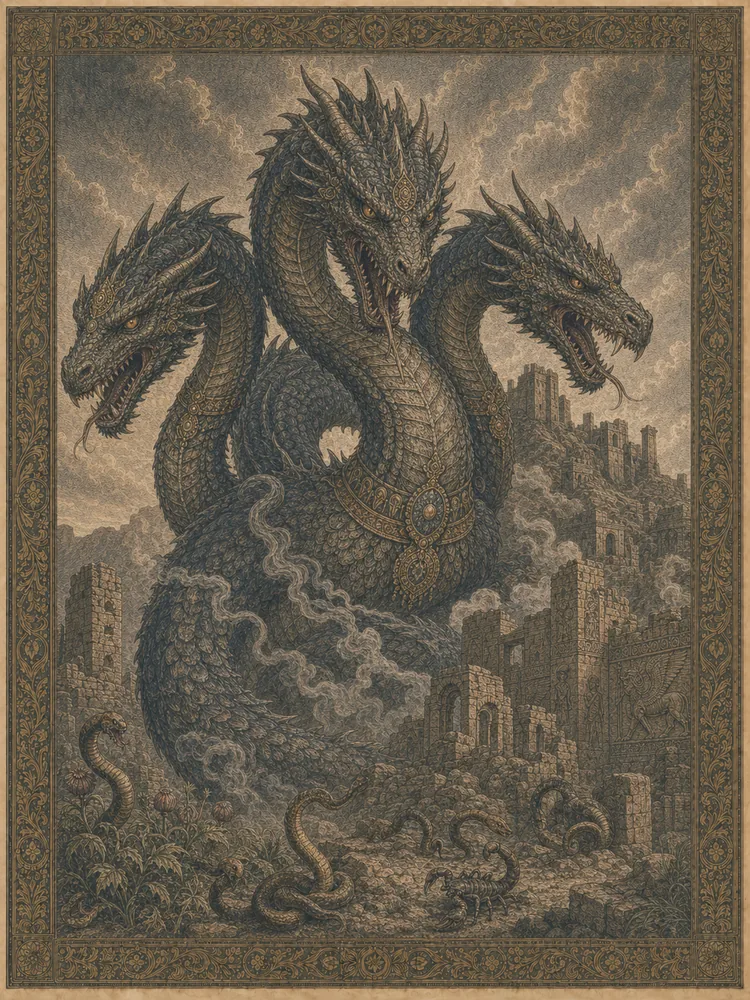
Aži Dahāka — "the Snake Dahaka" — was the great cosmic adversary of the Iranian heroic tradition, the three-headed dragon who was the most fearful of all the creatures of Angra Mainyu. He had three mouths and six eyes; he had three heads, on the central neck of which it was difficult to land a killing blow; his body was filled with foul creatures (snakes, scorpions, lizards, toads) that would burst forth and pollute the world if his body were ever opened. He was, in short, the embodiment of cosmic evil in concentrated form, the chief weapon of the Hostile Spirit against the good creation.

The Avestan tradition places his origin in the early days of the world, before even Yima's golden age; he was created by Angra Mainyu specifically to attack the good creation. He sought to extinguish the fires of Atar; he sought to seize the Khvarenah; he sought to destroy the cattle and the cultivators of the earth. After Yima's fall, Aži Dahāka established himself as the tyrant of the world and reigned for a thousand years, slaying Yima at the end of his usurpation by sawing him in two.

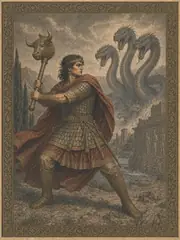
His defeat by Thraetaona (treated above) did not kill him but bound him; he is chained beneath Mount Damavand, gnawing eternally at his chain, awaiting the moment of his final release. At the end of the world, the chain will break, Aži Dahāka will burst forth, and he will devour a third of all life on earth — both human beings and animals, and even the stars themselves — before being slain by the eschatological hero (Keresaspa in the older tradition, the Saoshyant in the later) at the final cosmic battle. His death will mark one of the closing acts of the cosmic war, after which the world will be renewed in the Frashokereti.

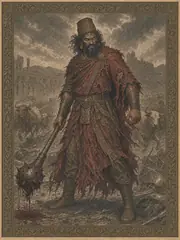
In the Shahnameh, Aži Dahāka appears as Zahhāk, the great tyrant of the early Pishdadian period. Ferdowsi gives him a more humanized and tragic backstory: Zahhāk was a young Arab prince of pure character, corrupted by the suggestions of Eblis (the devil); he murdered his father, took the throne of Iran by treachery, and after Eblis kissed him on the shoulders, two black serpents grew there which had to be fed daily on the brains of two young men. Zahhāk's tyranny lasted a thousand years before Faridun (= Thraetaona) overthrew him and chained him beneath Damavand. The Shahnameh's Zahhāk is at once a literal historical fiction (a wicked king) and the same cosmic dragon as the Avestan Aži Dahāka; the literary genius of Ferdowsi was to fuse the two.
Curator’s note

What the sources say, and what later tradition added. The sources for this bay

Aži Dahāka is the central adversary in Yasht 5, Yasht 19 (Zamyad), and numerous other Avestan passages; the imprisonment beneath Damavand is in the Pahlavi Bundahishn (chapter 29). The Shahnameh of Ferdowsi gives the literary form as Zahhāk, with the famous shoulder-serpents and the daily sacrifice of brains. The figure has been compared with the Vedic Aži (a cosmic serpent slain by Indra in Rigveda 1.32) and with the Mesopotamian Tiamat and the Greek Typhon; the Indo-European antiquity of the cosmic-dragon-slayer myth is one of the most secure findings of comparative mythology (M. L. West's Indo-European Poetry and Myth, 2007, gives a thorough treatment). The ending — the dragon imprisoned, awaiting eschatological release — has interesting parallels in later Christian and Islamic apocalyptic imagery (the dragon of Revelation, the Dajjal of Islamic eschatology), though direct influence is hard to demonstrate.

Kin in the sources

Each tie is quoted from the entry that states it.

When the sources speak

Dated witnesses for Heroes, Adversaries and the Final Renewal. A date marks when the evidence was written down, not when the belief began. The whole timeline

late 2nd–early 1st millennium BCE, debated
The Old Avestan Gathas and Yasna Haptanghaiti emerge in an eastern Iranian ritual-poetic setting; Zarathustra’s date remains disputed.
1st millennium BCE
Younger Avestan hymns, ritual texts, and legal-purity materials develop over a long period of oral transmission.
c. 550–330 BCE
Achaemenid inscriptions invoke Ahuramazda in imperial royal ideology; their relationship to later Zoroastrian orthodoxy requires care.
330 BCE–224 CE
Hellenistic and Parthian eras preserve Iranian cults through sparse and regionally varied evidence.
224–651 CE
Sasanian institutions sponsor priestly learning and the redactional organization associated with the Avesta and Zand.
7th–10th centuries CE
After the Islamic conquest, Middle Persian books record cosmology, law, exegesis, and summaries of lost material.
c. 9th century CE
The Bundahišn, Dēnkard, Wizīdagīhā ī Zādspram, and related works preserve systematic late antique and early Islamic syntheses.
c. 977–1010 CE
Ferdowsi composes the Shāhnāmeh from epic and royal traditions with both pre-Islamic and Islamic-period mediation.

Floor plan

The rooms follow one another in the order their peoples first appear in the written record.

  1. The Cradle of Citiesc. 3400 BCE to 395 CE. 115 works
  2. The Gift of the Nilec. 4000 BCE to 395 CE. 73 works
  3. The Olympian Orderc. 1600 BCE to 750 CE. 152 works
  4. The Persian Worldc. 2000 BCE to 1010 CE. 30 works
  5. The Levantine Borderlandsc. 1200 BCE to 500 CE. 20 works
  6. The Edges of Empirec. 2000 BCE to 1500 CE. 33 works
  7. The Etruscan Worldc. 900 BCE to 750 CE. 22 works
  8. The Roman Inheritancec. 1200 BCE to 500 CE. 58 works
  9. The Northern Inheritancec. 2000 BCE to 1600 CE. 131 works