A Compendium of the Ancient Gods
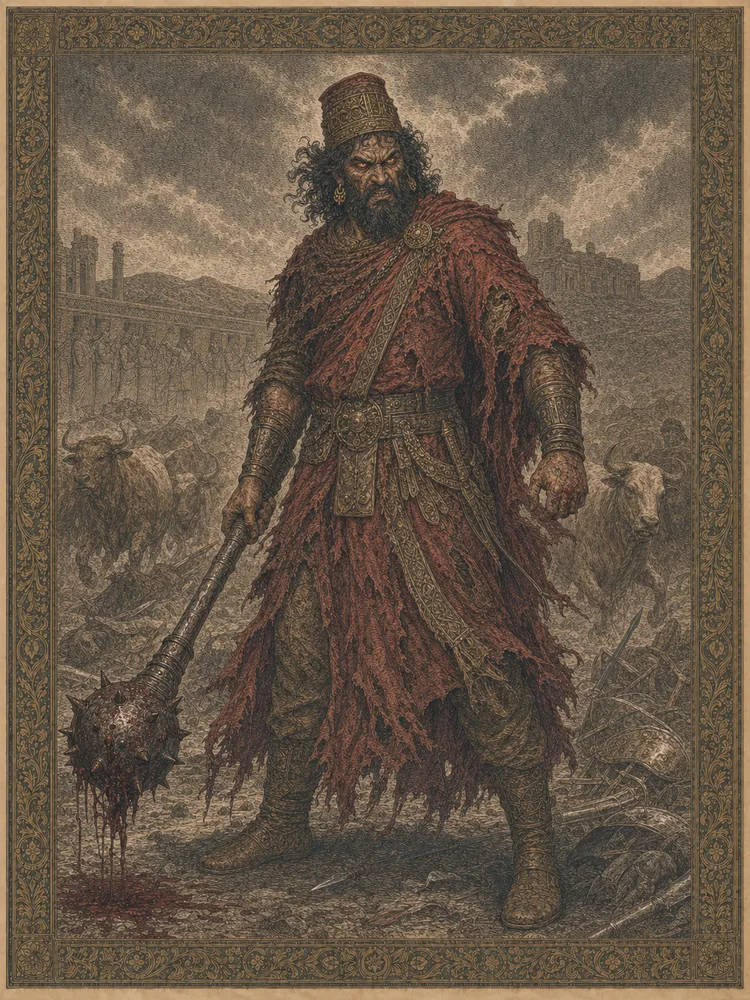
Aeshma, plate

Aeshma — "Wrath," or more fully Aeshma-daeva, "the Demon of Wrath" — was the chief of the daevas, the demons of the Zoroastrian system. He was the personification of riotous violence, of fury, of the kind of anger that destroys both its object and the one who feels it. He carried a great mace stained with the blood of his victims, and he rode through the world looking for cattle to slaughter, men to incite to murder, and women to drive into wild lamentation. Of all the demons, he was the closest to direct attack on the worshipper, the demon most likely to be encountered in the ordinary disorders of human life.

His Avestan opposite was Sraosha (treated above) — "Obedience," the disciplined attentive listening to the divine word. The opposition is exact: where Sraosha represented the soul ordered by the religious life, Aeshma represented the soul disordered by passion. The two were always paired in the cosmic war, and the worshipper who cultivated obedience to Ahura Mazda was thereby resisting the inroads of Aeshma. The daily Zoroastrian discipline of right thought, right speech, and right action was, on its negative side, an exercise in resisting Aeshma's suggestions.

Aeshma had a remarkable career in late Jewish demonology. The Book of Tobit (composed in the Achaemenid or early Hellenistic period, when the Iranian religion was strongly influencing Jewish demonological speculation) names a demon "Asmodeus" who has fallen in love with the heroine Sarah and who has killed her seven husbands on their wedding nights before they could consummate the marriage. The name Asmodeus is straightforwardly from Aeshma-daeva (Aeshma > Ashmedai > Asmodeus), and the figure is a Jewish-domesticated version of the Iranian demon of wrath transposed into a story of jealous love. The Talmud and the medieval Jewish demonological literature elaborated Asmodeus extensively, making him at once the king of the demons and a figure of considerable folk-narrative interest (the medieval legend of Solomon and Asmodeus is one of the great instances). Christian demonology inherited Asmodeus through the Jewish tradition and continued the elaboration through the Middle Ages, with Asmodeus eventually identified as one of the seven princes of hell.

So the Iranian Aeshma — a relatively minor figure in the Zoroastrian system — became, through the late Jewish reception, one of the most famous demons of the Western religious imagination. His Iranian original is far less developed than his Jewish-Christian descendants, and the comparison gives some sense of how thoroughly the late Jewish demonology drew on the Iranian source while transforming it into something quite different.
Curator’s note

What the sources say, and what later tradition added. The sources for this bay

Aeshma is invoked throughout the Avesta, particularly in pair with Sraosha. The Vendidad (chapter 19) describes the cosmic battle between Aeshma and the divine forces. The transmission to Jewish demonology is documented in the Book of Tobit (chapters 3, 6, 8) and in the rabbinic literature (Talmud Pesachim 110a, Gittin 68a-b — the Solomon-Asmodeus stories). The standard study of the Iranian-Jewish demonological transmission is Bernard Bamberger's Fallen Angels (1952) and James Russell's various articles. The continuity from Aeshma to Asmodeus to Hollywood-and-occultist-Asmodeus is one of the cleanest cases of trans-cultural demon-genealogy in religious history.

Kin in the sources

Each tie is quoted from the entry that states it.

When the sources speak

Dated witnesses for Heroes, Adversaries and the Final Renewal. A date marks when the evidence was written down, not when the belief began. The whole timeline

late 2nd–early 1st millennium BCE, debated
The Old Avestan Gathas and Yasna Haptanghaiti emerge in an eastern Iranian ritual-poetic setting; Zarathustra’s date remains disputed.
1st millennium BCE
Younger Avestan hymns, ritual texts, and legal-purity materials develop over a long period of oral transmission.
c. 550–330 BCE
Achaemenid inscriptions invoke Ahuramazda in imperial royal ideology; their relationship to later Zoroastrian orthodoxy requires care.
330 BCE–224 CE
Hellenistic and Parthian eras preserve Iranian cults through sparse and regionally varied evidence.
224–651 CE
Sasanian institutions sponsor priestly learning and the redactional organization associated with the Avesta and Zand.
7th–10th centuries CE
After the Islamic conquest, Middle Persian books record cosmology, law, exegesis, and summaries of lost material.
c. 9th century CE
The Bundahišn, Dēnkard, Wizīdagīhā ī Zādspram, and related works preserve systematic late antique and early Islamic syntheses.
c. 977–1010 CE
Ferdowsi composes the Shāhnāmeh from epic and royal traditions with both pre-Islamic and Islamic-period mediation.

Floor plan

The rooms follow one another in the order their peoples first appear in the written record.

  1. The Cradle of Citiesc. 3400 BCE to 395 CE. 115 works
  2. The Gift of the Nilec. 4000 BCE to 395 CE. 73 works
  3. The Olympian Orderc. 1600 BCE to 750 CE. 152 works
  4. The Persian Worldc. 2000 BCE to 1010 CE. 30 works
  5. The Levantine Borderlandsc. 1200 BCE to 500 CE. 20 works
  6. The Edges of Empirec. 2000 BCE to 1500 CE. 33 works
  7. The Etruscan Worldc. 900 BCE to 750 CE. 22 works
  8. The Roman Inheritancec. 1200 BCE to 500 CE. 58 works
  9. The Northern Inheritancec. 2000 BCE to 1600 CE. 131 works