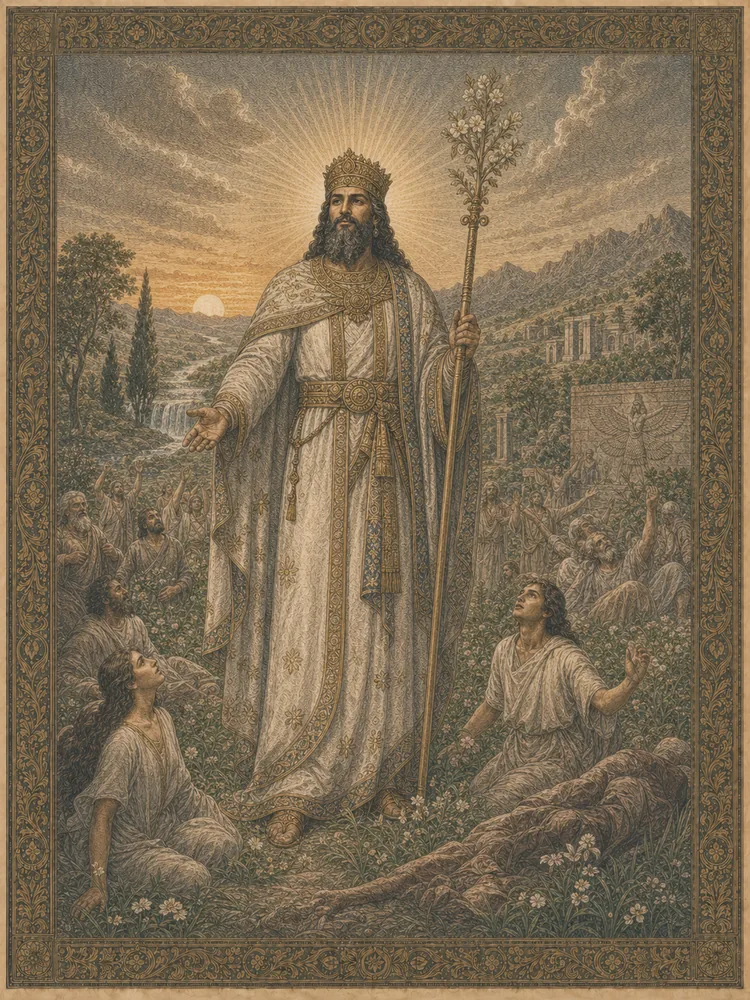
Saoshyant — "the One Who Will Bring Benefit," "the Saviour" — was the eschatological figure of Zoroastrian theology, the redeemer who would come at the end of time to defeat Angra Mainyu, raise the dead, conduct the final judgment, and inaugurate the renewed creation called the Frashokereti. He was the culminating figure of the Iranian religious imagination, the one in whom the cosmic war reached its decisive resolution.
In the developed Sasanian theology, three Saoshyants were anticipated, each born of a virgin mother who had bathed in Lake Kasaoya in the eastern province of Sistan, and each conceived from the seed of the prophet Zarathushtra preserved miraculously in the lake's waters. Each Saoshyant would come a thousand years after the last, and each would advance the work of redemption further than his predecessor. The first, Ushedar, would defeat one third of the powers of evil; the second, Ushedarmah, another third; the final and greatest, Astvat-ereta, would defeat the last third and accomplish the work in fullness.
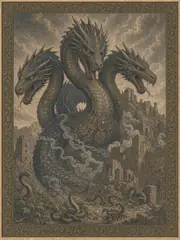
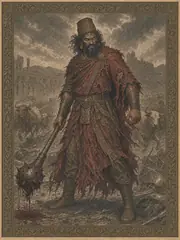
Astvat-ereta — "the Embodied One," "the One Who Embodies Truth" — was the supreme Saoshyant. He would arise in the eastern province at the end of the present age, gather the righteous around him, and lead them in the final battle against the forces of evil. He would receive the Khvarenah in full strength (the same Khvarenah that had been with Yima at the beginning, with the kings through history, with Zarathushtra in the prophetic period); with his mace he would slay Aži Dahāka the cosmic dragon, who at the end of time would have burst from his bonds beneath Damavand. He would call forth the dead from their graves; their souls and bodies would be reunited; the great molten metal flood would purify the world; the righteous would walk through it as through warm milk and the wicked be consumed.
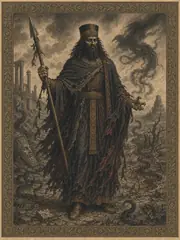
After the final battle, the Frashokereti — "the Making Wonderful," the renewal of creation — would be accomplished. Angra Mainyu would be cast back into the original darkness from which he had come, the demons would be destroyed, the world would be restored to the wholly good condition Ahura Mazda had originally intended. The renewed creation would be without death, without disease, without evil; the human beings (now resurrected and transformed) would live forever in the company of Ahura Mazda and the Amesha Spentas, in a state of perfect blessedness. So the cosmic war would end, the long struggle would be vindicated, and the world would be made whole.
The doctrine of the Saoshyant has had immense influence on later religious thinking. The Jewish messianic expectation, the Christian Second Coming, the Islamic Mahdi, all bear some relation to the Iranian template of the saviour-who-comes-at-the-end. The specific elements — the saviour born of a virgin, the resurrection of the dead, the final judgment, the renewed creation — all appear in the Iranian tradition before they appear in the Jewish and Christian sources, and the lines of historical influence (through the Persian period of Jewish history, through the Hellenistic-Jewish syntheses, through the early Christian milieu) are reasonably traceable. The Saoshyant is, in this sense, one of the great Iranian gifts to the religious history of the world — a gift that has often gone unacknowledged, but that may be felt every time the eschatological hope is invoked in any of the Abrahamic traditions.